
Field Guide

All About Arizona Ash Trees

An Arizona ash lives thirty to fifty years in Central Texas, and where yours lands in that range is decided by its structure — and by whether anybody stays ahead of it — rather than by its health. So if yours is old and doesn’t look great, the question you’re really asking is whether it’s salvageable. That splits two ways. If the tree already has too much decay in it, I’ll tell you it’s time. If it doesn’t, the decision is yours, and both answers are legitimate.

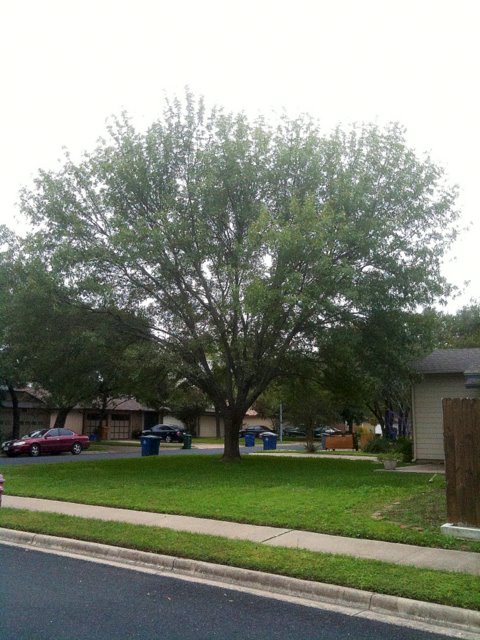
Arizona ash is referred to as “Arizona trash” by many people. Personally, I don’t really agree with that attitude. Don’t get me wrong, they aren’t perfect trees. But an ash grows into a large tree quickly and provides significant shade from the hot summer sun that is much needed in Texas, and it’s one of the few trees around here that will consistently produce vibrant yellow foliage in the fall.

Nobody is shopping for one anymore — they aren’t really available and we don’t plant them. But a lot of people have one, usually inherited with the house, and that’s who this is for. They also self-propagate, so an ash in your yard didn’t necessarily get planted there by anybody at all. Inherited or come up on its own, it’s a tree you didn’t pick, and that’s a different conversation from a bad purchase.

At a glance

  • Scientific name: Fraxinus velutina
  • Also sold as: Fan-Tex ash or Rio Grande ash — those are two trade names for one seedless selection of this same species, not two different trees. If you bought a “Fan-Tex,” you own an Arizona ash
  • Realistic lifespan here: 30–50 years — about 20–30 left to its own devices, up to 50 if you keep up with the maintenance
  • When limb failure starts: around year 15–20 without proper pruning
  • Mature size: typically around 40 feet tall, with a spread to about 70 feet
  • Growth rate: fast, and that’s the whole appeal
  • Fall color: reliable yellow, which most trees here don’t give you
  • What decides its lifespan: structural integrity, not health or vigor
  • Watch for: borers, anthracnose, surface roots, heavy seed set when stressed
  • Availability: essentially none. Not grown or sold here in any quantity

What actually ends an Arizona ash

This is the part that gets misunderstood, and it changes what you should spend money on. How long an Arizona ash lives is more related to structural integrity than to health or vigor. Without proper pruning from a good arborist, this tree will start to experience limb failure sometime around year 15 to 20.

Once the first limb breaks out it is a domino effect. That wound begins to decay, which makes the rest of the tree weaker. Before you know it there isn’t enough canopy left to consider it a functioning tree. The tree is still alive the whole time. It just stops being the thing you wanted in the yard.

Decay is the thread running through all of it. People manage cholesterol for a long life; trees are managing decay. Wood-eating organisms are trying to turn the wood back into soil, and the tree has defenses to hold them off. Every wound is a door — and an ash doesn’t hold those doors shut nearly as well. It compartmentalizes decay poorly, which is why the losses compound instead of getting walled off.

The decision you’re actually making

Before I diagnose the problem a tree has, I need a prognosis. Does this tree even have a chance long term? If not, there’s no point going down the diagnostic rabbit hole. With an old ash, that question comes in two tiers, and only the first one belongs to the tree.

  • Tier one — is there too much decay? That’s the tree’s call, not yours and not mine. If it’s already got too much decay, I’ll simply tell you it’s time. Money buys nothing past that point.
  • Tier two — if not, do you have the money and the motivation? That one is entirely yours. Keeping an old ash going is a real, ongoing commitment, and choosing not to make it is a perfectly good answer.

Two things worth being straight about. “Too much decay” is a judgment, not a percentage, and there isn’t a number I can hand you. It also isn’t something you can assess from the ground looking up. A thin canopy, small leaves, poor color, some tip dieback — that’s the general decline presentation, and plenty of different things produce it. The symptoms don’t carry the diagnosis. That’s what a consultation is for. It’s the smart step — measure twice, cut once. On an old ash the honest answer is sometimes that there’s nothing worth doing, and that’s a real result too.

The other half of the prognosis is the ceiling. A hackberry is only going to live about fifty years in a best-case scenario, so if it develops a severe problem at year twenty-five, there’s no chance it recovers and lives another hundred. It was never going to live a hundred years to begin with. Arizona ash sits in that same grade. That’s not a reason to write the tree off. It’s a reason to know what you’re buying.

What “keeping it going” actually involves

If the tree clears tier one and you want to keep it, here’s the honest scope of work. None of it is a one-time heroic treatment.

  • Stay ahead of the limb failures. Arizona ashes need pruning on a cycle to help avoid the domino problem. About every three years is the conservative version of that — some trees need it more often than that, and some need it annually. That’s reduction pruning on the heavy, overextended lateral limbs — not stripping out the interior, which is a different thing and a bad one. I used to favour cables more than I do now.
  • Keep the water consistent. There are two laws, volume and consistency, and abrupt changes are the worst thing you can do. Don’t water faithfully for years and then quit cold.
  • Stop the weed-and-feed. Broadleaf herbicide doesn’t know the difference between your weeds and your tree. A tree is basically just a very large weed. This one is free, and we sell none of it.
  • Feed it on the tree’s schedule, not the calendar. Spring foliar feeding timed to new foliage before the waxy cuticle forms, and fall root feeding, which is the most important treatment of the year.

That last one is worth explaining, because it’s the item people assume is the upsell. The fertilizer is not a silver bullet. What a tree care program actually buys on a tree like this is presence — several visits a year, which is how the irrigation gets checked in July, how somebody notices a limb starting to sag, and how the lawn service gets told not to spread weed control under the canopy in March. Homeowners don’t fail from a lack of information. They fail because nobody is there at the moment the correction matters. On a tree whose lifespan is decided by accumulated structural damage, catching things early is most of the game.

What that program is not is a spray truck on a calendar. The distinction is whether each treatment is timed to something the tree is doing — new foliage before the cuticle forms, root growth after leaf drop — or to a billing cycle. A schedule-billed “deep root” plan is the version we argue against, and it’s worth knowing the difference before you buy either one.

Arizona ash is not a forgiving tree. Skip the maintenance and it will find the twenty-to-thirty end of its range on its own.

Surface roots, seeds, and the rest of the complaints

Most of what people search for about Arizona ash isn’t disease. It’s the inconveniences.

Worth knowing about the shape first: a mature Arizona ash is often about twice as wide as it is tall — roughly forty feet up and seventy across. It takes up considerably more room than people expect.

Surface roots. Arizona ash produces them, and they can be unsightly and a genuine tripping hazard. Too near the house they become more than an inconvenience. In my experience this is a species that puts a lot of root under foundations, and I’ve seen Arizona ash cause that kind of damage more than most species do. I’m giving you what I’ve seen in the trade since 1993 rather than a formula — but if you have an old ash close to the slab, it is worth knowing that about it.

Be careful about the obvious fix, though. Cutting roots on an ash is a bigger deal than it is on a coastal live oak, because ash doesn’t compartmentalize decay nearly as well. An injured root is a door, and on this species what can come through it — root rot, trunk rot, basal rot — is a very serious concern. That’s failure at the bottom of the tree, not a limb you can lose and carry on from. If a root genuinely has to go, that’s a decision worth getting somebody out to make.

Seeds. An Arizona ash will produce a robust amount of seed when it’s stressed, which can make it messy. But in fairness, all trees are messy. If yours is the seedless selection sold as Fan-Tex or Rio Grande ash, you’ll see very little of it.

Pests and diseases

Two things are worth doing on an ash, and they do different jobs. Pruning is the one that keeps it standing — getting the heavy limbs reduced before they come out. Tree care is the one that gives the tree a better shot at helping itself. Both are valuable.

On pests and disease specifically, the only two common ailments I run into are borers and anthracnose.

Borers are beetle larvae that feed on the vascular system of the tree. They can be very problematic, and there isn’t much you should do to prevent them. Anthracnose is a foliar disease that usually rears its head in the early spring. It really drags down the tree, but it’s not the end of days when the tree gets it.

The best things to do to avoid insect and disease problems are to maintain good irrigation and fertilize appropriately.

Late freezes and Central Texas weather

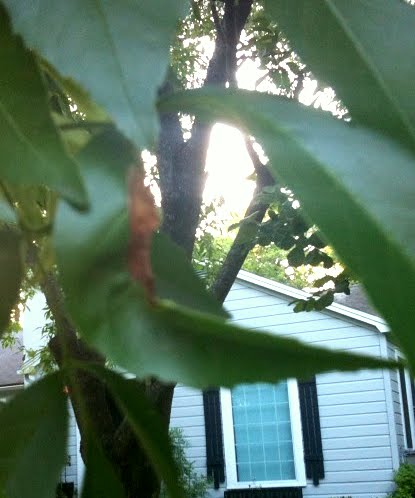
Arizona ashes are some of the first trees around here to start leafing out for the year, and that timing costs them in a late cold snap. In the spring of 2010 the Austin area got two cold snaps in late winter and early spring. Because the ashes were already pushing new foliage, that growth was exposed, and the trees came out of it with leaves full of dead spots that resembled anthracnose symptoms. Some were heavily defoliated. The treatment for a tree stressed that way is a proper fertilization regimen and close watching, because many insects are opportunistic for stressed trees.
That’s how the accumulation works: a late freeze, then a dry August with the irrigation off, then weed-and-feed the following March. No single one kills the tree — they stack. The hopeful version is true too: recovery is cumulative as well.

Our take

An Arizona ash can make for a nice shade tree in your yard. Just don’t forget to keep up with the maintenance. So before you start calling them “trash trees,” give them a chance.

But be clear-eyed about which end of the tree’s life you’re standing at. The goal isn’t saving every tree — it’s having good healthy canopy covering the yard. If yours is sound, keep it and take care of it. If it’s a hollowing old one that’s coming apart, don’t let sentimentality run the decision. Tear it off like a Band-Aid, and the sooner you get a new tree in the ground, the sooner you’re going to get where you want to be.

And if you’re replacing one, it’s worth knowing what you actually liked about it. Almost always it’s the speed. Most fast-growing trees check the wrong boxes — surface roots, short lifespan, structural problems, high maintenance — which is a fair description of the ash itself. The exception is Mexican sycamore, the only super fast growing tree that’s legitimately a good tree: sixty to eighty years, good structure, no surface-root problem. Plant a forty-five gallon one and in as little as five years you’ll have the beginnings of a nice shade tree — just site it further from the house than you would most trees, because it pushes ten to twenty percent past normal size. That’s the conversation I’d rather have than an argument about whether your ash was a bad tree.

If you’re looking at an old ash and can’t tell whether it’s worth the money, that’s the question an assessment answers — and it’s the one part of the decision that isn’t yours to make from the ground.

Talk to an arborist — (512) 996-9100

Common questions

How long do Arizona ash trees live?

Thirty to fifty years in Central Texas, and the spread is the useful part. Left up to mother nature, the typical life expectancy is about twenty to thirty. Keep up with the maintenance and these trees are capable of living fifty. Either way that's below the sixty-to-eighty-year band a good shade tree here should give you — but the difference between the two ends is a decision you make, not a lottery the tree runs.

Is Arizona ash a good tree?

Yes, with a ceiling and a maintenance requirement attached. Their bad name comes from a short life span. Set that aside and you have a fast tree that gives reliable yellow fall color — not common here — and a broad canopy that will cast much needed shade. They are beautiful trees. They also aren't forgiving. We don't plant them anymore, but owning one is perfectly reasonable.

Are Arizona ash trees messy?

They can be. A stressed ash will throw a robust amount of seed, and that's the main complaint. But in fairness, all trees are messy. The selection sold as Fan-Tex or Rio Grande ash is seedless, so if that's what you have, you'll see very little of it.

Do Arizona ash roots damage foundations or sidewalks?

They're a surface-rooting tree, so yes — they lift and buckle things and they're a tripping hazard in a lawn. Too close to the house, I've seen Arizona ash cause foundation damage more than most species do. What I'd be careful about is the obvious fix: ash doesn't compartmentalize decay well, so root rot, trunk rot and basal rot are all real concerns once you cut one. Cutting roots on an ash is a decision, not a landscaping detail.

Is it an Arizona ash or a Texas ash?

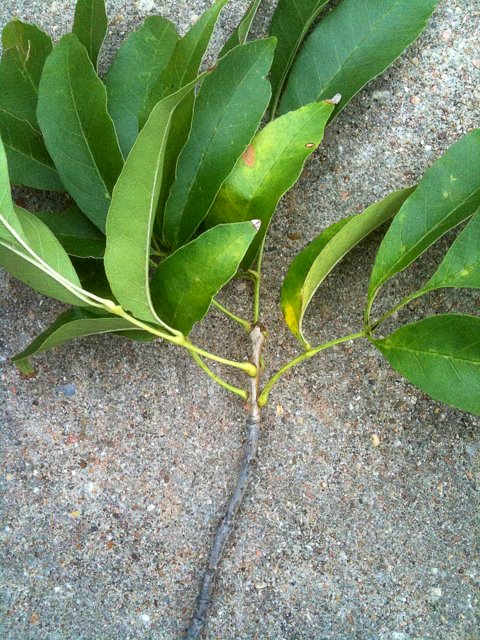
Look at the edge of the leaflets. On an Arizona ash (Fraxinus velutina) the teeth are fine and shallow, and plenty of leaves are close to smooth-edged. On a Texas ash (F. texensis) the margin is scalloped-toothed rather than finely toothed. Both species vary, so you'll find leaves that argue with you — but it's a rule, and worth settling, because the numbers on this page are for Arizona ash.

Should I be worried about emerald ash borer?

Not here yet — but closer than it was. As of August 2026 the Texas A&M Forest Service lists it confirmed in thirty-six Texas counties, and two of those are Bell and McLennan: the Temple and Waco stretch of I-35. It is not confirmed in Travis, Williamson, Hays or Bastrop. Confirmed means detected, which isn't the same as established — turning up in a trap in a county is not the same as killing trees across it. It's expected to reach us eventually, and where it establishes it's genuinely destructive, so I'm not waving it off. What I won't do is recommend a treatment for a beetle that isn't in town. It doesn't change anything about planting either — ash wasn't on my recommended list to begin with, for reasons that have nothing to do with beetles. If it shows up, we'll say so and say what to do about it.

Call (512) 996-9100