
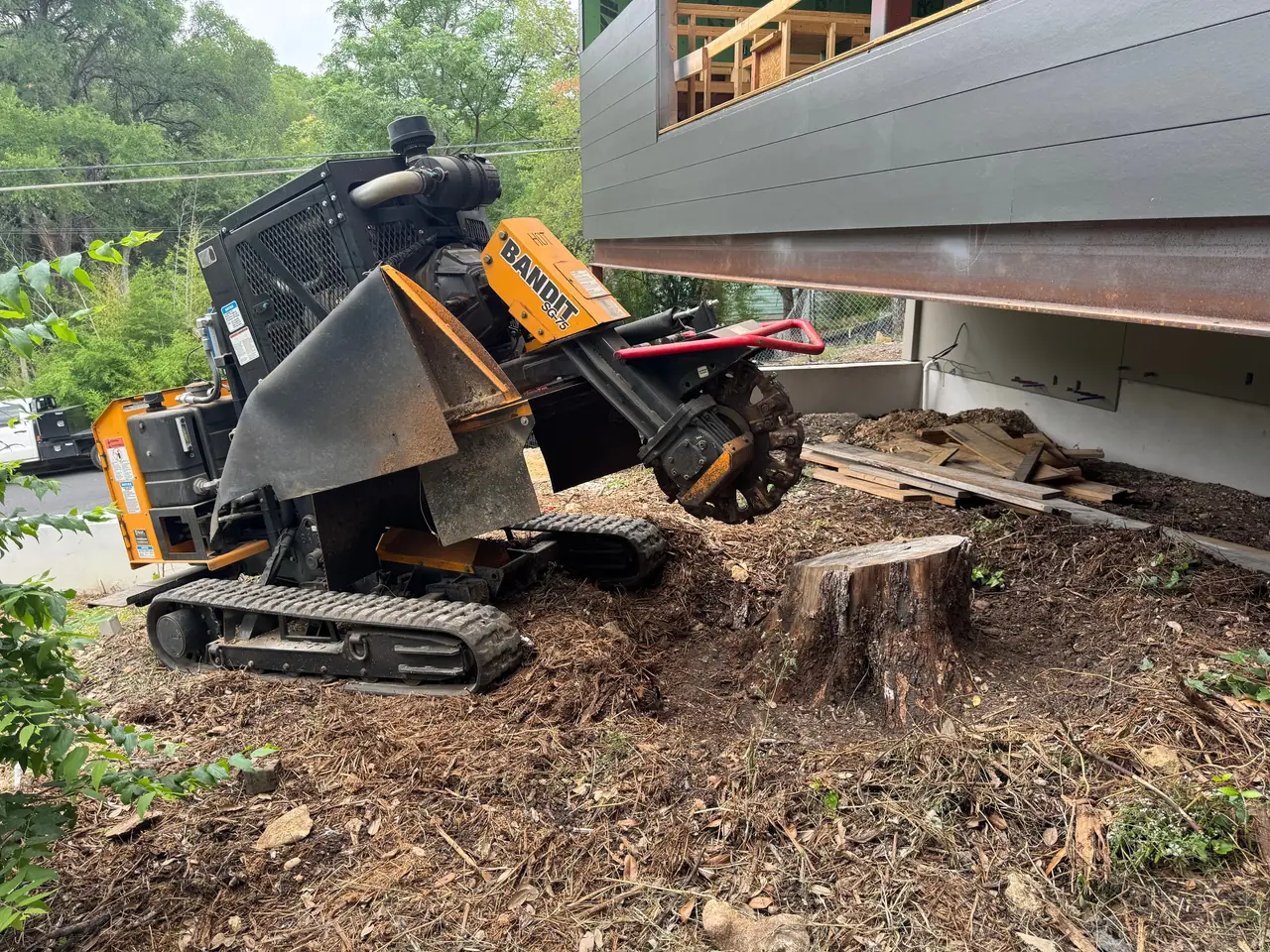
Stump Grinding in Austin

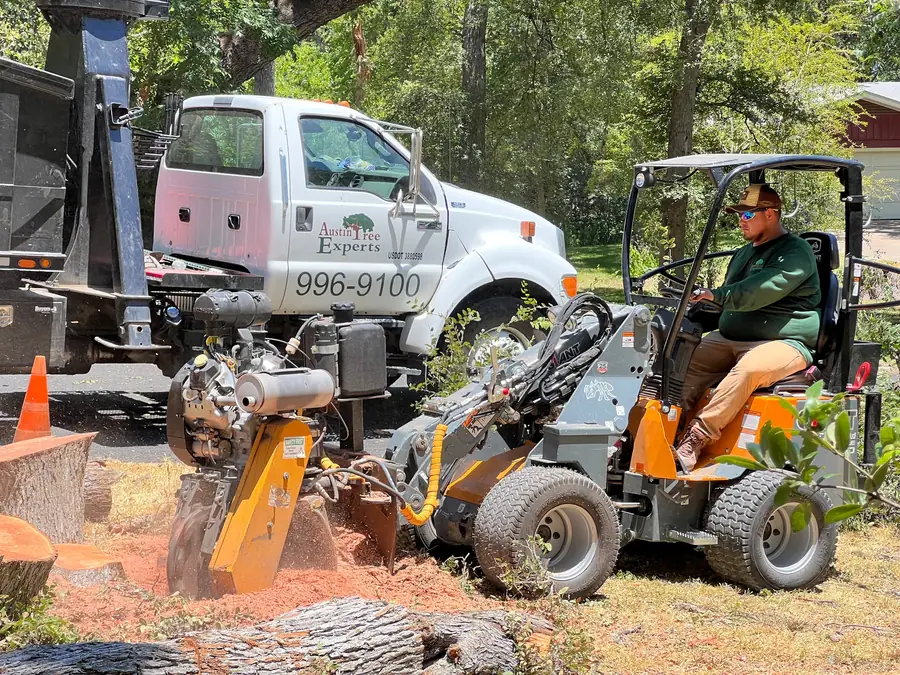
Stump grinding in Austin is mostly not about the stump. We take it out below ground level — four to six inches below grade as a standard spec, the entire root ball where the access allows — and past that, the service goes as far as you want it to go. We normally expect to leave the yard the way it looked minus the stump, and that prep and cleanup is most of what the job costs.

The rest of this page is the detail behind that last sentence: how far down we go and why it depends on what you are planting, what the three versions of the service actually include, and why access decides more about a stump job than the stump does.

The grinding is the short part

Here is the shape of a stump job on a finished landscape, in Keith’s words:

It’s not uncommon for us to spend three times as much time preparing the site — laying out plywood, laying out tarps, raking back gravel — to turn around and only spend twenty minutes of actual grinding, and then have a robust cleanup process of filling the hole, hauling away the extra grindings, replacing the gravel and rocks, carefully picking up tarps that caught air and debris.

A stump grinder throws material. On bare ground in a back corner, protecting what is around it costs nothing. Set the same machine next to gravel or aggregate, turf, a parked vehicle or a window, and the work is no longer grinding — it is protecting everything within range of the debris and then putting it all back.

So when we scope a stump, this is what we tell you:

The majority of my expense is gonna be related to preserving their landscape.

And then we give you the chance to do some of that work yourself, or to decline the prep and cleanup altogether. The stump grinding service goes as far as the client wants us to go.

That is worth knowing before you compare quotes, because it is the part a one-line stump price is silent about. The size of the stump is not the only thing deciding the number. Who is responsible for the gravel, the tarps, the hole and the pile when the grinder shuts off is the other half of it.

The three versions of the job

What we do
Grind and goAn active construction site, or a homeowner saving money by doing part of the work himself. We show up, grind the stump, push some of the grindings over the top of the hole, and leave the cleanup for someone else.
The defaultWe grind out the stump, break up the shavings nearby, leave enough in the hole to leave the ground mostly flat, and haul away the rest.
Finished landscapeGravel or aggregate nearby means plywood and tarps to protect the landscape and catch wood shavings before they settle into places we can’t get them out of — and extra sheets of plywood or a mesh containment system to protect nearby windows and vehicles from slinging debris.

Note which direction we are arguing here. On a tree removal we will talk you out of the middle option, because once the crew is handling wood the remaining distance to full haul-away is cheap. A stump is the opposite case: the prep and the cleanup are most of the job, so they are worth deciding on deliberately instead of assuming.

How deep, and why it depends on what happens next

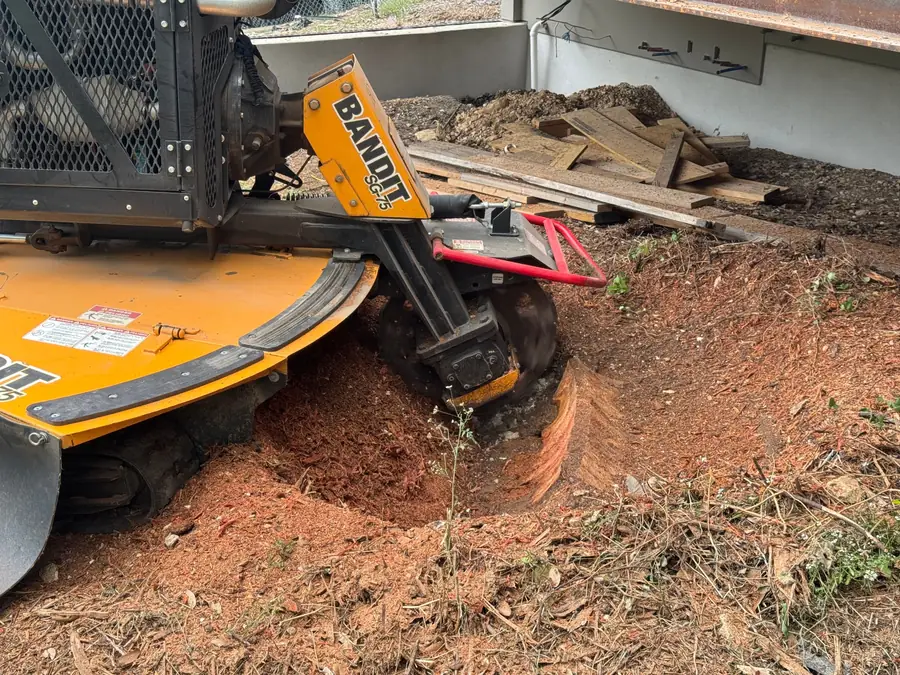
Standard spec is four to six inches below grade. That is enough to get soil and grass over the top and mow it without noticing.

Where we have very good access to get the larger grinder in, we go further and grind out the entire root ball, with no stump material left behind. Most back yard access situations prevent us from bringing that machine in — which is the whole reason the access section below exists.

The cost logic runs in the customer’s favor and it is counter-intuitive:

If we have to use our little grinder, then the additional grinding is truly an expense. With our big grinder, the additional root ball grinding really is not an additional expense.

Which is why we ask what you plan to do with the spot. If you want grass to grow over it so you can mow easily, we can do that and maybe save you a little. If you are planting a new tree there, you need more taken out, and the plan changes. And when getting the whole root ball is reasonably easy for us, we will often do it without being asked — Keith’s reason for that is not complicated:

If it’s something that’s reasonably easy for us to do, then I wanna do a good job.

Three ways to deal with an old stump

If the stump is in the way of a replanting, there are three options and they are not interchangeable:

  1. Do nothing. Under most circumstances there is no harm in leaving the stump — but you will need to move over a few feet to plant the new tree.
  2. Grind it below ground level. This is the right answer in the vast majority of cases. For a replanting it means taking the whole root ball out, and that is what needs access for the large stump grinder. One thing worth knowing before you decide: grinding does not always end the tree. A ground-out Bradford pear will sucker back from the rootstock, so on that species the stump is not finished with you when the grinder leaves.
  3. Excavate the root ball with a small machine. This physically removes all of the stump and root ball, and it is the option that lets a new tree go back in exactly the same location the old one was.

Option 3 is what you need when the location itself is the point — a spot in a bed, an alignment along a drive, the place the old shade actually was.

Access decides more than the stump does

Stump grinding is another service that we really excel at because of our equipment fleet.

Our removal work wins on cost and our construction work wins on schedule. Stump grinding wins on access, and it is a different argument: the machines are not there to grind faster, they are there to reach stumps that other machines cannot get to.

  • Front yards are easy. Back yards need a large service access gate, or, where it makes sense and the fence allows it, we will take down a fence panel and put it back up when we are done.
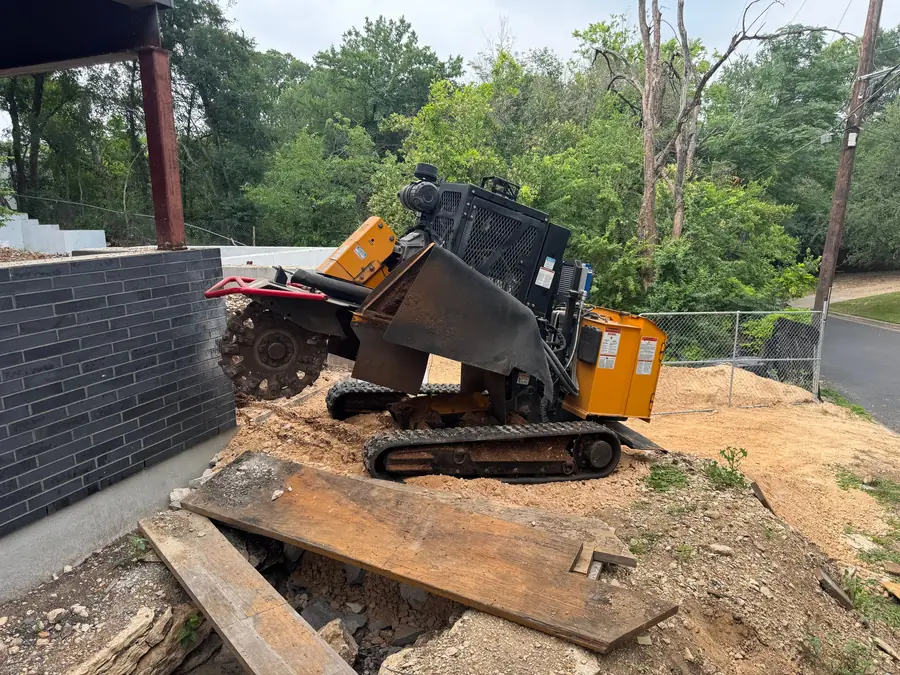
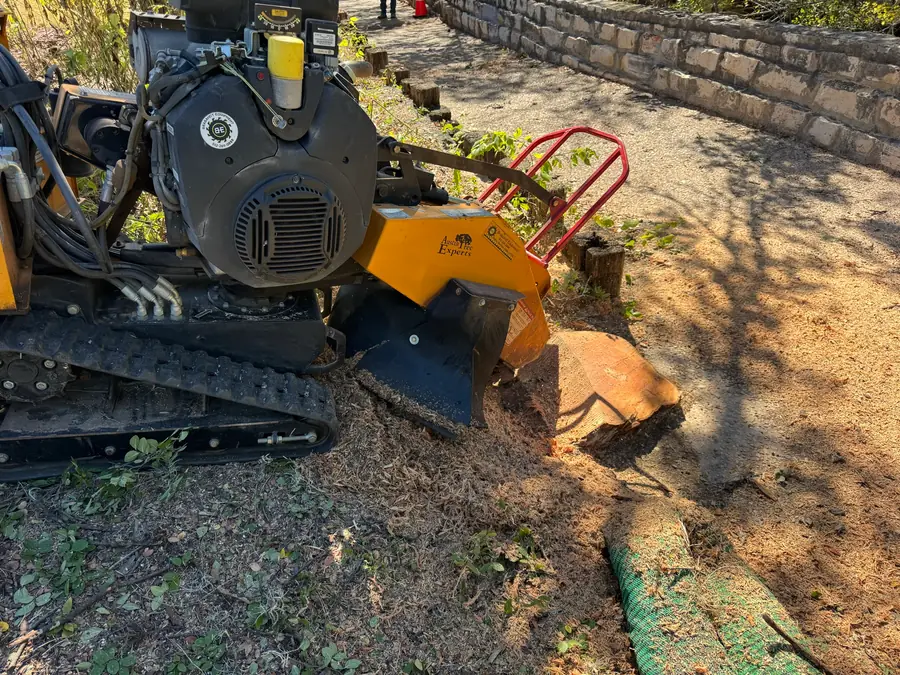
  • The Bandit SG40 is only twenty-nine inches wide as a track machine, forty horsepower gasoline. Very capable and competent, and good at accessing hard-to-get-to places or small gates.
  • The Bandit SG75 is seventy-five horsepower diesel and very efficient — it will grind very large stumps in a very small amount of time. We just have to have access.
  • The Top Notch .38 Special is a forty-horsepower self-powered grinder that mounts on the attachment plate of our GiANT G1200 teleloader. The G1200 has a telescopic boom, and that is what it is for here:

If the stump is on a slightly elevated garden bed, four feet from the travel path, we can lift the boom and extend out the tele-arm and reach those stumps. Maybe you need a stump ground out in a drainage valley — we can drive up to the edge of the culvert, boom down, tilt the grinder down, and get the stump ground out.

That is the part that is hard to copy. A walk-behind grinder has to stand where the stump is. A grinder on a telescoping arm does not.

The same fleet handles what comes after. The G1200 and our two Boxer 320 mini skid steers — compact enough to fit through a thirty-six-inch gate — are what get the debris from a large stump grind back to the trucks at the street efficiently.

What actually drives the price of a stump grind in Austin

We do not publish prices, because a published price goes stale quietly and people arrive quoting last year’s figure. What moves the number on a stump is worth knowing:

  • How much landscape is in range. Gravel and aggregate, turf, nearby windows, parked vehicles — protection going in, and putting it back coming out. This is the majority of the expense on a finished landscape.
  • How much of the prep and cleanup you want us to do. All of it, some of it, or none of it.
  • Access. Can a machine reach the stump at all, and which one? That question is settled before anyone starts grinding.
  • Whether the root ball comes out, or only the stump. With the big grinder in, the additional root ball grinding is not really an additional expense. With the little grinder, it truly is.

An arborist comes out, looks at the site and at what it takes to get a machine to the stump, and you get a free estimate in writing. If the stump is attached to a tree that is still standing, scope the removal and the grinding as one conversation instead of two.

Get a free estimate

Call (512) 996-9100 or request an estimate online. Tell us what you want the spot to be afterwards — lawn you can mow, a bed, or a new tree — because that is what decides how deep we go.

We grind stumps across Austin and the surrounding Central Texas metro — Bastrop, Bee Cave, Briarcliff, Buda, Cedar Park, Dripping Springs, Elgin, Georgetown, Kyle, Lakeway, Leander, Lockhart, Pflugerville, Point Venture, Rollingwood, Round Rock, San Leanna, San Marcos, Sunset Valley, Volente and West Lake Hills. See the areas we serve. Commercial and construction sites as well — the grind-and-go version is written for exactly that situation.

Related: Tree Removal · Tree Planting · Construction Site Services · Our Equipment

Common questions

How deep does a stump grinder go?

Our standard spec is four to six inches below grade. Where we have very good access and can bring the larger grinder in, we will grind out the entire root ball, with no stump material left behind. Which one you want comes down to what happens next on that spot: grass you can mow over needs less than a new tree going in the same hole.

Does tree removal include the stump?

Not automatically. Cutting the tree as close to the ground as possible is the floor of a removal, and grinding the stump out below grade sits past that floor as its own decision. It is worth settling while the removal is being scoped rather than after. Booked together, we normally do both on the same visit — the same access, one plan instead of two.

Can I plant a new tree where the stump is?

There are three ways to deal with an old stump. Leave it alone — there is usually no harm in that, but you will need to move over a few feet to plant, and grinding does not always end the tree: a ground-out Bradford pear suckers back from the rootstock. Grind it below ground level, which needs access for the grinder — this is the right answer in the vast majority of cases. Or excavate the root ball with a small machine, which physically removes all of it and lets a new tree go back in exactly the same location, and that is worth doing only when the location itself is the point. Tell us which one you are planning and it changes how we grind.

Do you need access to the back yard?

Front yards are easy. Back yards need a large service access gate, or, where it makes sense and the fence allows it, we take down a fence panel and put it back up when we are done. Our SG40 grinder is a twenty-nine-inch tracked machine built for exactly this. The larger diesel grinder needs a real opening, and most back yard access situations are what prevent us from bringing that machine in.

What happens to the grindings?

On the default version of the job we break up the shavings, leave enough in the hole to leave the ground mostly flat, and haul away the rest. What stays behind is not waste: ground-up wood chips mixed in with the native soil are actually exceptional planting material, and it is the solid chip material that gets hauled off. If you would rather keep the material or do the cleanup yourself, that is a legitimate way to buy the job and it is worth saying so before we quote it.

How much does stump grinding cost in Austin?

We do not publish prices. What drives the number is easy enough to plan around: how much of the landscape has to be protected and put back afterwards, how much of that prep and cleanup you want us to do, whether a machine can reach the stump at all, and whether you want the root ball gone or only the stump. Call (512) 996-9100 or request an estimate and an arborist will look at the access before anyone quotes it.

4.3of 5 from 29 Google reviews
Aak
April 2026
5.0of 5

Keith and the crew were wonderful - very knowledgeable and efficient. They offered competitive pricing, flexible scheduling, and are genuinely good people. Highly recommend!

Response from the owner: Thank you so much for the business and kind words! I’m planning to stop by in the next couple weeks so I can put an eye on the pecan in the back when the leaves come. Not worried about it, just want yo know. Thanks again.

Kristi
April 2026
5.0of 5

I've been utilizing Austin Tree Experts for 18+ years. I have 20+ oak trees and other misc. trees on my property - they've been trimming and fertilizing them and helping me during storms to clear debris and I would highly recommend them.

Response from the owner: Thank you for the patronage all these years!

Read more customer reviews

Call (512) 996-9100