

Tree removal in Austin covers City permits, dead trees, young trees that need replacing, large and hazardous trees, cedar removal and land restoration, stumps, and trees damaged in a storm. We work across the Austin metro, from small yard trees to heritage-size oaks and pecans. A removal includes taking the tree down and hauling the debris away, and the stump is a separate decision.
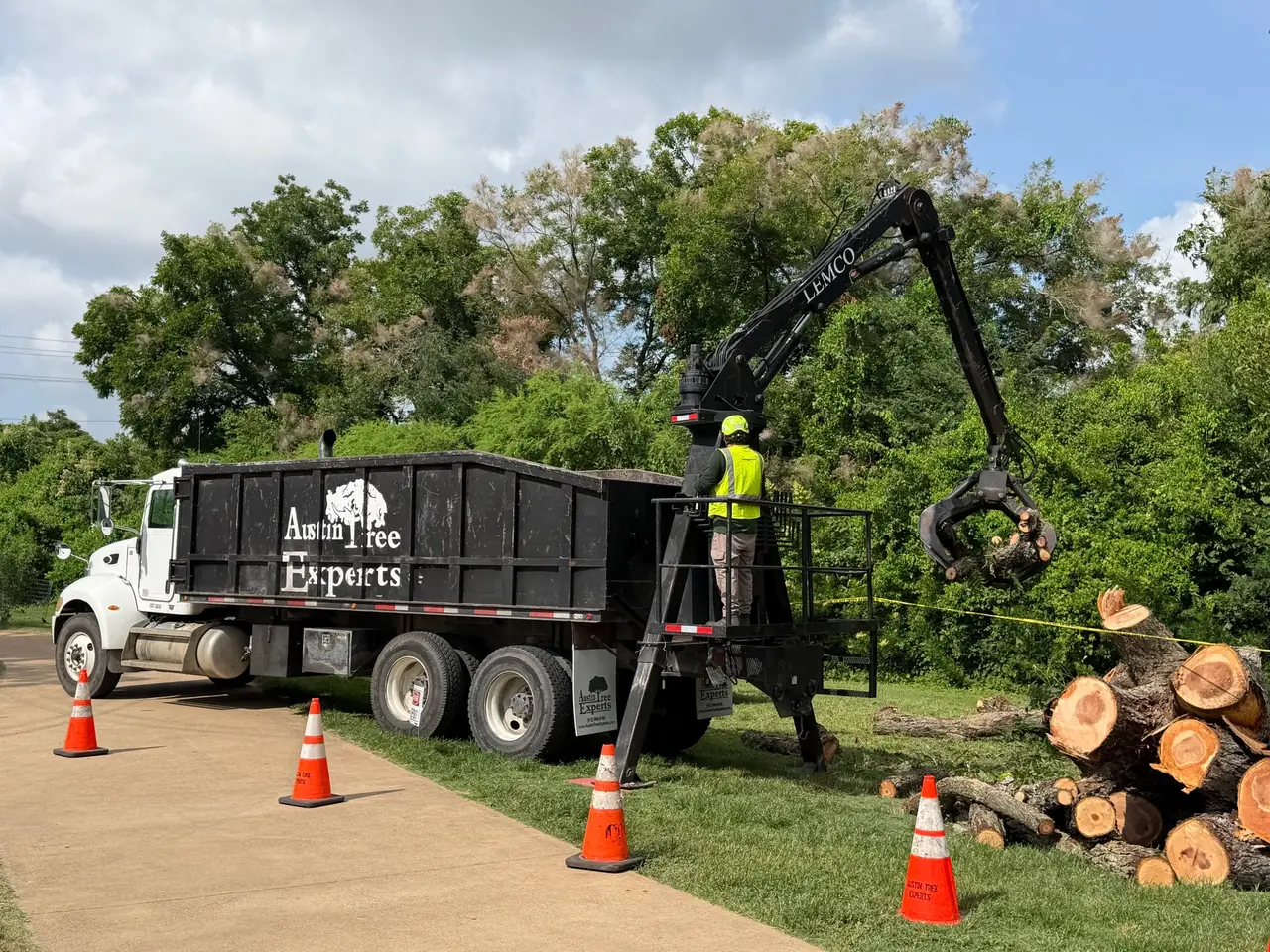
Two things decide a removal. The first is what can reach the tree: we run our own grapple truck, bucket truck, tracked lift, mini skid steers and excavators, and we rent a grapple saw crane when a job calls for one. The second is which of those the tree actually calls for, and that judgment belongs to our ISA Certified Arborists and our ISA Board Certified Master Arborist. Crews work to ANSI Z133, the safety standard for tree care operations, and to ANSI A300 where a job includes pruning or root work. We carry general liability and workers’ compensation coverage.
Tree Removal Permits
Whether a tree needs a permit before it comes down is the first question on a lot of removals. Inside Austin city limits a permit is required to remove a protected tree, meaning any tree 19 inches or larger in diameter measured 4.5 feet above grade. At 24 inches and larger, ten listed species are heritage trees and carry a stricter review. Where mitigation applies, it may be replacement planting or a fee in lieu paid to the City. Other municipalities in the metro set their own thresholds, and the Austin tree ordinance page breaks down which rules cover an address.
Our consulting arborists, led by an ISA Board Certified Master Arborist, prepare the documentation a removal application needs: tree inventories, condition assessments, canopy impact assessments and mitigation plans. We file the application on your behalf. We do not represent you at the City, and the decision belongs to the City Arborist.
One boundary worth naming plainly, because it is a licensing question rather than a capability one: a tree survey is the work of a state registered surveyor, so what we provide is a survey audit and a tree inventory. Mitigation plantings are ours as well. Where a build is underway, protection fencing, ground protection and root pruning sit on the construction site services page.
Dead Tree Removal
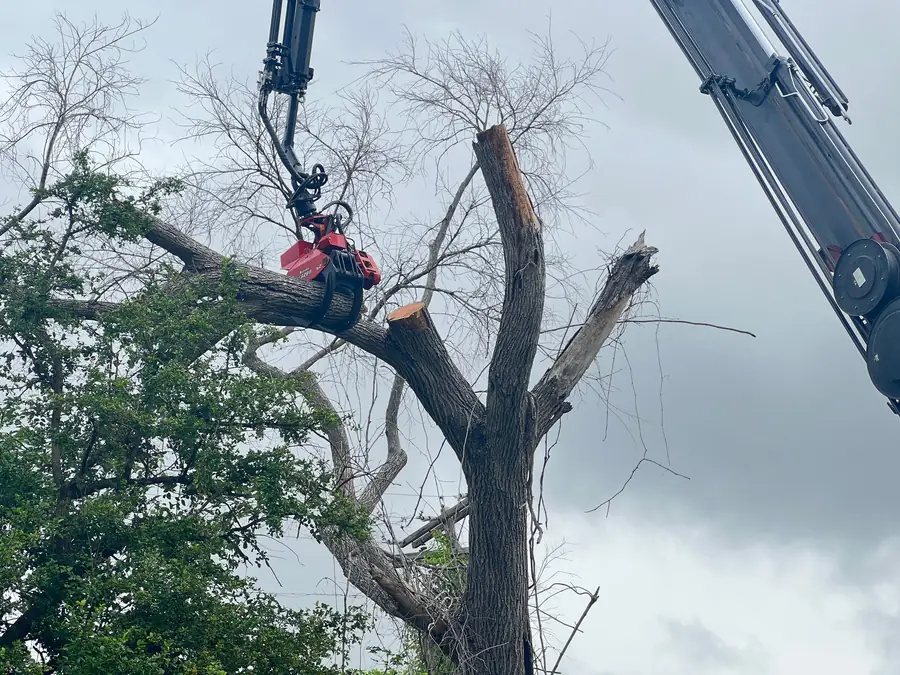
Dead trees come out. The work is simple to describe and less forgiving to perform, because dead wood does not bend, does not hold rigging the way live wood does, and gets more brittle the longer it stands. That pushes the job toward the bucket truck, the tracked lift and the grapple rather than toward a climber, and it is why a dead tree is often a bigger production than the live tree next to it.
A declining tree is the harder call, and we would rather make it honestly than make it in our own favor. Some trees that look terrible respond to a tree care program, water and soil work and time. Others still hold green leaves and are already past the point where care changes the outcome. We look at the root flare, the trunk, the structure of the unions, and what has happened on the site recently before we recommend removal.
On oaks we confirm the diagnosis first, including oak wilt, because what is wrong with one tree affects what we recommend for the others around it. If you want a written opinion rather than an estimate, that is arborist consulting, and we will tell you which one you need.
Remove and Replace Young Trees
Not every tree that has to come out is a big one. A young or newly established tree that is not going to make it, one planted too deep or set into a hole that never drains, or one that was the wrong species for that spot from the day it went in, is a removal as well. Taking it out and putting the right tree in its place is a short job while the tree is small. The same mistake at forty feet is not.
The judgment is which of those you are actually looking at. Young trees recover from a great deal, and we would rather correct a planting depth or set up the structure than sell you a replacement. What does not improve with more care is a species that is wrong for the soil, the drainage or the exposure it sits in, or a tree whose roots were compromised before it ever reached the site. We look at the root flare, the depth it was set at, how the ground drains and what the species needs, then say which way we would go and why.
Removal at this size is small equipment work. The tree and its root ball come out by hand or with a mini skid steer, and the replacement usually goes back into the same opening. Which species goes there, and where exactly it sits relative to the house, the drive and the trees already established around it, is the part worth slowing down on. That is covered on the tree planting page.
Large or Hazardous Tree Removal
A large removal and a hazardous one are not the same problem, and plenty of jobs are both. Size is a rigging and access question: a heritage-size pecan over a pool has to come apart in pieces that can be controlled on the way down and then carried out. Hazard is a defect and a target lining up: a split union over a driveway, a hollow trunk beside a house, a lifted root plate above a fence line. Our arborists use the ISA Tree Risk Assessment Qualification (TRAQ) method to describe the defect and what it sits over before a crew is scheduled, and the first question is not how to cut the tree, it is whether anyone should be in it at all.
When the tree will not safely hold a climber, we work it from the outside. The Versalift 65-foot bucket truck puts a worker at canopy height without loading the trunk. The Peterbilt 340 grapple truck picks up whole logs and large sections with a knuckleboom loader, so wood that would otherwise be cut small and carried out by hand gets picked up in one piece. Two Yanmar excavators, a Vio55 and a larger SV100, run log grapples for holding and lowering wood at ground level.
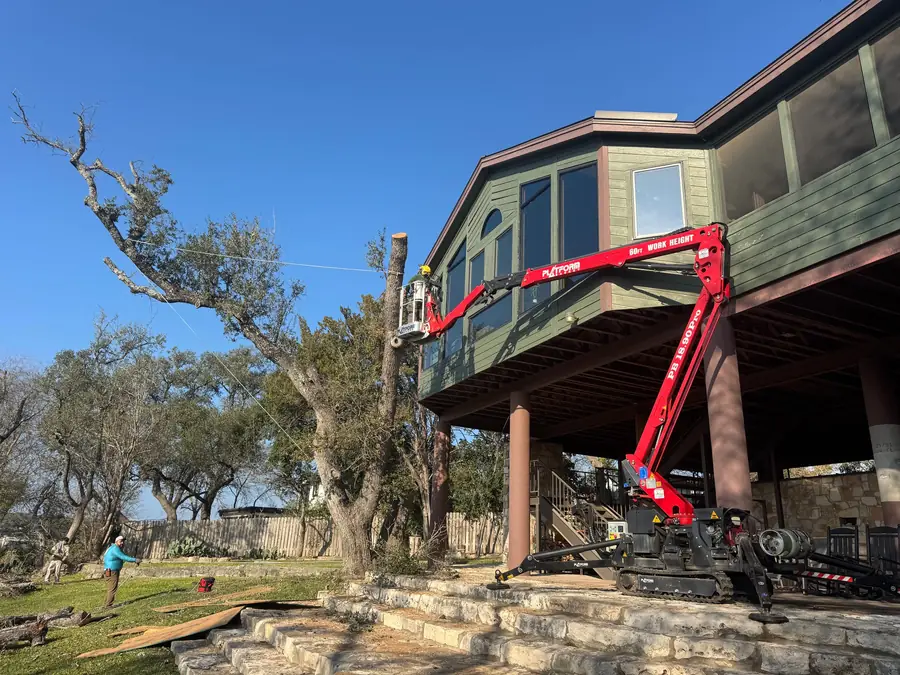
Access decides as much as size does. For a yard a truck cannot enter, the Platform Basket tracked lift drives through the gate and into the backyard, which the bucket truck cannot do. Our two Boxer 320 mini skid steers fit through a 36-inch gate and carry logs and brush back out the same way. When the wood has to go up and over instead of out through the yard, we rent a grapple saw crane and take the tree down in sections from above, which is also how we work a tree standing over a structure.
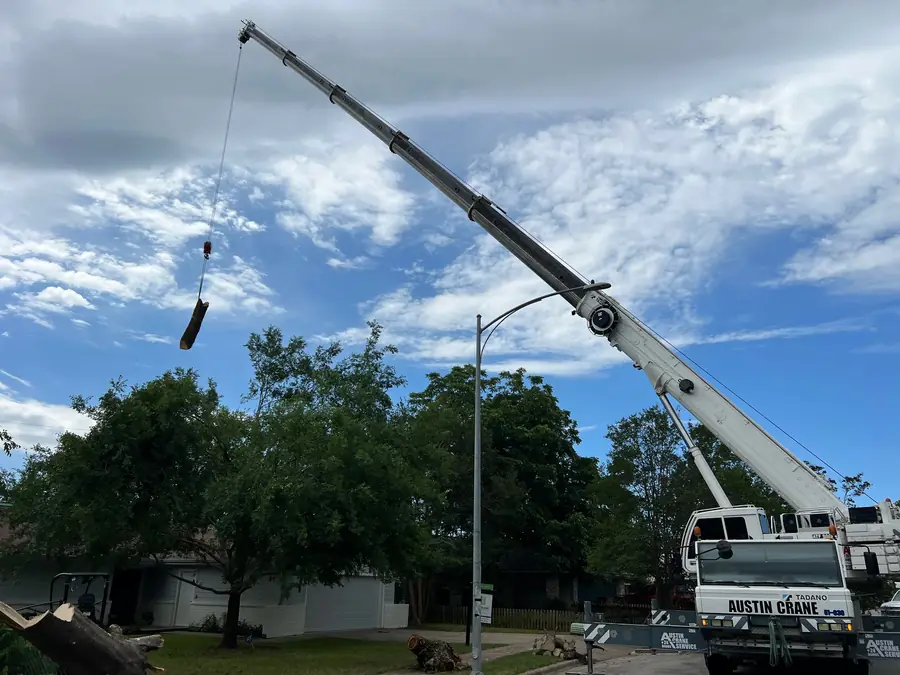
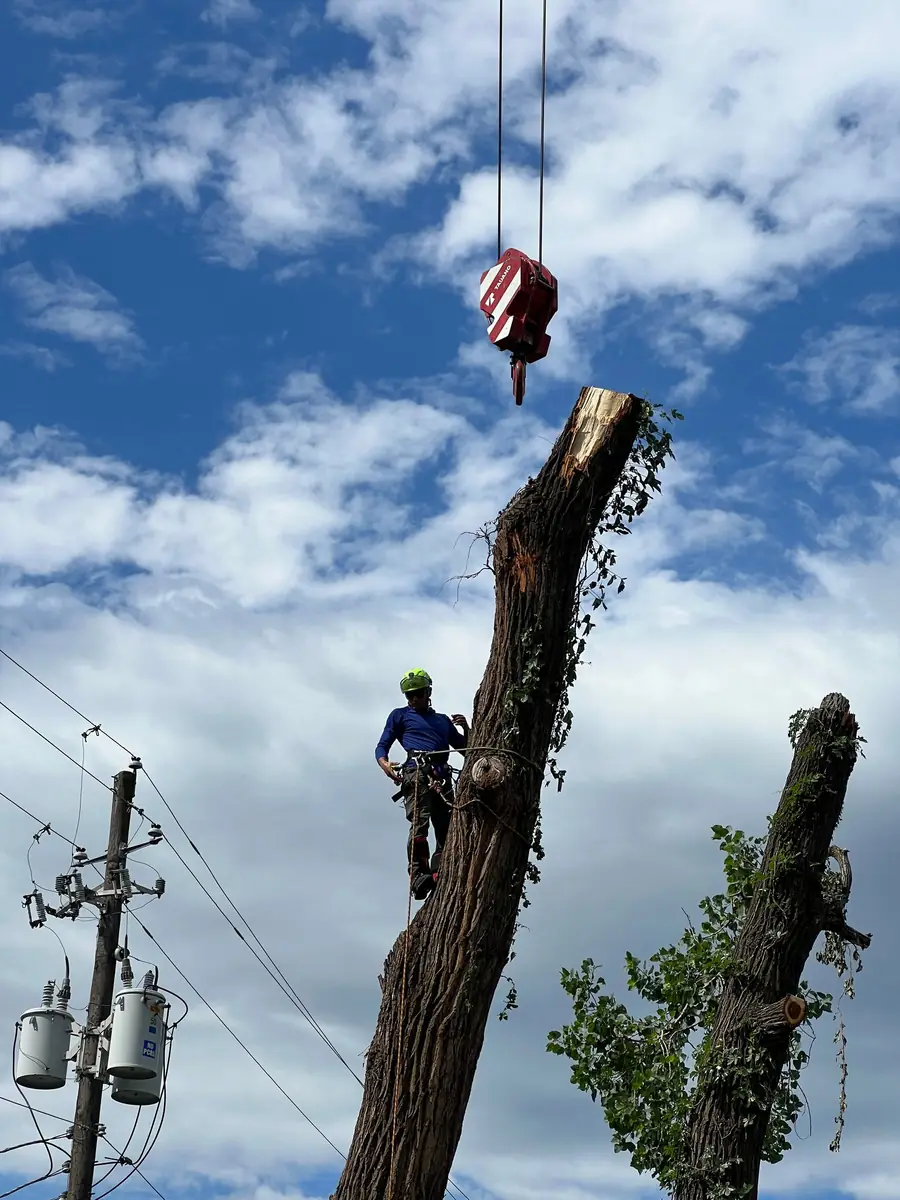
The competency is knowing which of those to bring, and when the plain answer is the better one. Pulling a fence panel, working off a neighbor’s driveway with permission, or bringing a crane for two lifts and finishing the tree conventionally can all beat the impressive version. What we will not do is put a climber in a compromised tree because the machine would not fit. Z133 governs the setup, the drop zones and the rigging loads, and if a removal needs a lane closed or a neighbor’s permission, we say so when we quote it rather than on the morning of the job.
Cedar Tree Removal and Land Restoration
Cedar (Ashe juniper) removal is rarely one tree. On Hill Country acreage it is a stand: dozens or hundreds of stems grown in under and between the oaks, along the fence lines, across pasture and through the view. We scope this work by the property rather than by the tree, which means walking it with you and agreeing what comes out and what stays before anything is cut.
Which stems come out is most of the job. Clearing done without an arborist marking it first takes the young oaks and the madrones along with the cedar, and leaves the cedar that is holding a steep bank because it looks like all the rest of it. An ISA Certified Arborist marks the work, which is what keeps the trees you were trying to keep standing at the end of it.
Restoration is what happens once the cedar is off the ground. The material gets handled rather than abandoned in piles: chipped and run through the horizontal grinder at our yard on FM 969 into mulch and compost, or left on site as a mulch layer where that is what you want. Stumps come out or get ground flush depending on whether the ground has to be mowed afterward. Where the property is going to get its shade back, we plant it, and tree planting covers what goes where.
Where the objective is wildfire fuel rather than land use, the work is a shaded fuel break. The clearing techniques, forestry mulching and the fuel-break scope are on the shaded fuel breaks page.
What About Stumps from Tree Removal?
A removal takes the tree down and hauls the wood and brush away. It does not take the stump out unless you ask for that as well, and plenty of people want exactly that: the tree gone, the stump left. Tell your arborist during the estimate which one you want.
How deep we grind depends on what is going in that spot next. Sod needs less than a replanting does, and a patio or a driveway is a different work plan again. We carry three grinders in different sizes: one compact enough to pass a standard backyard gate, a 75-horsepower machine for heritage-size stumps, and a third that mounts on the Giant G1200 tele-loader so it can be lifted to a stump in a raised bed or on the far side of a culvert. When the whole root ball has to leave the site, usually on a construction job or where a new tree is going in the same hole, the Yanmar SV100 with a log grapple pulls it.
The machines, root ball excavation and surface root grinding are covered on the stump grinding page. Booked together, the removal and the grinding normally happen on the same visit.
Emergency Tree Removal and Storm Damage
We are competent in emergency and hazard situations, and storm work is a large part of that: uprooted trees, snapped stems, trees hung up in a neighboring tree, and trees down on a roof, a fence or a vehicle. A failed tree is under load, and the load is the whole problem. Wood in tension releases when it is cut, so the order of the cuts and where the crew stands is the job, not the sawing.
What the tree is resting on sets the sequence and decides what we bring. A trunk lying across a roofline is being held by the structure under it and comes off in pieces small enough to control. An uprooted tree with the root plate still attached is loaded like a spring and can stand back up if it is cut in the wrong order. A hung-up stem is carrying the weight of two trees at once. Those are calls an arborist makes on site, before the saws come out.
The grapple truck earns its keep on this work. It picks up whole trunk sections without anyone standing under them, and it clears a yard of storm debris without a crew feeding every limb into a chipper by hand. On larger sites the Caterpillar IT14 and the Giant G1200 move the volume, and the tracked lift reaches backyards a truck cannot get into.
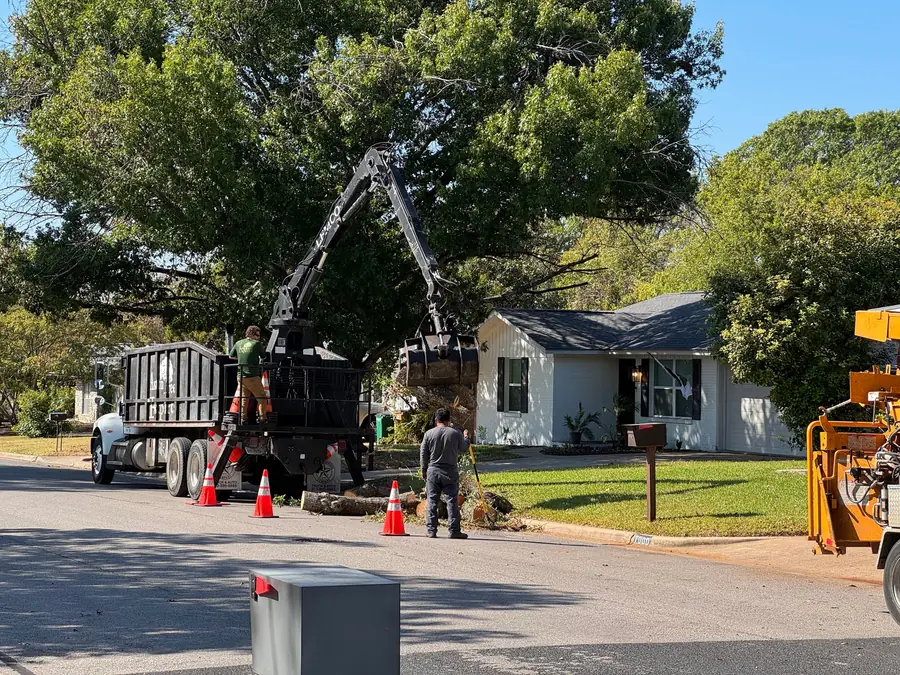
Not every storm-damaged tree has to come down. A tree that lost a scaffold limb but held its root plate and most of its canopy is often worth keeping, and cutting it back to sound wood is tree pruning work rather than removal. Which of the two you have is the call we make first.