

Arborist consulting in Austin is advice rather than tree work: a professional judgment, and the document that carries it. We assess and diagnose tree condition, perform TRAQ tree risk assessments, assess what a construction project will do to the trees on a site and prepare the reports a permit application requires, appraise trees, and assess trees before a property changes hands.
The consulting work here is done by an ISA Board Certified Master Arborist, license TX-0985B, and by ISA Certified Arborists. Recommendations are written against the ANSI A300 standards, which govern how tree work is specified, so a report names a practice rather than leaving it to whoever ends up holding the saw.
Tree Condition Assessment and Diagnosis
A condition assessment answers what is actually wrong with a tree and what the options are, including the option of doing nothing. We work through species, site history, soil, root collar, trunk, branch structure and canopy together, because the same symptom in the leaves can come from four different places and only one of them is treatable.
Much of what looks like a tree problem is a site problem: grade changes, compaction, drainage, irrigation, something buried near the root flare. When the answer is below grade we use air-spade excavation to see the roots without cutting them. For oaks in decline we assess for oak wilt, which has its own diagnostic pattern and its own management path.
You get a written evaluation of what we found, what caused it, and what to do next. Where a treatment program is the answer, that becomes a tree care plan. Where it is not, we say so, and a diagnosis that ends in nothing to buy is still the right answer.
If you can, send photos before the visit: close-ups of leaves and bark, the root flare, and wide shots showing the tree in its surroundings. Photos narrow the likely causes before we arrive, which makes the time on site count for more.
TRAQ
TRAQ is ISA’s Tree Risk Assessment Qualification, and it is the method we use when the question is not what is wrong with a tree but what the tree might do. A TRAQ assessment rates how likely the tree is to fail, how likely a failure is to reach a target, and how bad the consequences would be, and combines the three into a risk rating that can be acted on rather than argued about.
The method is scalable, and choosing the level is most of the judgment. A limited visual pass over a hundred trees along a drive, a basic assessment of the pecan over the patio, and an advanced assessment using decay detection or root collar excavation on one tree with a serious target under it are three different jobs that answer three different questions. We will tell you which one the situation calls for, and we would rather talk you down a level than sell you an investigation the tree does not need.
An assessment ends in options rather than a verdict: pruning to reduce end weight, cabling or bracing a weak union, moving the target, a monitoring interval, or removal. Risk is a function of the target as much as the tree, which is why the simplest mitigation is sometimes moving where people park.
Decay Detection and Tomography
Tomography measures how much sound wood is left inside a trunk without cutting into it. Sensors go on in a ring around the stem, each one numbered, and the instrument reads how sound travels from one to the next. Decayed wood carries sound differently from sound wood, so what comes back is a cross-section of the inside of the trunk, taken entirely from the outside.
That matters because the outside of a tree is a poor guide to the inside. A trunk with an open hollow can have plenty of sound wall left, and a trunk that looks fine can be most of the way gone. Drilling tells you about the line you drilled and nothing either side of it, and every hole is a wound on a tree you are trying to keep. Tomography gives you the whole section and leaves the tree as it found it.
It belongs at the advanced end of a TRAQ assessment rather than in a routine visit. The question it answers is narrow and worth paying for only when it is the question you actually have: a heritage tree somebody wants to keep, a stem with old decay and a serious target under it, or a trunk whose condition has to hold up in a written report.
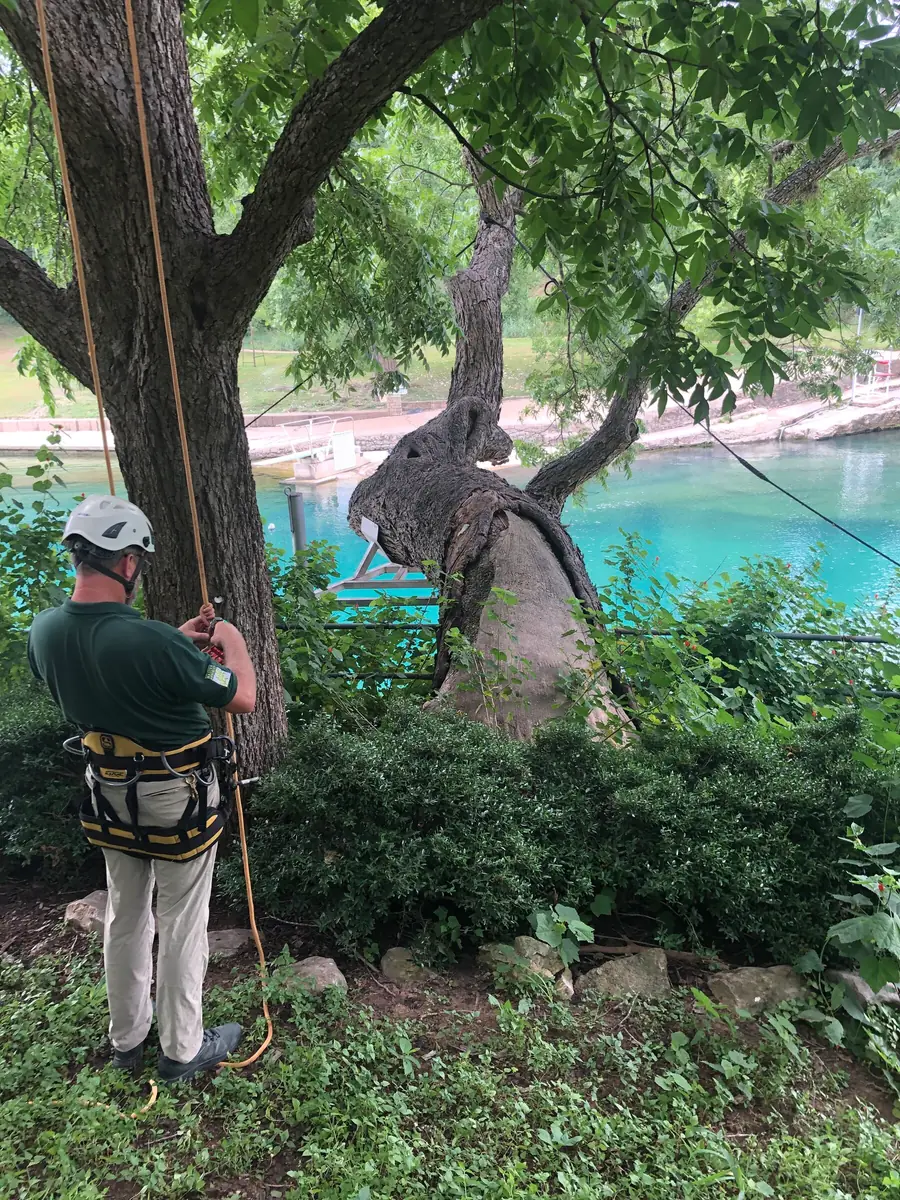
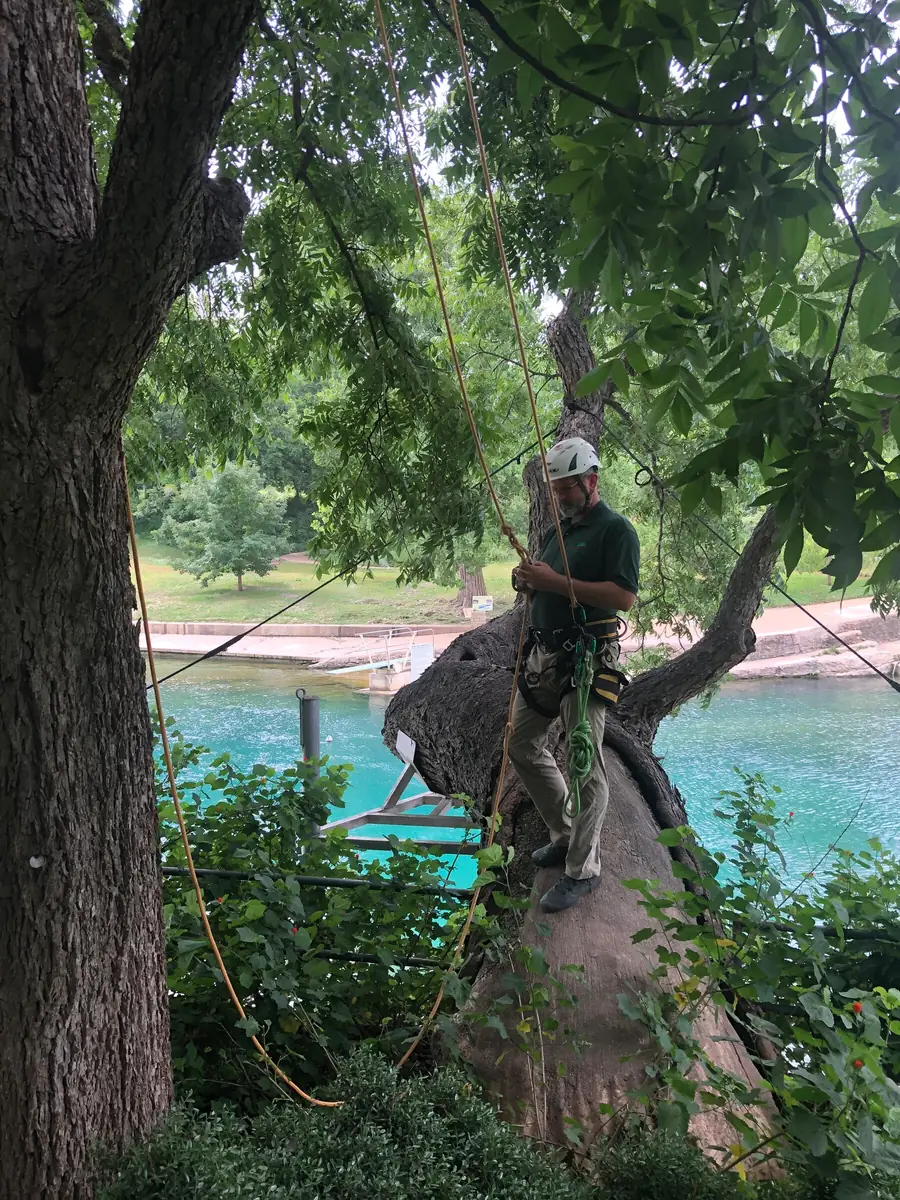
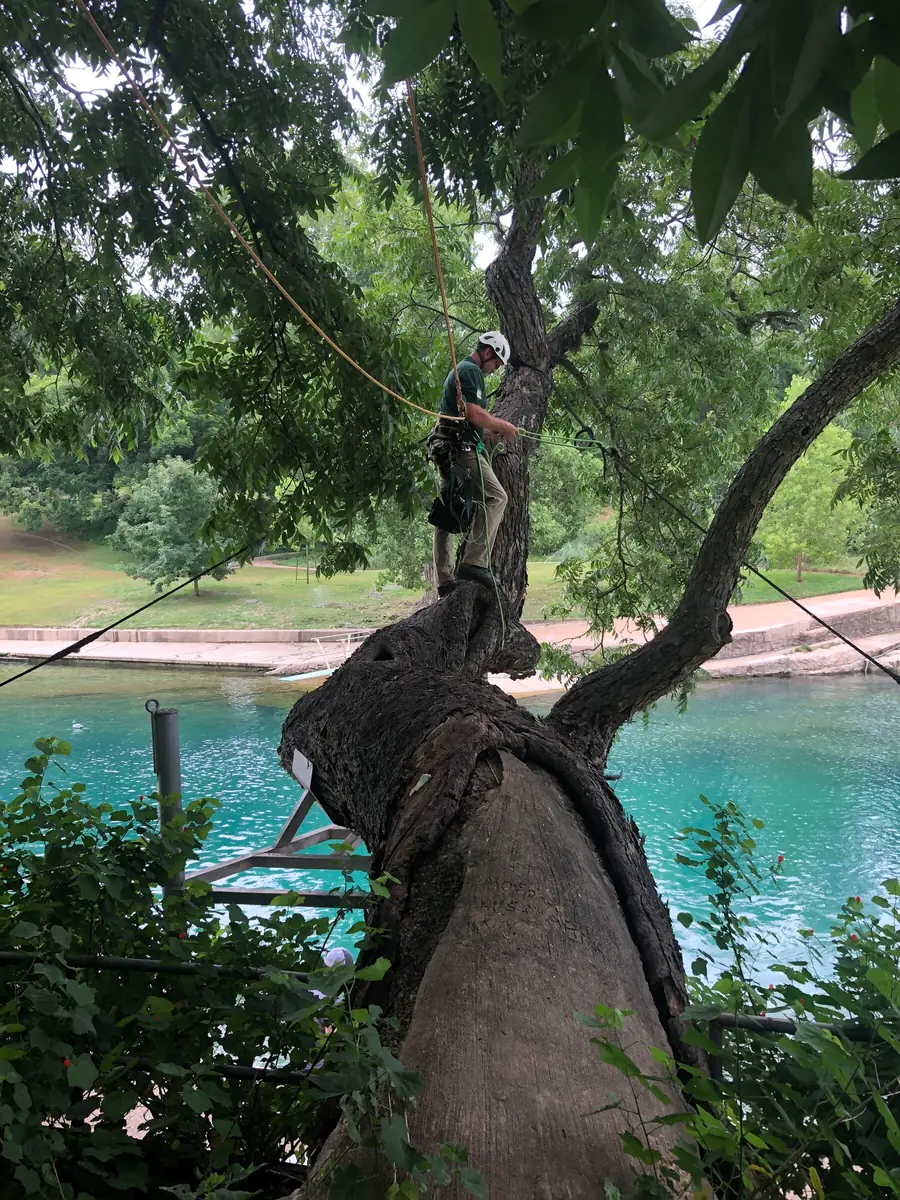
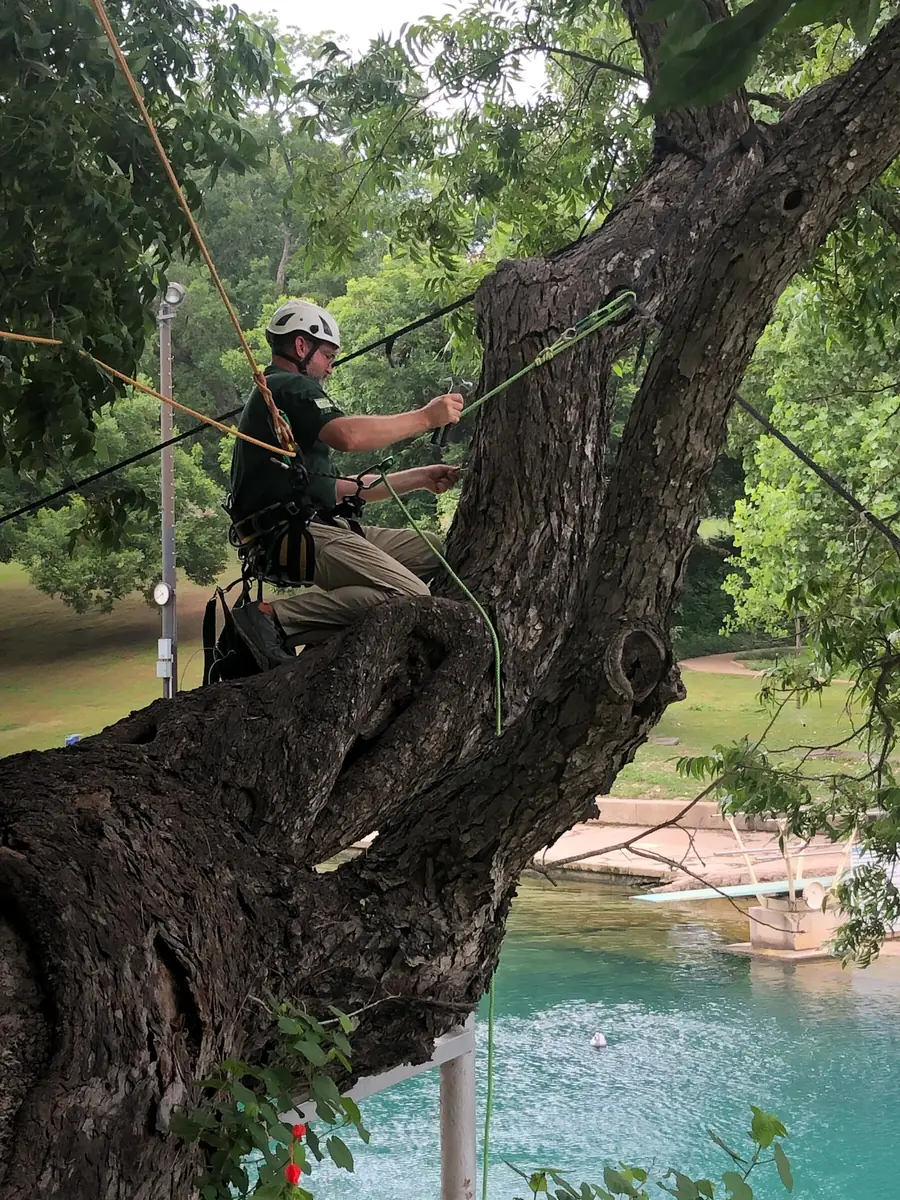
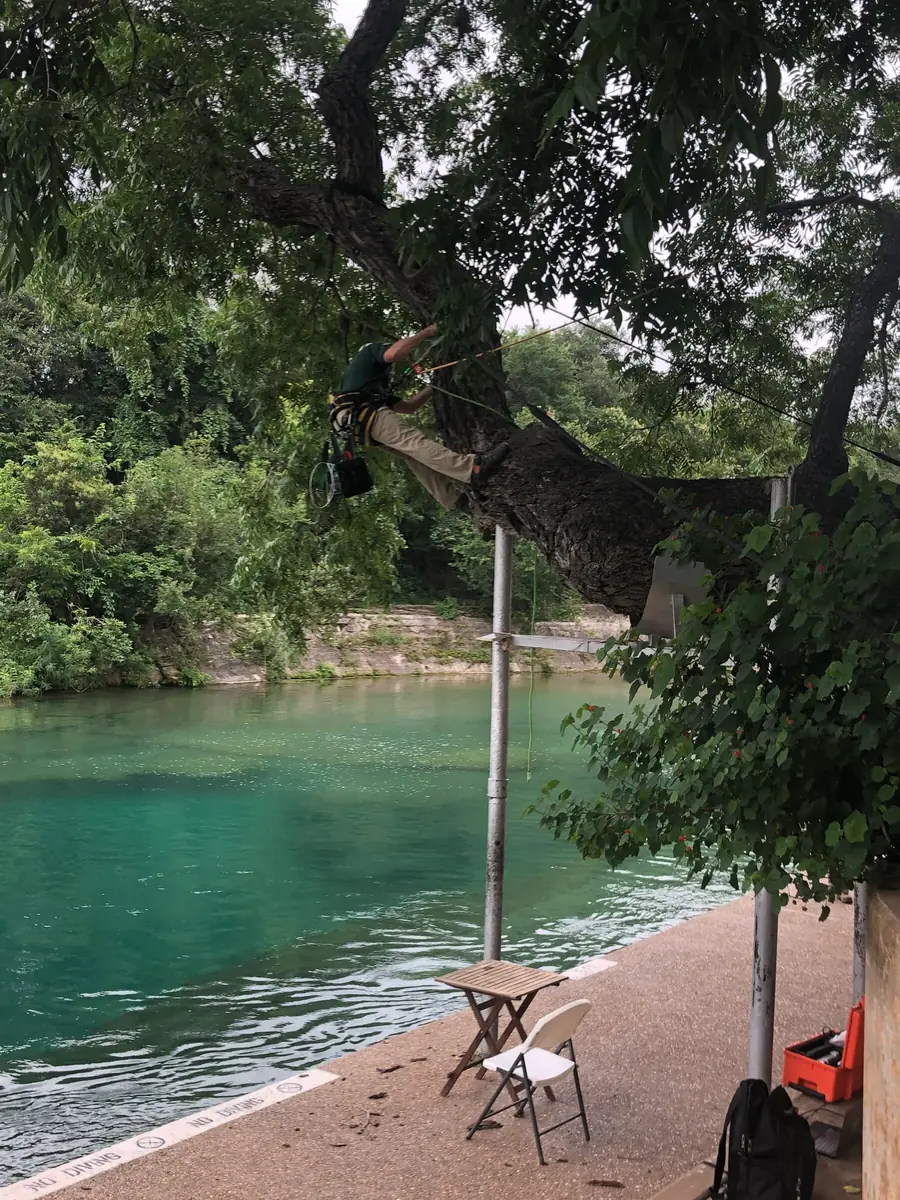
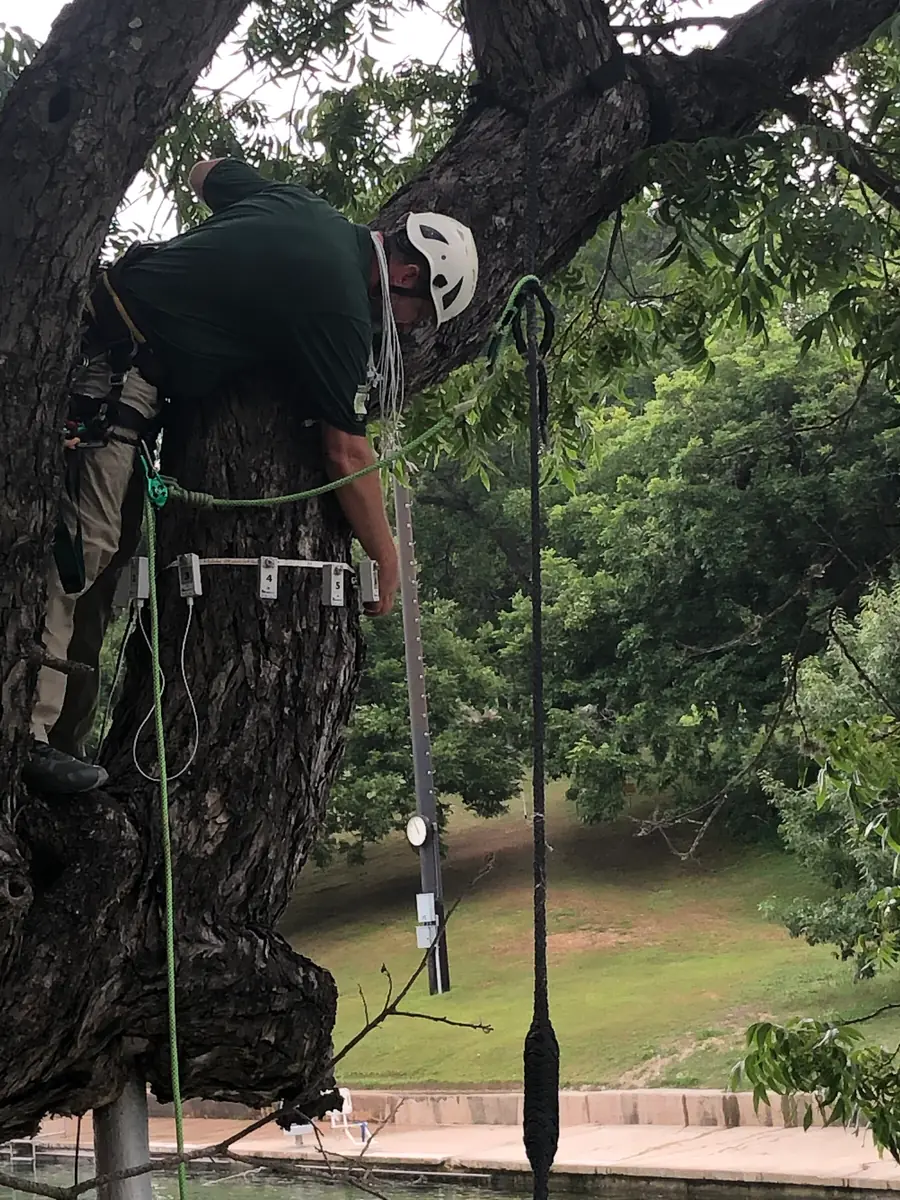
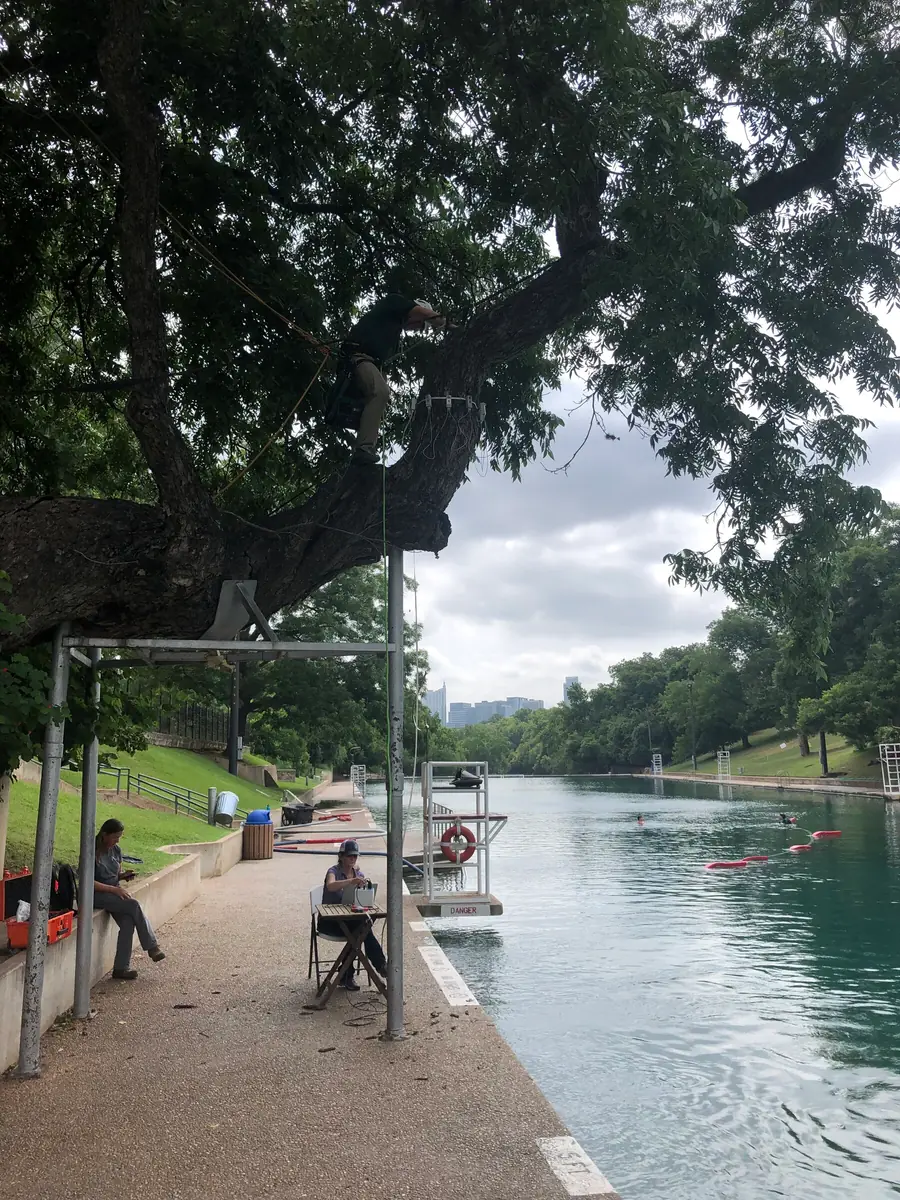
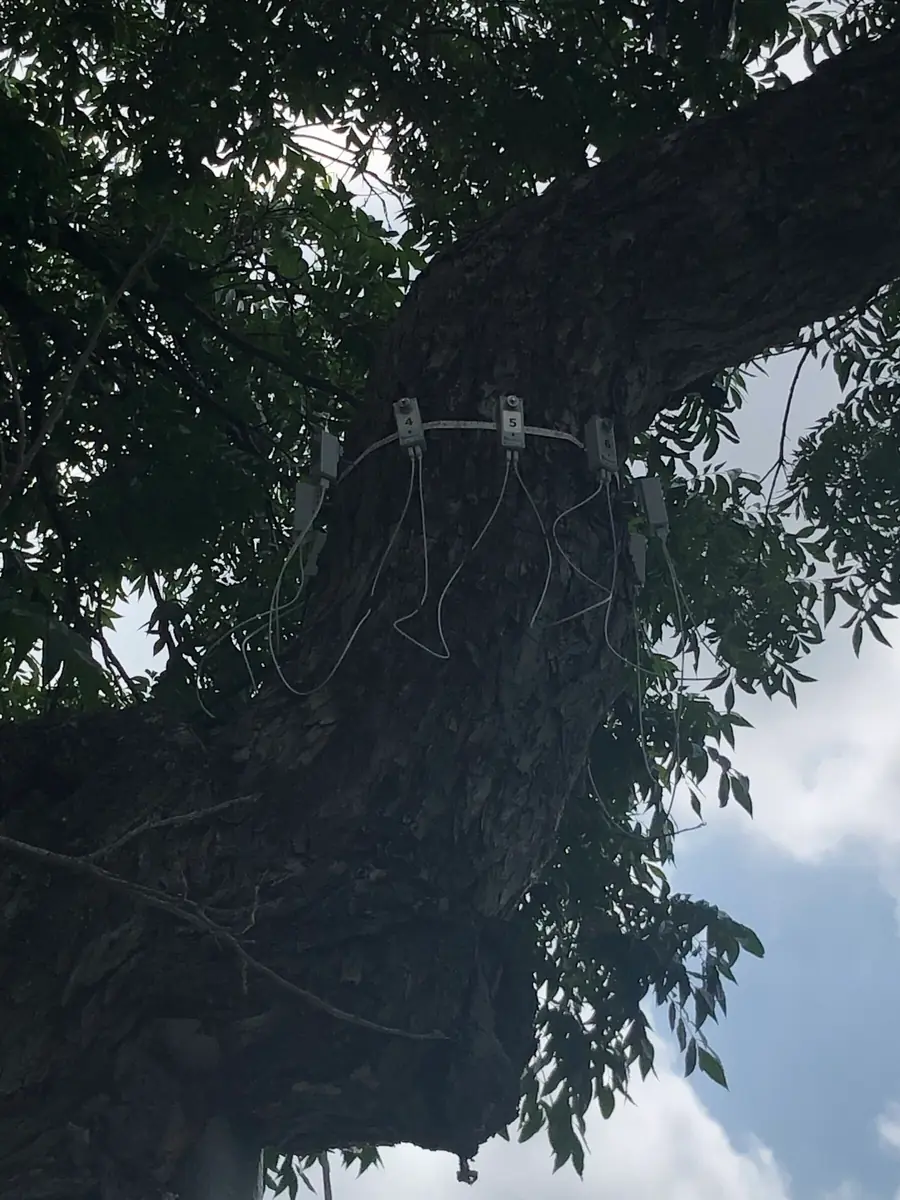
That is Keith in the tree, in June 2019. The tree is Flo, the pecan that leaned out over the water at Barton Springs, and Flo was a landmark long before she was a job. In his words, he was “honored with the opportunity to perform an evaluation and install the tomo sensors for the scan.”
Flo has since been removed.
That belongs in this section rather than being left out of it, because it is the honest shape of the work. A scan does not save a tree. It tells you what is actually inside one, so that whatever gets decided next is decided on the wood rather than on how the trunk looks from the path. Sometimes the answer supports keeping a tree for another twenty years. Sometimes it does not. The value is the same either way, and it is worth more on the trees people care about most.
Construction Implication Assessment and Permitting Required Reports
The time to bring an arborist onto a build is during design, while moving a driveway ten feet is still a change to a drawing rather than a change to a build. We assess which trees are protected, where the design conflicts with root zones, what the plan set has to show, and which trees are worth designing around versus which are already a liability that a build will only make worse. Where a design decision turns on what a tree is actually going to survive, that is a call worth making before the machines are scheduled.
Where a permit application needs arborist documentation, we prepare it: a tree inventory with species, size, condition and location for each tree, a condition assessment, documentation of canopy and critical root zone impacts, and a mitigation plan where mitigation is required. Mitigation can take the form of replacement planting or a fee paid in lieu of planting, depending on the jurisdiction and the tree, and which options are open to a project is worth establishing early.
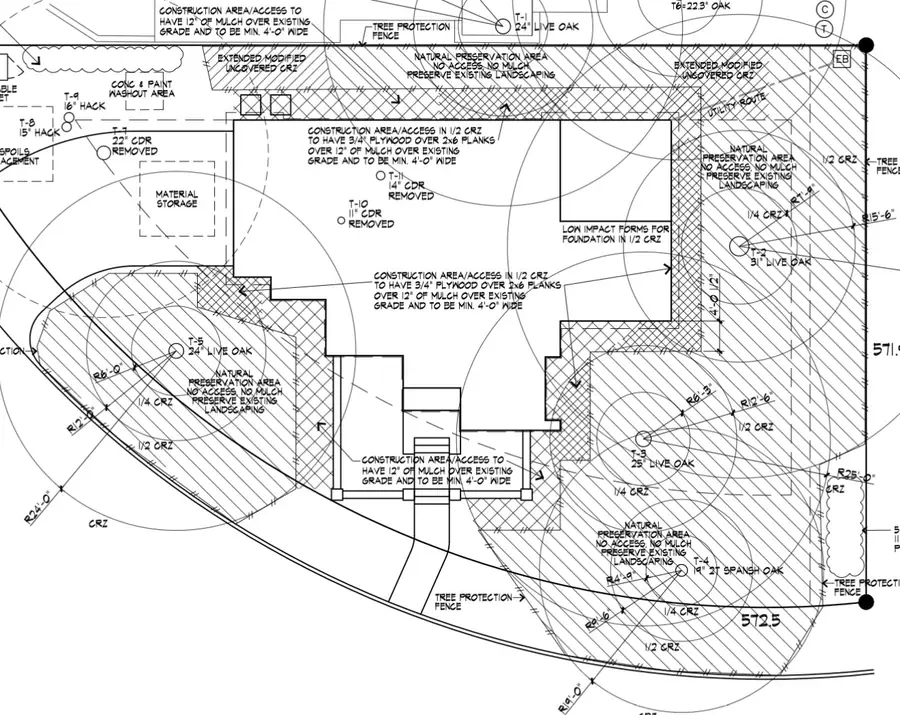
Three boundaries, stated plainly. A tree survey is a surveyor’s document and requires a state registered surveyor; where a project already has one, we audit it against what is standing on the site and tell the design team what needs correcting. Tree inventories are ours outright. And we can file an application on a project’s behalf, but we do not represent a client at the City.
Requirements are not uniform across the metro, and the first question on any permit-driven job is which set of rules applies to the parcel. Start with the Jurisdiction Finder, and see the Austin tree ordinance for how the City treats protected and heritage trees. For the physical work on site, protection fencing, ground protection, airspading around utilities and piers, clearance pruning and permitted removals, see construction site tree services.
Tree Appraisal
A tree appraisal establishes what a tree is worth in money, in writing. We appraise using the trunk formula technique from the Guide for Plant Appraisal, the appraisal standard authored by the Council of Tree and Landscape Appraisers and published by the International Society of Arboriculture. It works from the trunk’s cross-sectional area and the cost of the largest replacement tree that could realistically be planted on the site, then adjusts that figure by species, condition and location ratings.
The ratings are where the judgment sits, and they are the reason an appraisal is a site visit rather than a spreadsheet. Condition is a call made standing under the tree, looking at roots, trunk, structure and foliage together, and it moves the answer more than people expect. Location covers what the tree is doing where it stands: shade on a west wall, screening, a street tree in a row, a specimen in the middle of a front yard.
People commission an appraisal after storm damage, after a tree is injured during construction or utility work, and when a value has to be stated for a property matter or an insurance claim. We appraise single trees, and we appraise a stand or a whole property where that is the question.
Our free tree appraisal calculator runs the trunk formula arithmetic on one tree and shows how far the result moves when the condition rating moves. It is a good way to understand the method. It is not an appraisal.
Real Estate and Pre-Purchase Assessment
Before you close on a property with mature trees, an arborist assessment tells you what you are buying. We evaluate condition and structure, proximity to the house and other structures, root conflicts with foundations, drives and utilities, whether any of the trees are protected under the local ordinance, and what work is already due.
The result is information while there is still room to act on it: what has to be done now, what can wait, and what is going to need attention year after year. Sellers and listing agents use the same assessment in the other direction, to get ahead of a tree question before a buyer raises it.
The rules that govern a parcel change at the city line, and a protected tree is protected for whoever owns the property next. Check which jurisdiction governs a parcel with our Jurisdiction Finder, and see the Austin tree ordinance for how protected and heritage trees are treated inside the city.