
Tree trimming in Austin is several different jobs wearing one name, and most of the decision is knowing which one you need. We prune mature shade trees, train young trees for structure, reduce overextended limbs, clear roadways, maintain the trees on commercial and industrial property, and keep established hedges and screens in shape.
All of it starts the same way. An ISA Certified Arborist walks the property, evaluates each tree, and writes a work plan. An arborist can meet you at the property, or drive the site and send the proposal over for you to read on your own time. Pruning is one of our top three services.
Mature Tree Pruning
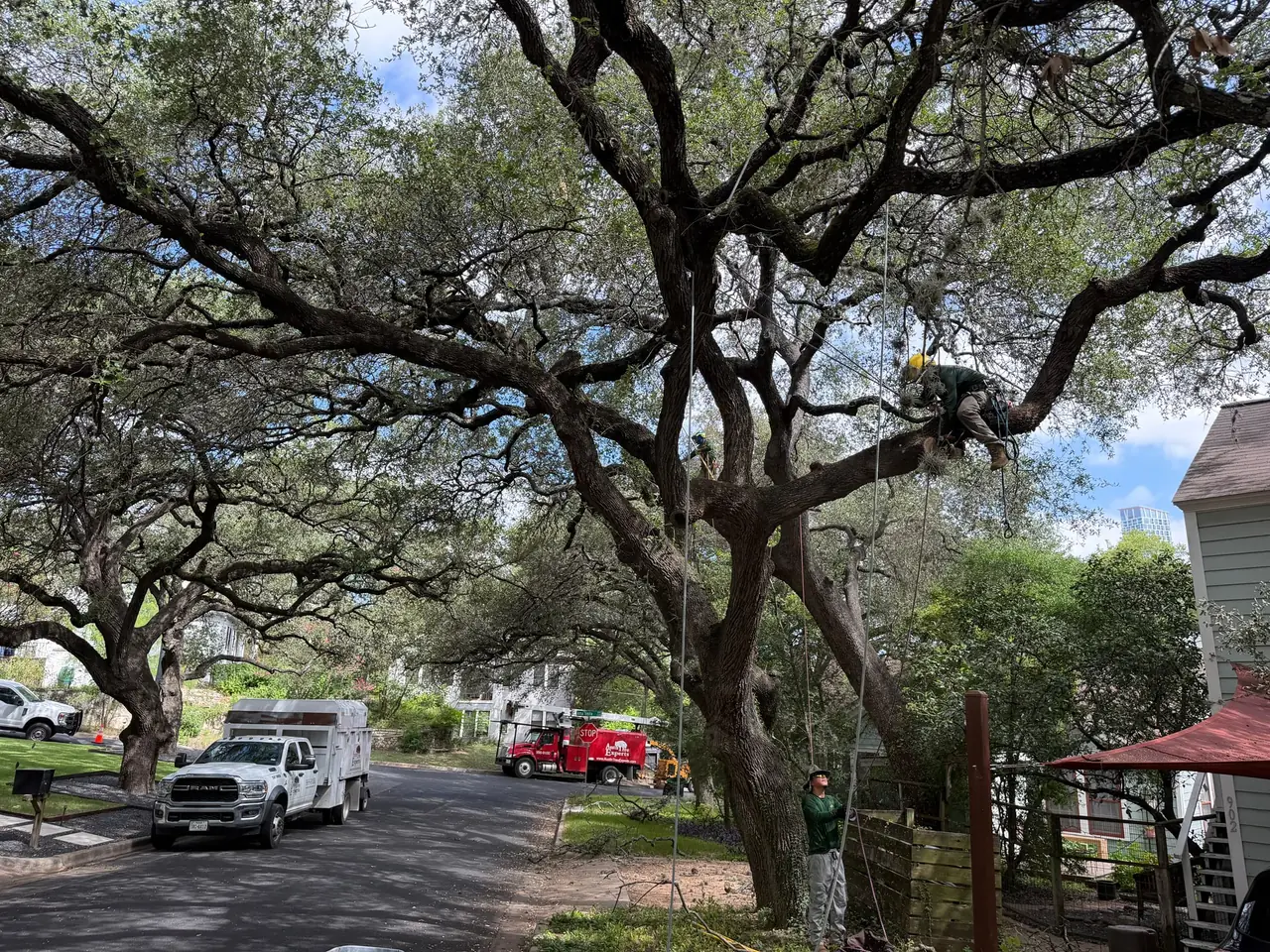
Our native live oaks do not need much creativity in the work plan. Most of the time the right scope of work is deadwood and building clearance, and a good arborist will tell you that instead of finding more to cut. Most other mature species take more consideration, usually around reduction pruning to bring weight back off long limbs and improve how the canopy carries itself.
Large trees in established Austin neighborhoods often have not been pruned in years. On a heritage-size live oak or a mature pecan, the arborist walks the entire canopy footprint before writing a single line of work plan: weight distribution, co-dominant stems, included bark, deadwood, and what sits underneath the tree. On a tree that took decades to reach its current shape, we will often write a phased approach, the most critical work first and a return in a year or two for the next round, rather than taking too much canopy off at once.
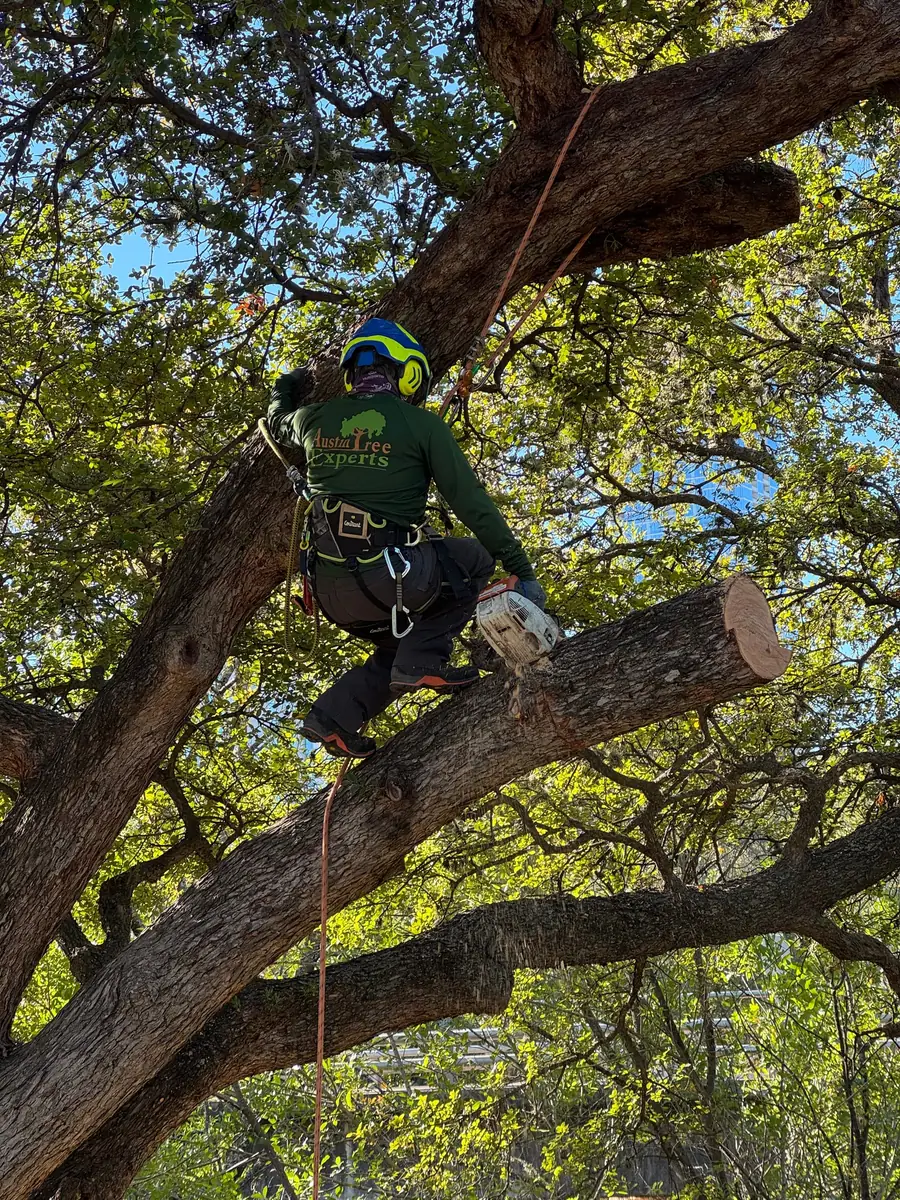
Fruit trees belong in this section rather than beside it. In an urban or suburban landscape we most often recommend pruning fruit trees for appearance rather than for production, because production pruning is not beautiful: in a real orchard the trees are managed for ease of harvest and ease of maintenance, which is rarely what a landscape is meant to look like. If you want a hobby orchard that looks good in the yard, we will prune it that way. If you want to push output from a small orchard, we will prune it that way instead. Tell us which one you are after and the work plan follows.
Young Tree Pruning
We perform a lot of young tree pruning, and it is some of the highest-value work a property will ever buy. Nurseries grow and prune trees to look full and lush on the lot. Out in the landscape that same tree usually needs correcting toward a strong central leader with balanced scaffold limbs. A few quality sessions across the first several years does more for the tree’s structure and its lifespan than anything anyone can do to it at forty years old.
The competency here is restraint. A young tree is easy to set back by taking too much at once, so a young-tree work plan is usually a small number of cuts and a note about when to look at it again. If you have recently had trees planted, this is the work that establishes dominance of the central leader and heads off the co-dominant stems and included bark that give mature trees structural problems later.
Structural and Reduction Pruning
Structural pruning is corrective. It changes the architecture of a tree over time by choosing which stems keep growing and which get shortened: reducing a competing leader, addressing a weak union with included bark, correcting a canopy that has grown lopsided toward the light. It applies to young trees and to mature ones, and on a mature tree it is the same idea done slower and more conservatively, usually across more than one visit.
Reduction pruning shortens long, overextended limbs back to a lateral large enough to take over as the new end of the limb. It is the treatment for species that carry a lot of weight out at the ends, pecans, ashes and elms among them, and for individual limbs that have simply grown past what the union at their base was built for.
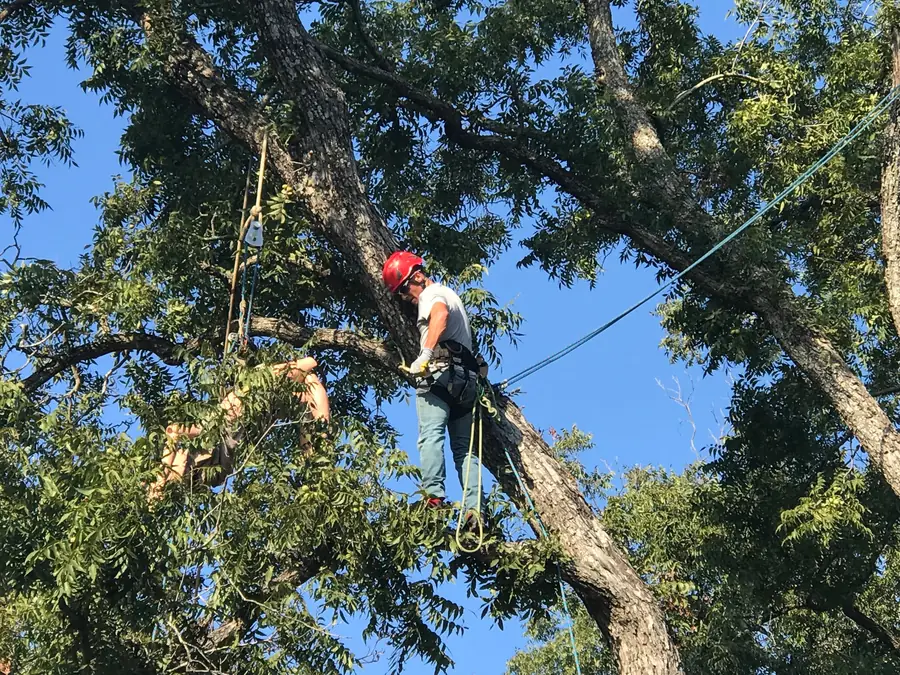
It is worth saying once what reduction pruning is not. It is not stripping the interior and lower limbs out of a canopy and leaving the growth at the ends. That practice moves weight further out on the limb instead of bringing it back, which is the opposite of the objective. When we write reduction, we mean shortening the long limbs.
Right of Way Maintenance Pruning
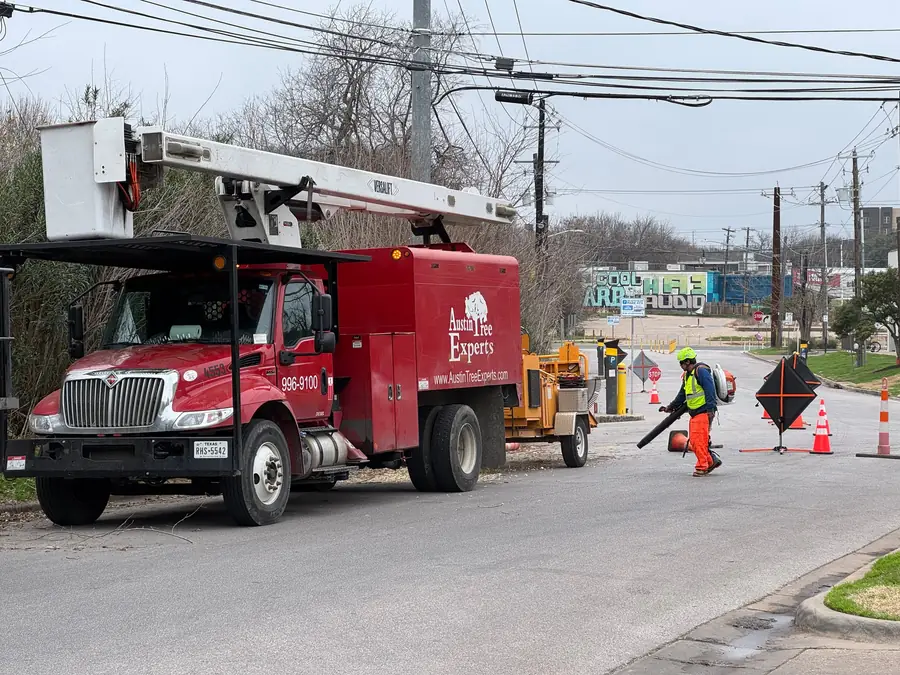
Right of way pruning is written from the clearance requirement backward rather than from the tree forward. Streets, alleys, sidewalks and driveway approaches each have a height and a width that has to stay open: delivery trucks, buses, garbage trucks, emergency vehicles, pedestrians walking under a sidewalk canopy, and clear sight lines at intersections and signage. The work plan names the clearance, and the pruning is the means to it.
We do this work for municipalities, for HOAs on their common frontage, and for property owners responsible for the right of way in front of their own lots. The required clearance is local: some jurisdictions publish a number, some leave it to the property owner. Our Jurisdiction Finder will tell you which one governs your address.
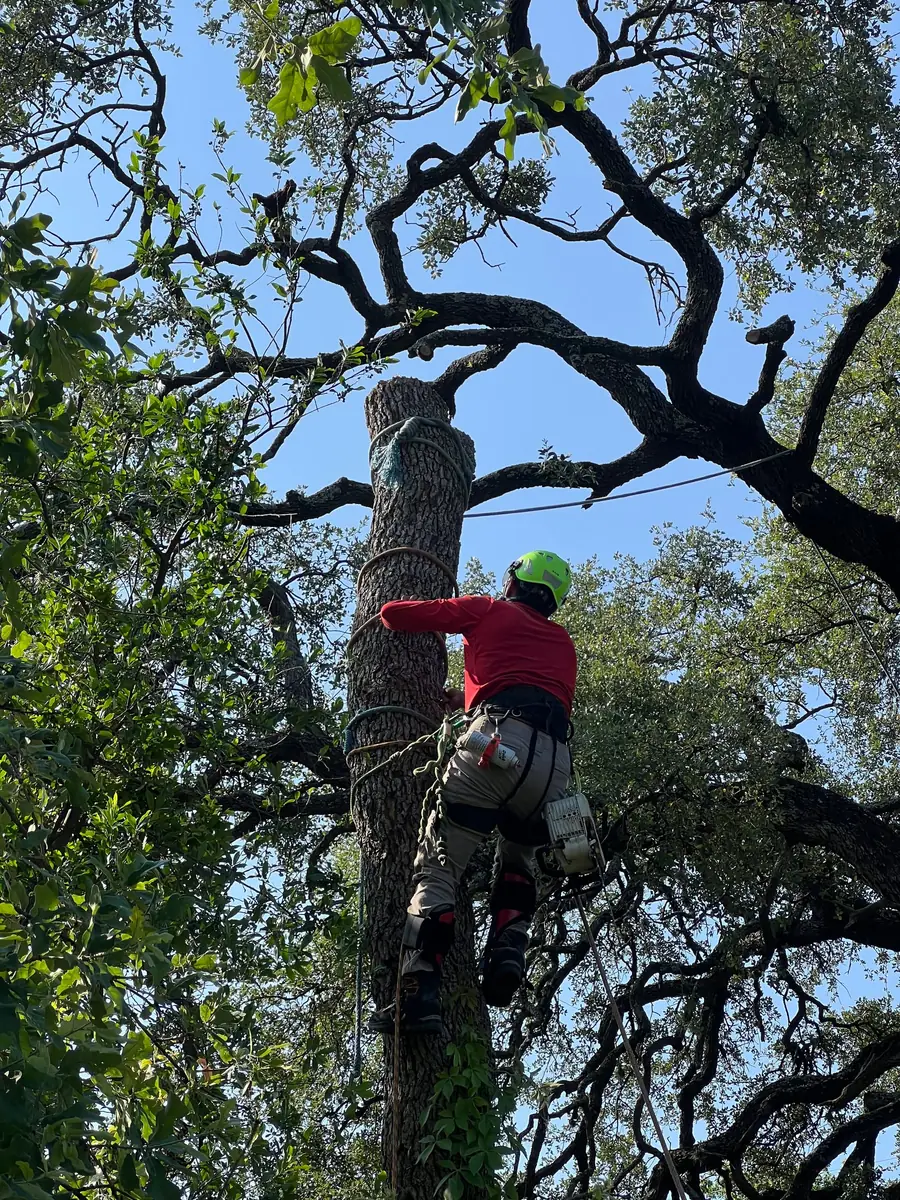
Access is the practical constraint on street and frontage trees, and it is usually solvable. Most roadway pruning is done from a bucket truck. Where a truck cannot be positioned, we climb it, or bring a tracked lift that drives through a gate and works from the ground the truck cannot reach.
Facility Maintenance Pruning
Facility maintenance pruning is recurring tree work on commercial and industrial property: office parks, retail centers, apartment and multifamily communities, HOA common areas, schools, churches, industrial yards and municipal facilities. The unit of work is the property, not the tree. We look at what is there, write one work plan across the whole site, and schedule the work around your operating hours, your parking and your tenants.
That last part is most of the job on an occupied site. Pruning a parking lot means working around cars that are there during business hours. Pruning a retail frontage means not blocking an entrance on a Saturday. Pruning at a school means being off site before dismissal. We plan for it rather than discover it, and it is the reason a facility work plan is written once and executed in phases rather than negotiated on the day.
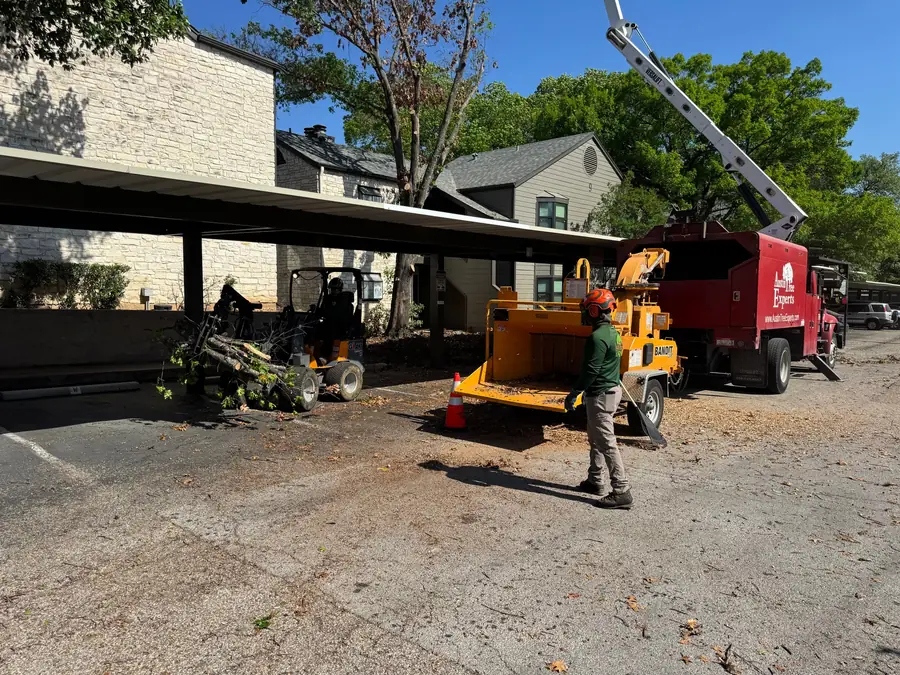
On commercial and industrial property the constraint is usually not the tree. Tree canopies need to be lifted to a certain height regardless of whether it is good for the tree, because parking requires it. Trees in parking islands need to provide clearance for the vehicles that park under them and drive past them. Security cameras and lights need clearance no matter what. Commercial signs need visibility no matter what. We acknowledge that public safety and business priorities supersede tree needs in many commercial and industrial circumstances, and we will write the work plan to your constraint.
What you get from us is not an argument about it. You get the clearance you need, made with the cuts that cost the tree the least of the available options, and a straight answer about what that costs the tree so you can plan the rest of the property around it, including which species belong in a parking island the next time one is replanted.
Construction changes the rules on a facility site, and the rules are local. Most municipal jurisdictions in Central Texas have some variety of tree protection ordinance, and Austin in particular pays attention to how much pruning happens during construction activity. We can evaluate what your project’s tree protection plan actually allows, prune for equipment clearance and to keep limbs out of the way of machinery, and handle the rest of your construction site tree protection and ordinance compliance alongside it.
Hedge and Screen Pruning Maintenance
We perform hedge pruning maintenance: ongoing pruning of an established hedge or screen so it keeps doing the job it was planted to do. Formal hedges, privacy screens, evergreen borders along a property line, and screening around commercial enclosures, equipment pads and utility yards.
The work is shaping and holding an established planting. Keeping the height and the face where you want them, keeping the base a little wider than the top so the bottom of the hedge holds its foliage, and cutting back the growth that has pushed past the line. On a commercial property this usually rides along with the rest of the site’s tree work plan rather than being scheduled on its own.
Pruning to ANSI A300 and Z133
Two industry standards sit behind everything above, and they are worth naming because they are what make a pruning work plan checkable instead of a matter of taste.
ANSI A300 is the performance standard for tree care work. Part 1 covers pruning, and it supplies the vocabulary a work plan is written in: crown cleaning, crown raising, crown reduction and the rest. Written to A300, a work plan means the same thing to our arborist, to the crew executing it, to you, and to a city plan reviewer reading it two years later. It is also what makes finished work inspectable against the document it was sold from.
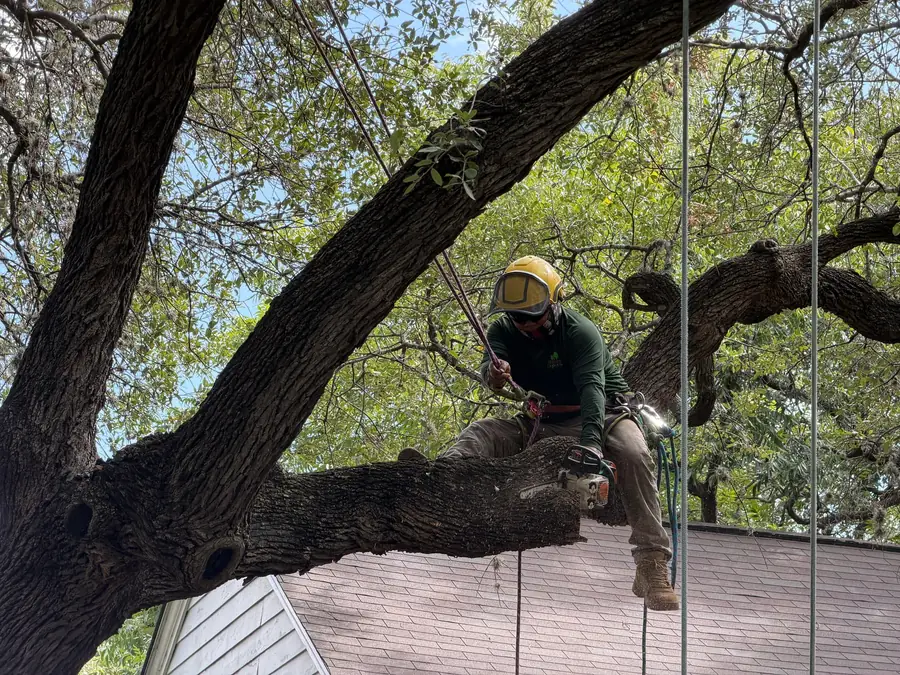
ANSI Z133 is the safety standard for arboricultural operations, and it governs how the work gets done rather than what gets cut: work zones and drop zones, aerial rescue capability, chainsaw and climbing practice, and traffic control on a roadside job. On a commercial, municipal or institutional site it is usually the part your risk manager wants to hear about.
Austin Tree Experts was founded in 2003 and is run by an ISA Board Certified Master Arborist, license TX-0985B, in the trade since 1993. Our arborists write the work plans, and a Quality Control Arborist inspects completed pruning against the work plan it was written to.