
Austin & Central Texas · Mon–Fri, 8am–5pm
Talk to an arborist(512) 996-9100Get a Quote

Est. 2003

Professional Tree Service & Certified Arborists

Austin Tree Experts is a tree service in Austin run by certified arborists, working across Central Texas since 2003. Everything we do is listed below with a page for each: pruning, removal, stump grinding, tree care, planting, oak wilt, air spade root work, construction sites, consulting, shaded fuel breaks, and mulch. The company is owned by an ISA Board Certified Master Arborist, and an arborist scopes the work before a crew is scheduled.

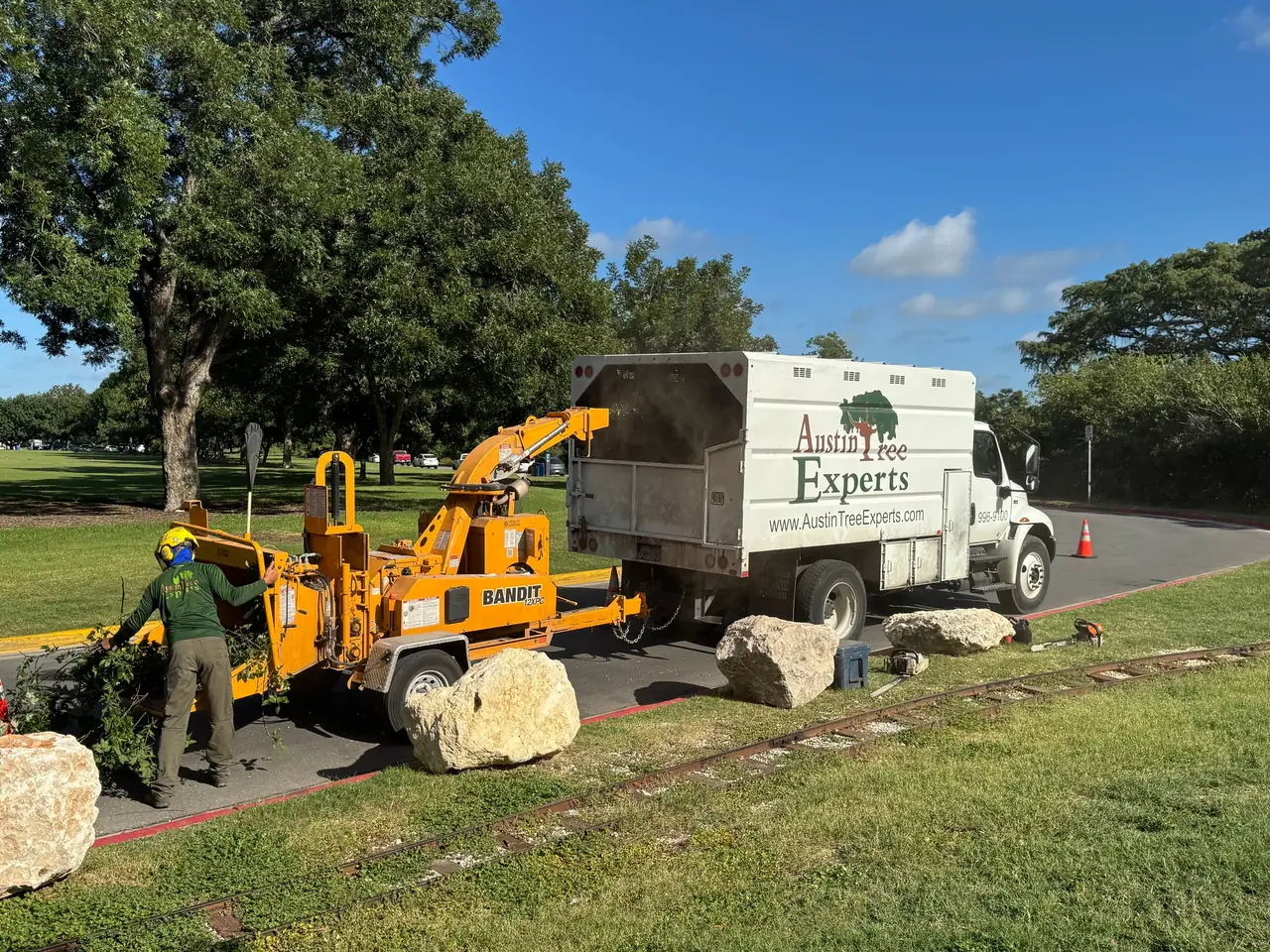
Austin Tree Experts chip truck and chipper on park grass, crew beside cut log rounds

Tree Services We Offer

Eleven service lines, each with its own page. If you already know what you need, go straight to it.

Tree Work

Tree Pruning

Mature tree pruning, young tree pruning, structural and reduction pruning, right of way clearance, facility maintenance pruning on commercial and industrial property, and established hedges and screens. An ISA Certified Arborist walks the property and writes a work plan before a crew is scheduled: what gets cut, what does not, and why. Performed to the ANSI A300 and Z133 standards.
Tree Removal

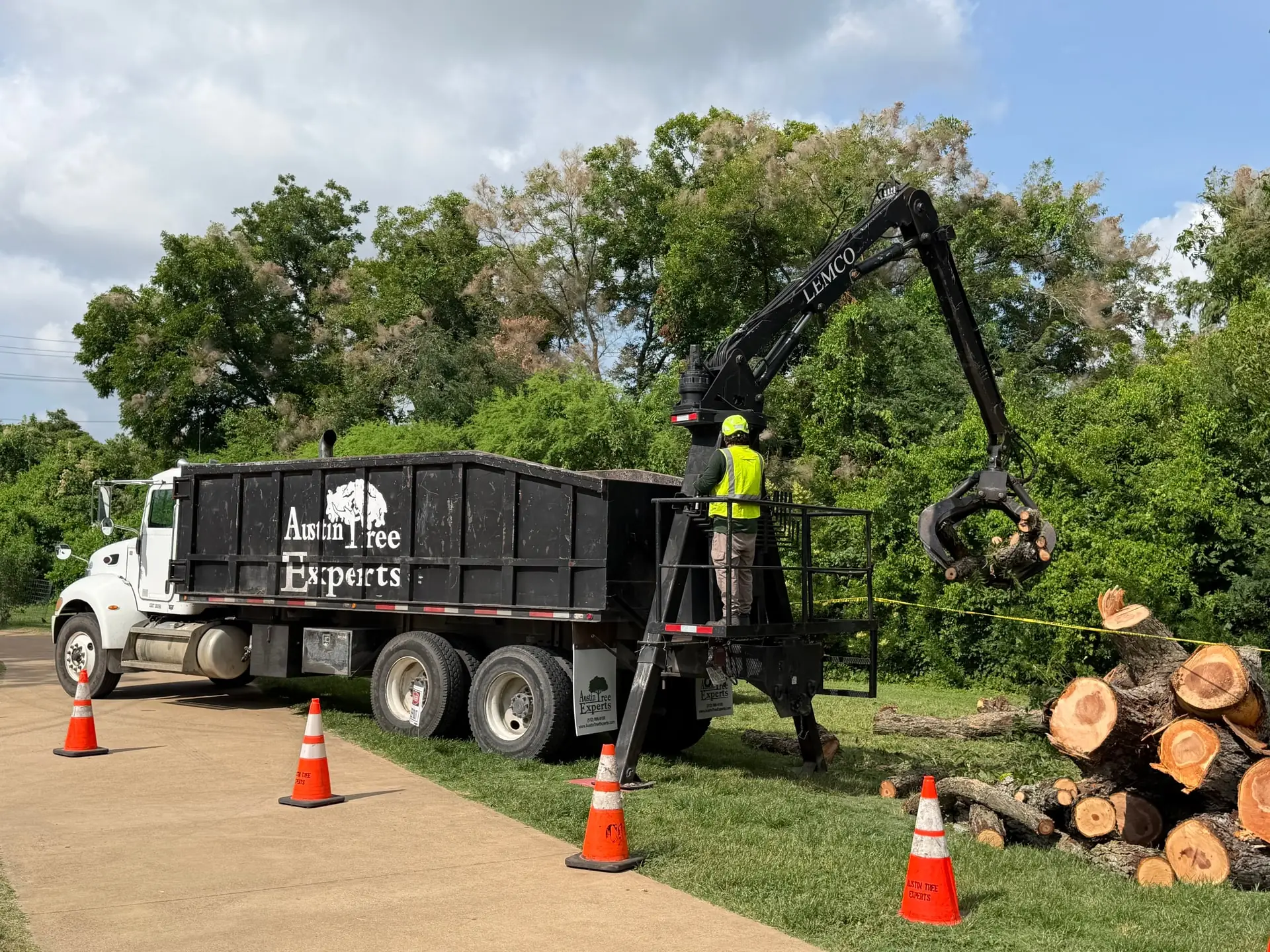
Hazard trees, dead and declining trees, storm failures, commercial and multi-tree jobs, and removals where the real problem is access rather than the tree. We work off a 65-foot bucket truck, a tracked lift that drives through a gate into a back yard, a grapple truck, and a grapple saw crane when the tree stands over something that cannot be moved. Where the jurisdiction requires a permit, we prepare and file the application.

Stump Grinding

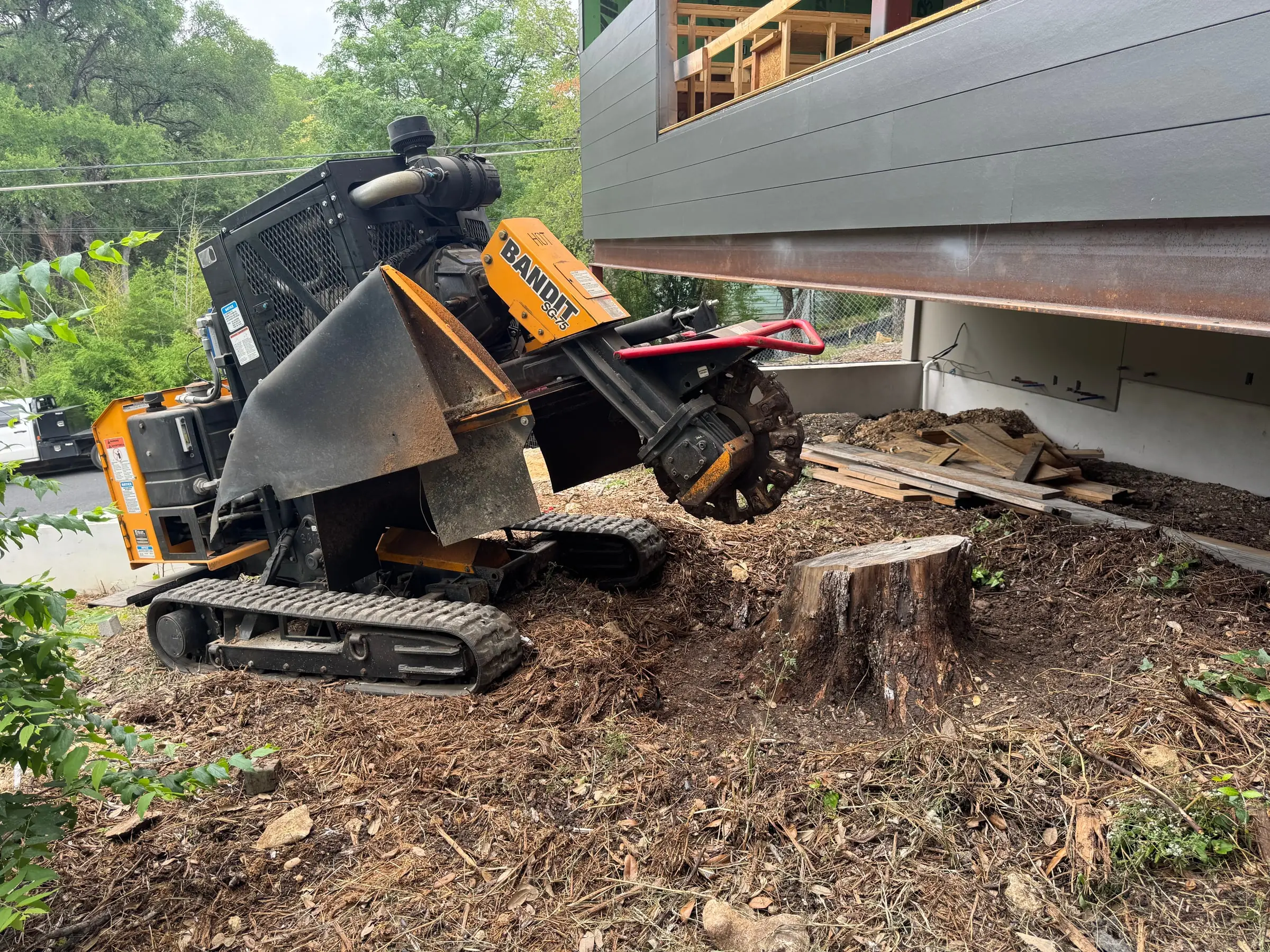
Stump grinding, root ball excavation, and surface root grinding where roots are lifting a walk or a drive. Three grinders, from one that fits through a standard gate to a 75-horsepower machine that takes down a heritage-size live oak stump, so the stump decides the machine instead of the machine deciding the scope. The site put back the way we found it.

Tree Planting

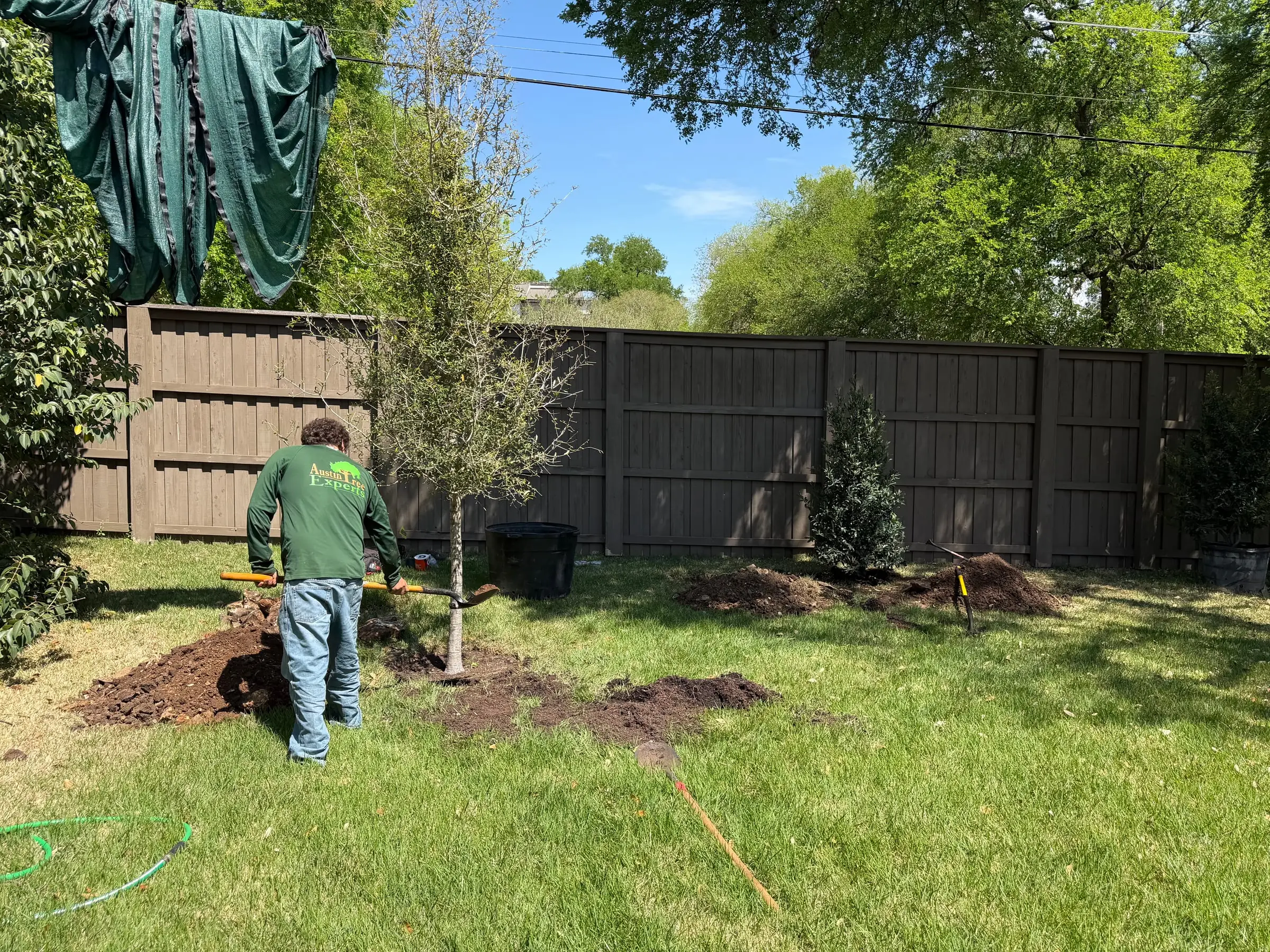
Species selection for Central Texas, siting and placement, planting season, large-caliber and commercial installation, mitigation plantings for permits, and establishment care afterward. Most of what decides whether a young tree thrives is settled before it goes in the ground, in the species and the spot.

Tree Health

Tree Care

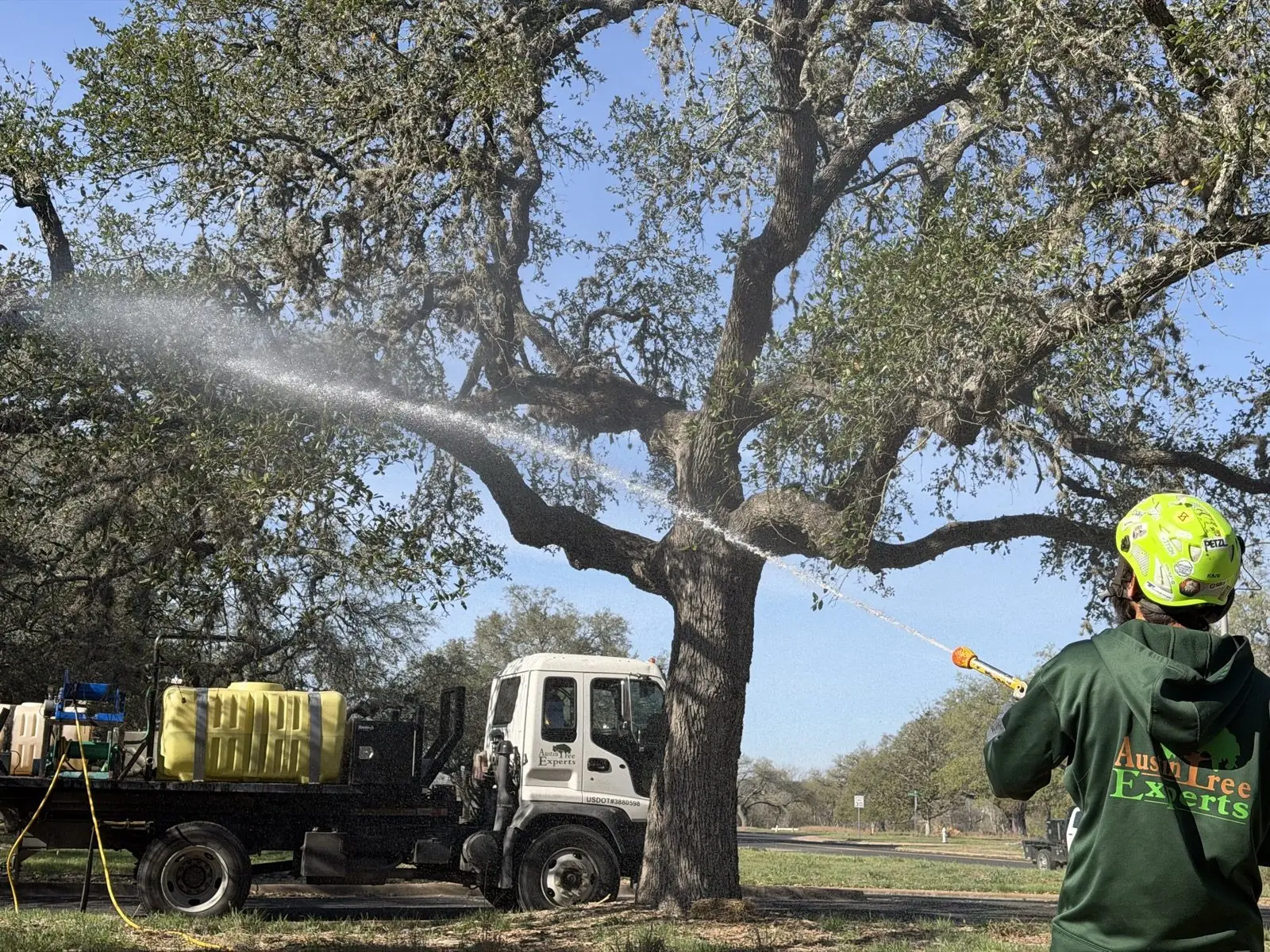
Fertilization programs timed to the tree’s season rather than to a billing calendar, insect and disease treatment, soil decompaction, and compost. Treatments are applied under a Texas Department of Agriculture licensed applicator. The quiet value of a program is that it puts an arborist on your property several times a year, which is when a watering problem or a herbicide problem gets caught early enough to matter.

Oak Wilt

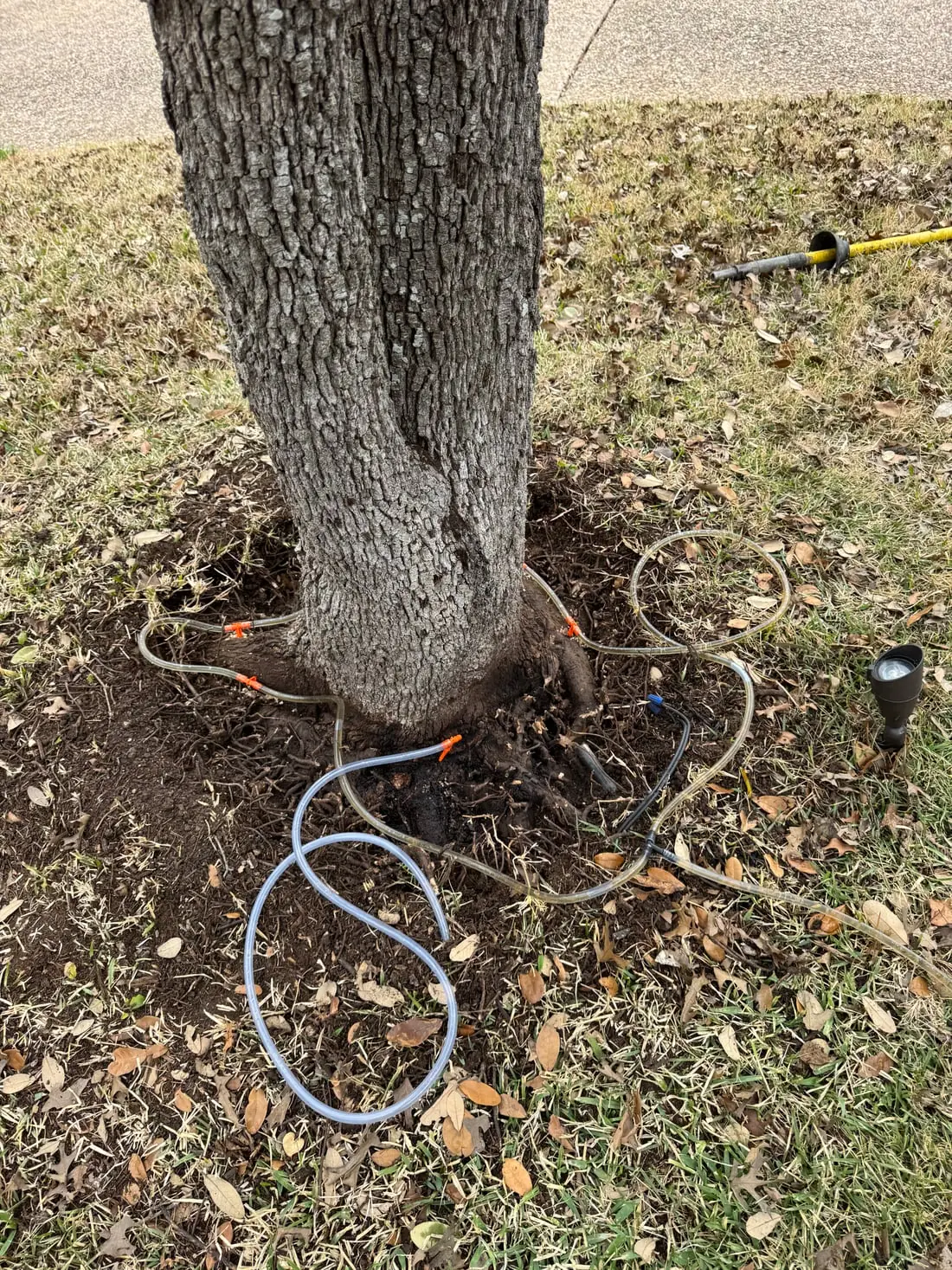
Diagnosis and confirmation, fungicide injection treatment, trenching and root separation, ongoing monitoring and management, replanting in oak wilt sites, pruning timing, and consulting, mapping and drone surveys on larger properties. Diagnosis comes first, and it is the part most worth getting right before anyone spends money on treatment.

Air-Spade Services

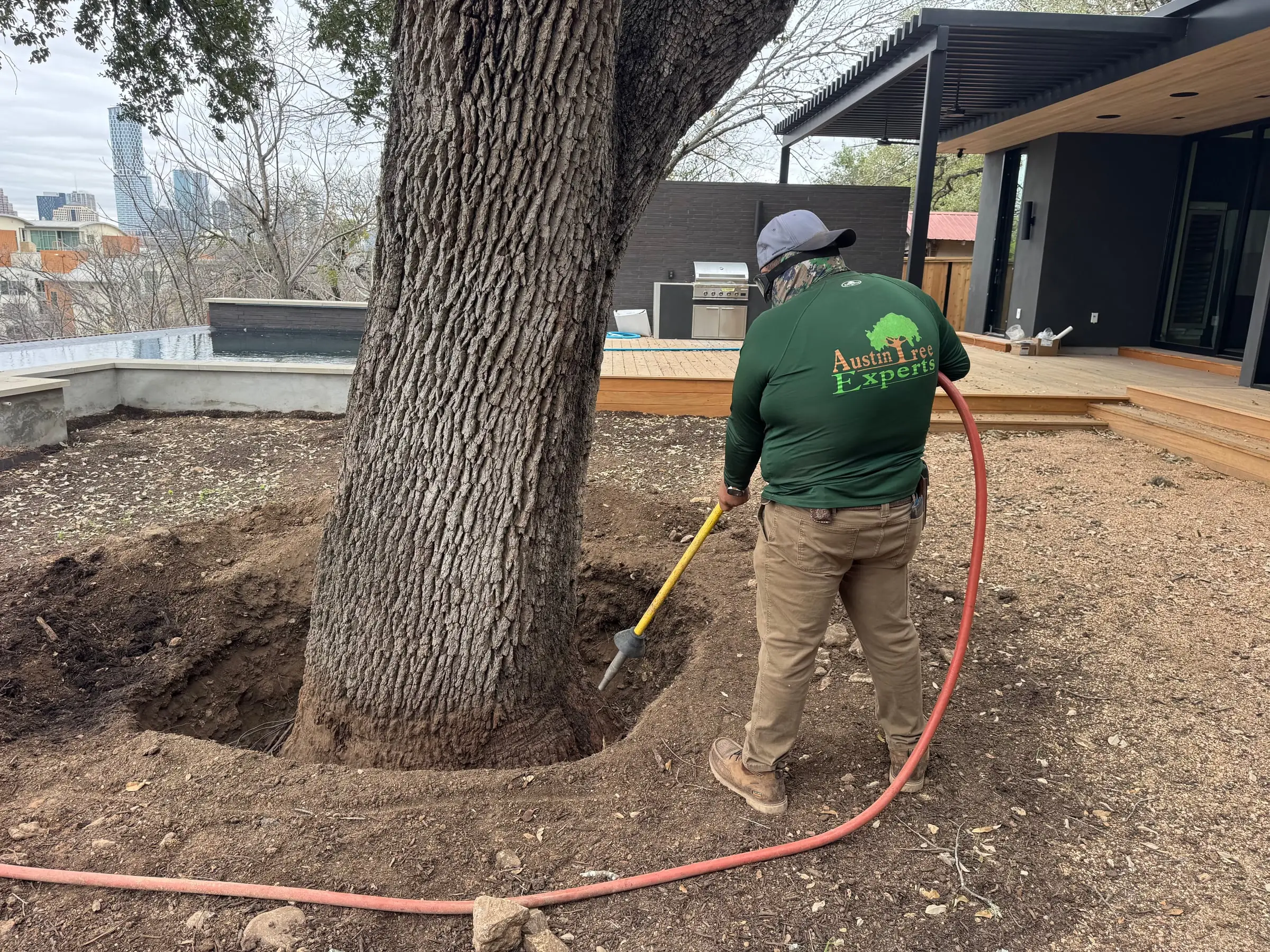
Root flare excavation, root investigation and root pruning, soil decompaction and amendment, and trenching through a root zone without severing the roots. Compressed air moves soil and leaves roots intact, which is what makes the work possible at all. The judgment is recognizing when the soil is the actual problem, which is more often than the canopy suggests.

Mulching and Composting

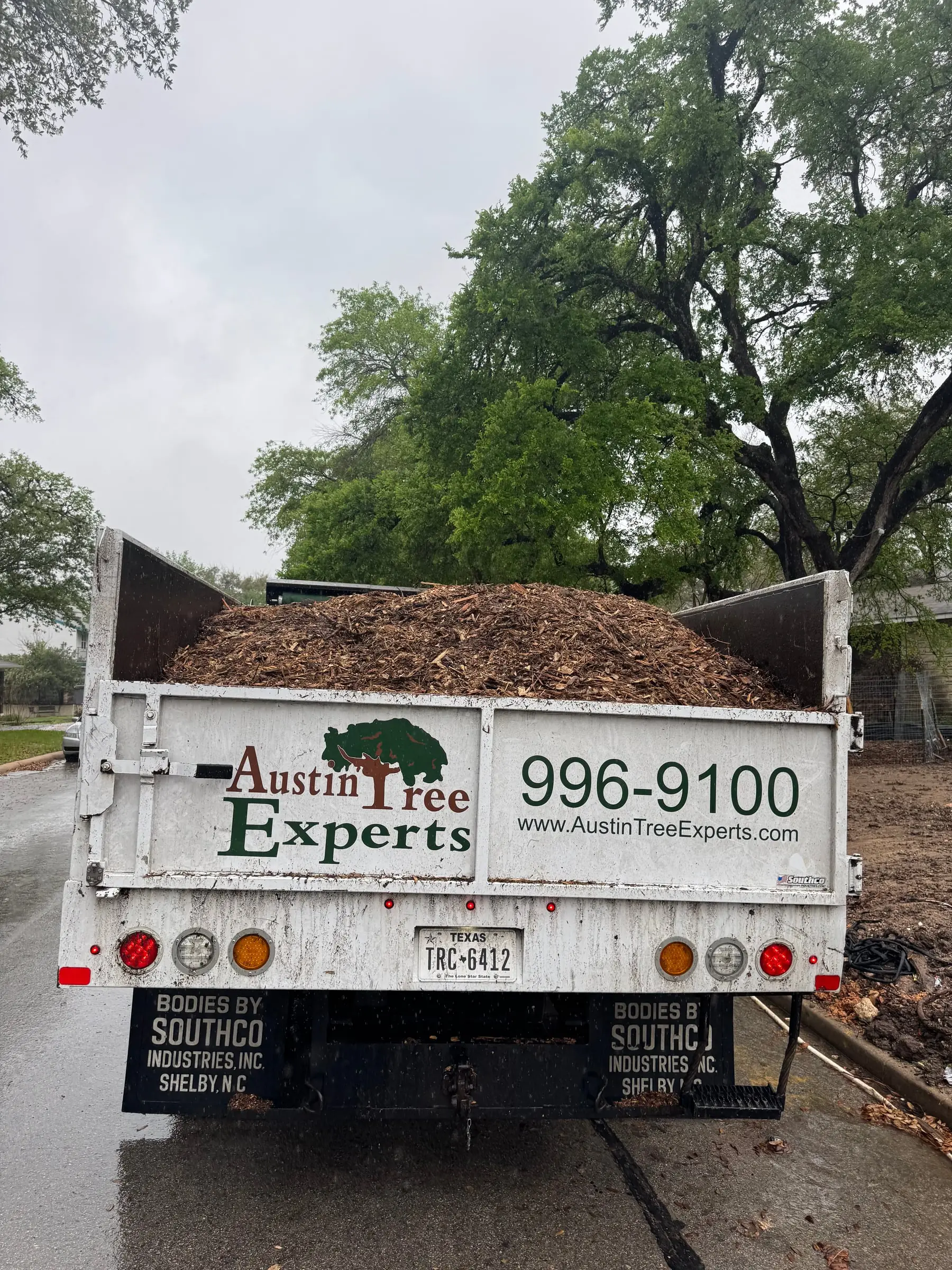
Mulch ground in our own yard from the wood our crews bring in, and compost used as tree care. Delivered in bulk. Depth and coverage area are where most of the benefit is won or lost, so we will tell you what your trees actually need rather than what fills the truck.

Land & Development

Construction Site Services

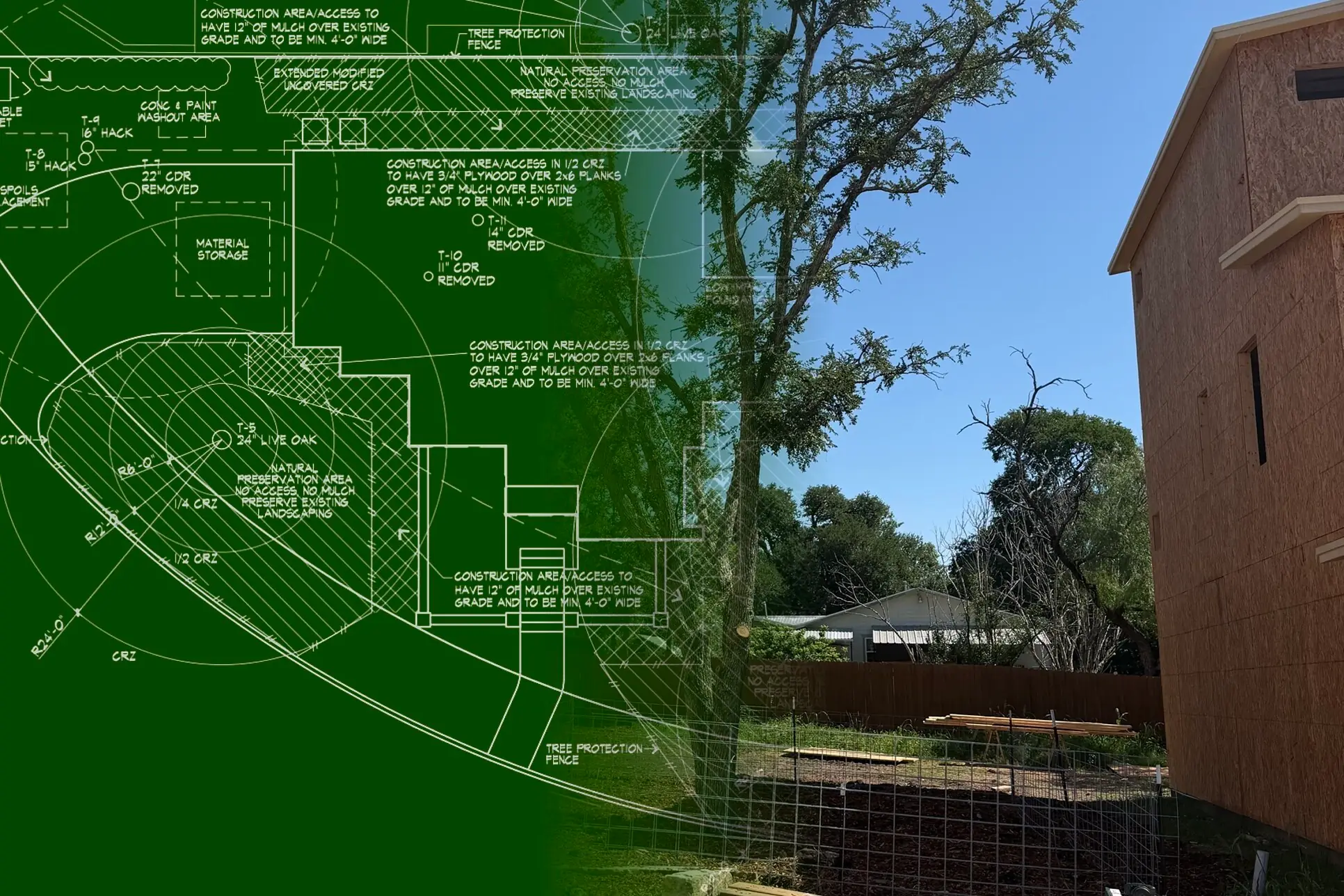
Ordinance compliance and permitting, arborist reports and documentation, tree protection fencing and ground protection, monitoring while the site is active, the tree work the build itself requires, tree inventories and survey audits, tree data delivered in CAD and GIS formats, and recovery care after the build. A tree survey has to come from a state registered surveyor; ours is a survey audit, and inventories are ours outright.

Arborist Consulting

Tree condition assessment and diagnosis, tree risk assessment using ISA’s Tree Risk Assessment Qualification method, tree appraisal, real estate and pre-purchase assessments, reports for permitting, and construction and development consulting. This is the work where what you buy is a written professional judgment rather than tree work.

Shaded Fuel Breaks

Shaded fuel breaks for residential properties, HOAs and municipalities: reducing the fuel that carries a wildfire while keeping the canopy that shades the ground under it. Reducing stand density to break up fuel continuity, forestry mulching, and land clearing, worked with excavators, loaders and a mulching head.

Arborist Competency Meets Service Capability

Two things have to be true for a tree job to go well. Somebody has to work out what the right scope of work actually is, and somebody has to be able to execute it. We built the company around holding both, because either one on its own is where jobs go wrong: a good plan nobody can perform, or good equipment pointed at the wrong work.

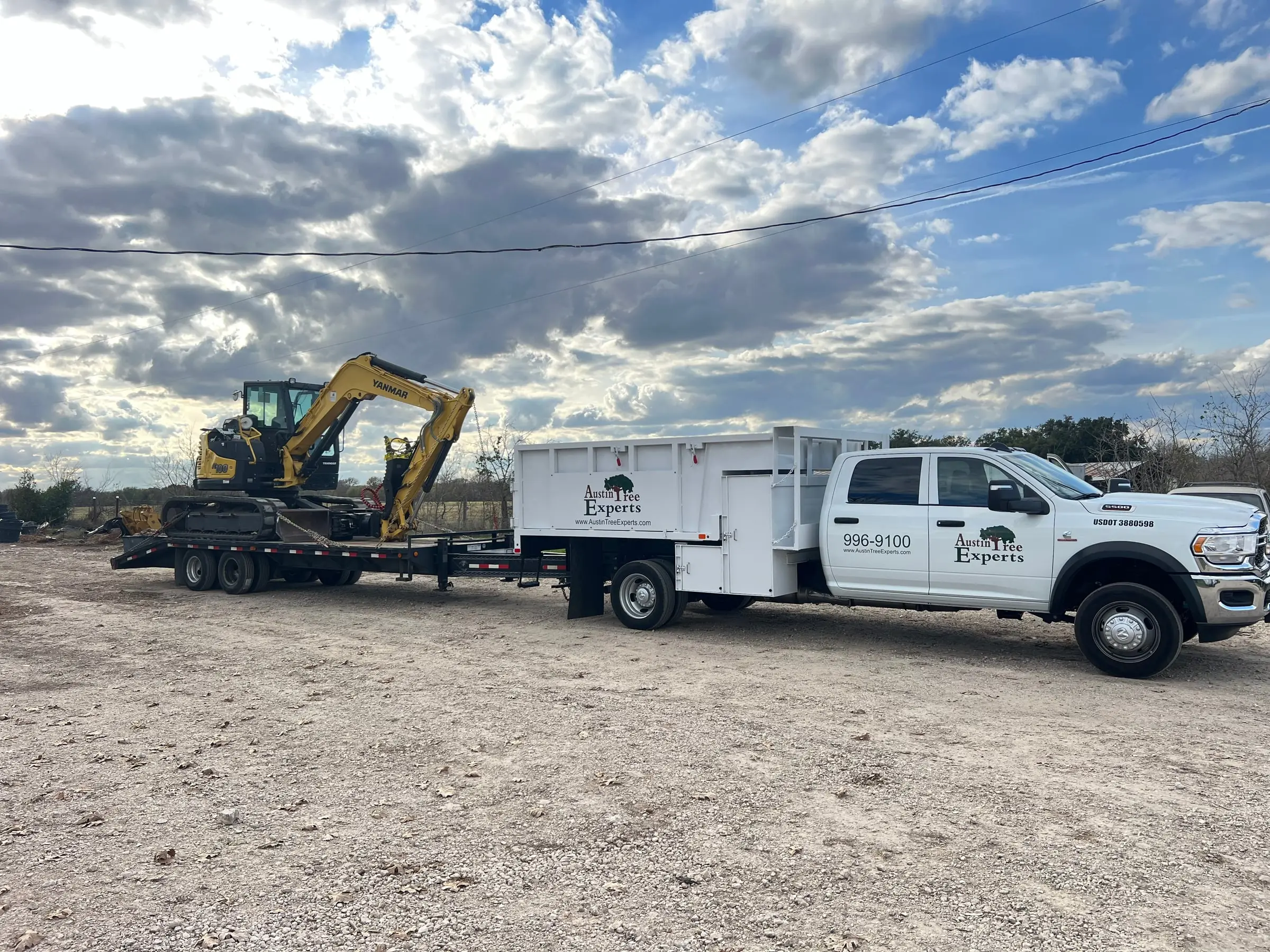
The capability is our own crews and our own equipment. Bucket trucks working to 65 feet, a tracked lift that drives through a gate and into a back yard no truck can enter, grapple trucks whose loading arms pick up whole logs, excavators and loaders, chippers, three stump grinders, air spades and compressors, spray and root-feeding rigs, and a horizontal grinder that turns the wood we haul out into the mulch we deliver. When a job calls for a machine we do not keep, a grapple saw crane or a forestry mower, we bring one in. The work itself is done by our employees.

The competency is who decides. An ISA Certified Arborist evaluates the trees, sets the prognosis before chasing a diagnosis, and writes the work plan the crew works from, so the scope is decided at the property and put in writing rather than improvised in the canopy. A Quality Control Arborist inspects completed work against the work plan it was sold from. That is also why we will tell you a tree is not worth saving, or that the right scope is smaller than you expected.

Our customers include homeowners, property managers, apartment and multifamily communities, HOAs, retail centers, schools, municipalities, developers, engineers, architects and general contractors. The jobs run from a single tree in a back yard to site development measured in acres.

Samples of Our Tree Service

Three projects, each one picked because it turned on a different part of the same pairing.

80-Foot American Elm Over a High-Traffic Road

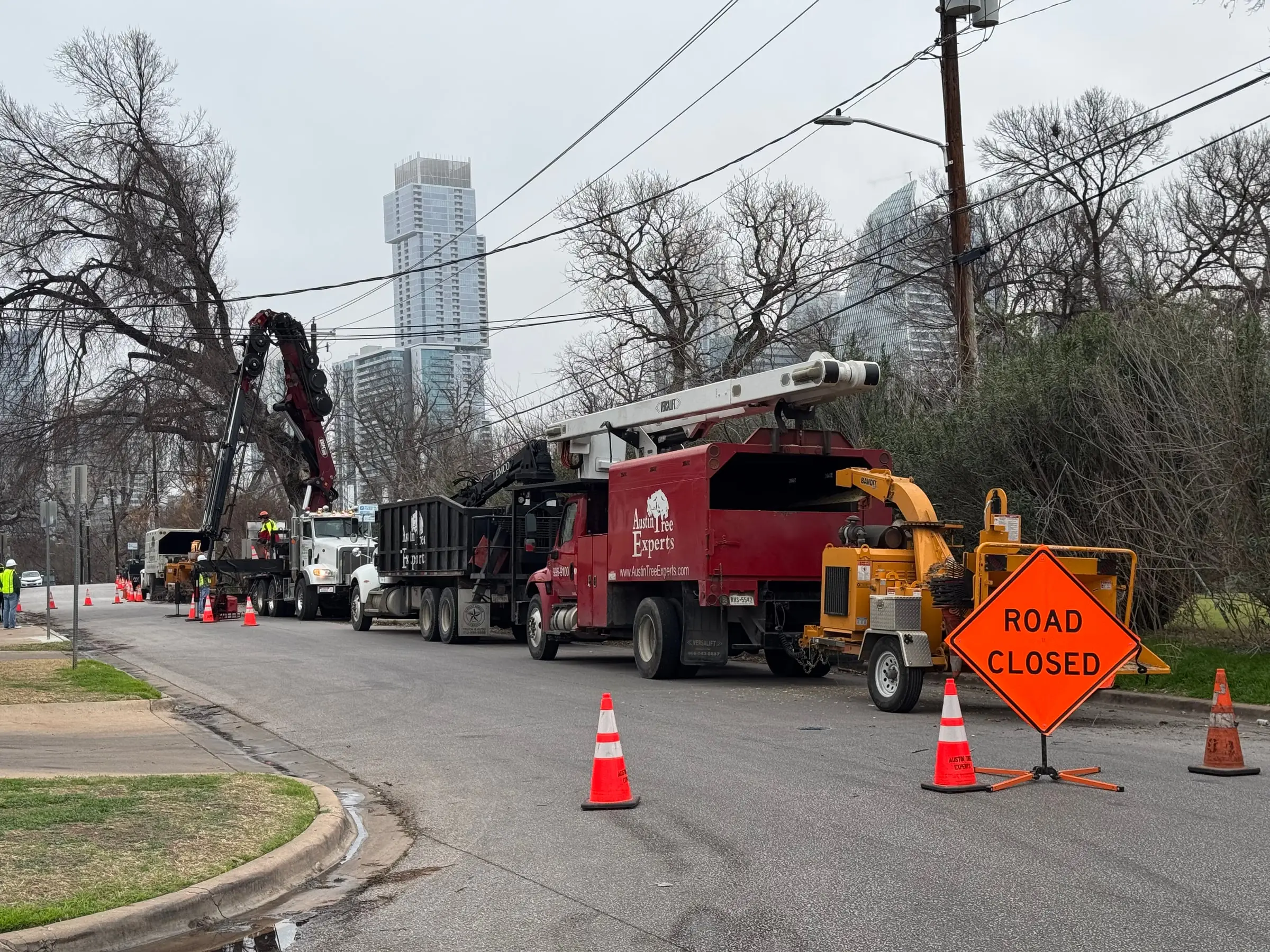
Zilker, beside the Butler Pitch and Putt course. A 63-inch diameter American elm that had been pruned around a power line for most of its life had to come down for safety. The tree was the straightforward part. The street was not: steady traffic, conductors overhead, and a neighboring public facility that could not lose its access for a day.

More

So the scope was written around the street rather than around the tree. The whole removal was planned as one continuous operation instead of staged over several days, because every extra hour on that road was another hour of traffic control and another day of disruption for everyone using it. We worked it with the bucket truck, a large chipper with a winch so brush went in as fast as it came down, and a grapple truck to pick up the big logs whole rather than cut them into pieces a person could carry. When a tree stands over something that cannot be moved we bring in a grapple saw crane, and this job had one. The traffic control devices came off the road before afternoon rush hour.

Austin Tree Experts crew removing a large elm on a closed street in downtown Austin, working under power lines with a grapple saw crane, bucket truck, grapple truck and chipper
The street closed, the crane set, and the crew working the elm under live conductors.

Landscape Renovation: 3 Removals, 12 Prunings, 13 New Trees

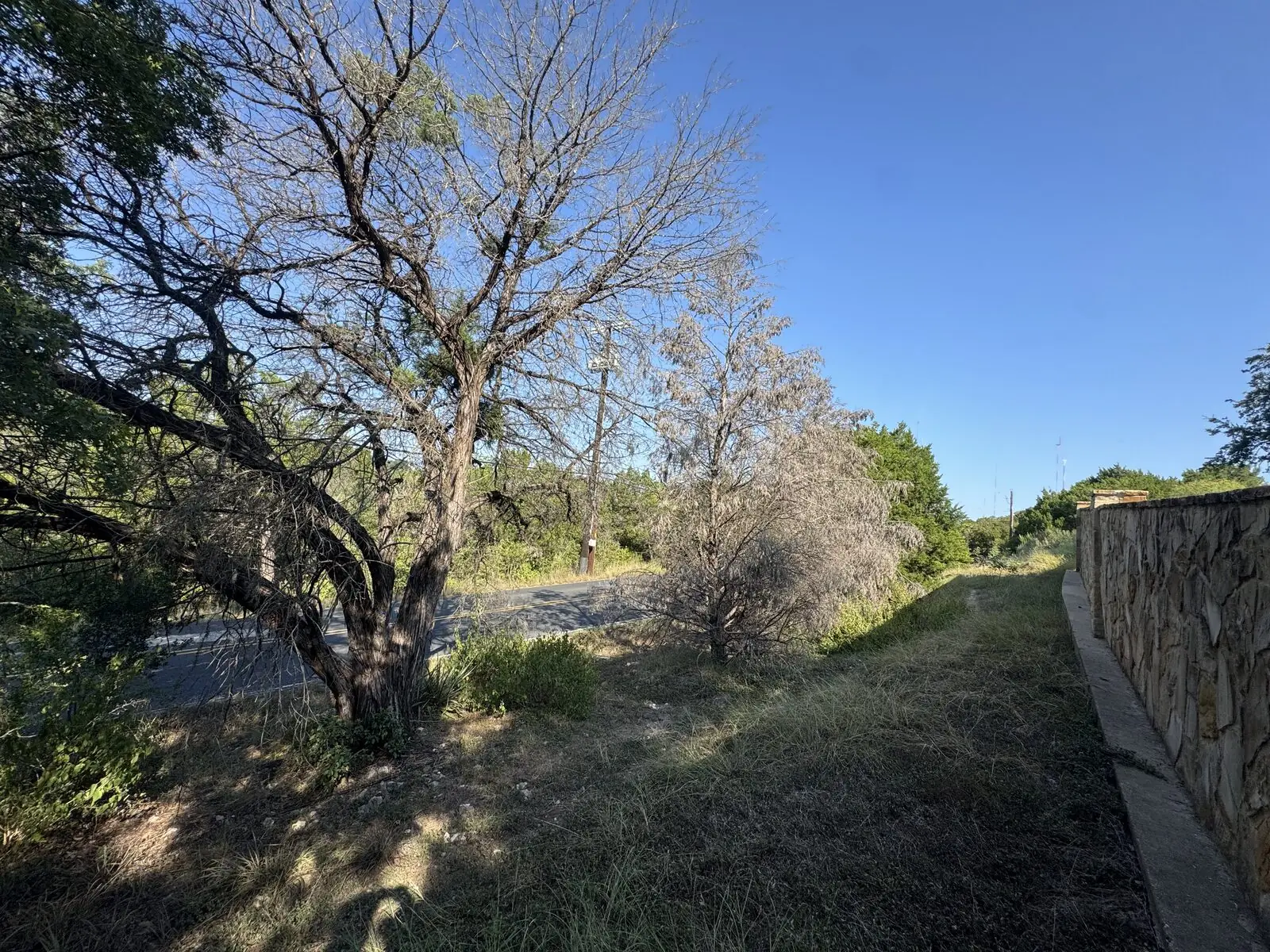
Westlake. Several large cedars along the front of the property had been lost over a run of bad weather, and the privacy screen along a busy road went with them. What the client wanted back was the screen, not the same trees.

More

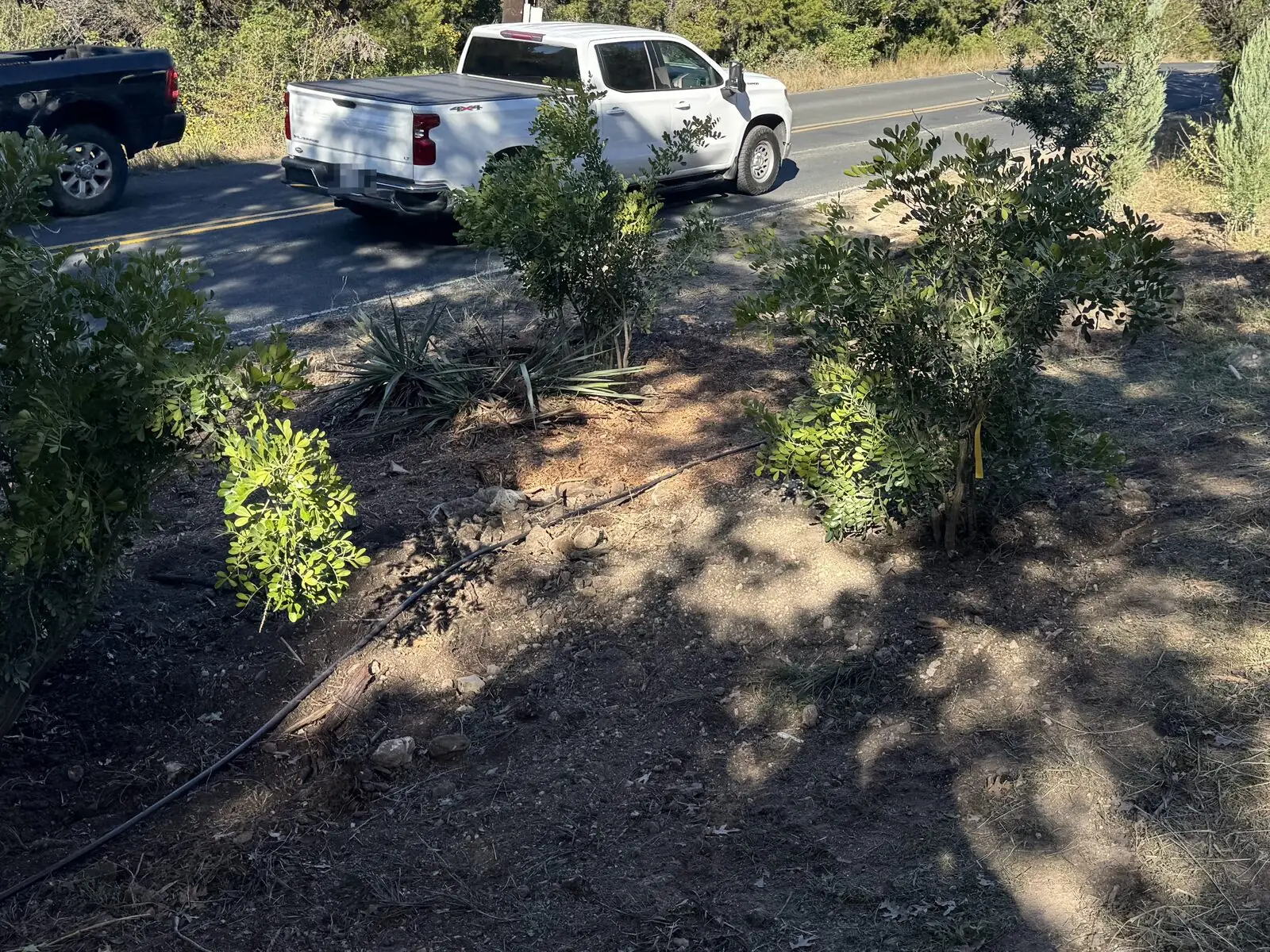
That made this a species and siting decision before it was a tree job. We took out the three failed cedars, ground the stumps, pruned the twelve trees that were staying, and replanted with live oak, Texas mountain laurel, eastern red cedar and yaupon holly, all natives suited to the exposure along that road. The capability half was doing it in one visit: removals, grinding, pruning and thirteen installs in a single day, with a crew of six and enough equipment on site that no part of the job waited on a second trip. We came back the next day to mulch, water the new trees in and finish the cleanup.

Dead cedars along a Westlake roadside, the failed privacy screen that left the property open to the road before replanting
What came out — the dead cedars, and the gap they left along the road.
Young native trees newly planted along a Westlake roadside, each with a drip irrigation line run to it
What went back in — natives sited for the exposure, each on drip.

A Tree Kept Through a Build, and Eleven Years of It

Travis Heights, a commercial site. The tree was staying, which is easy to write into a plan and harder to still be true about when the frame is up and everyone on site needs somewhere to put things.

More

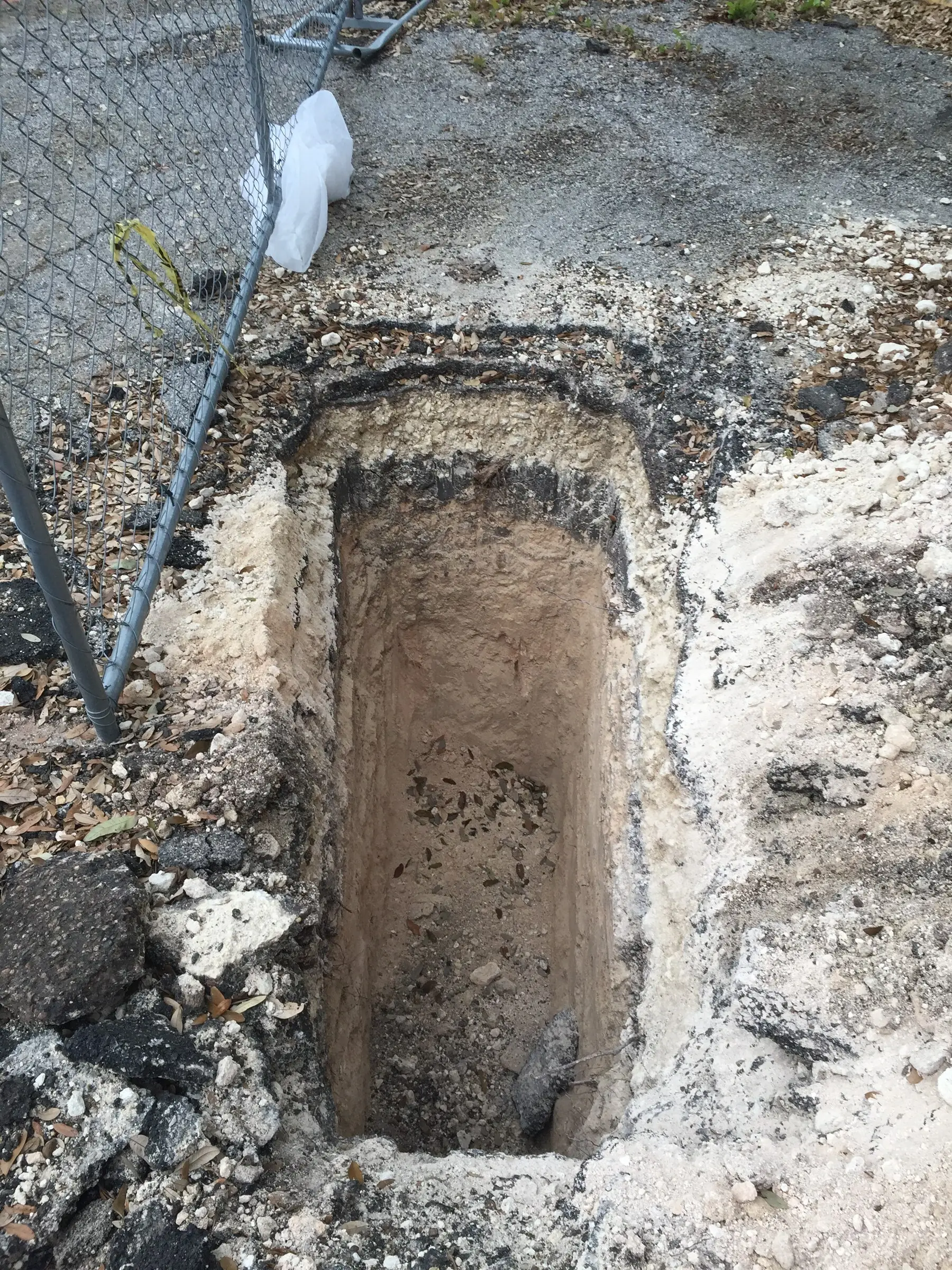
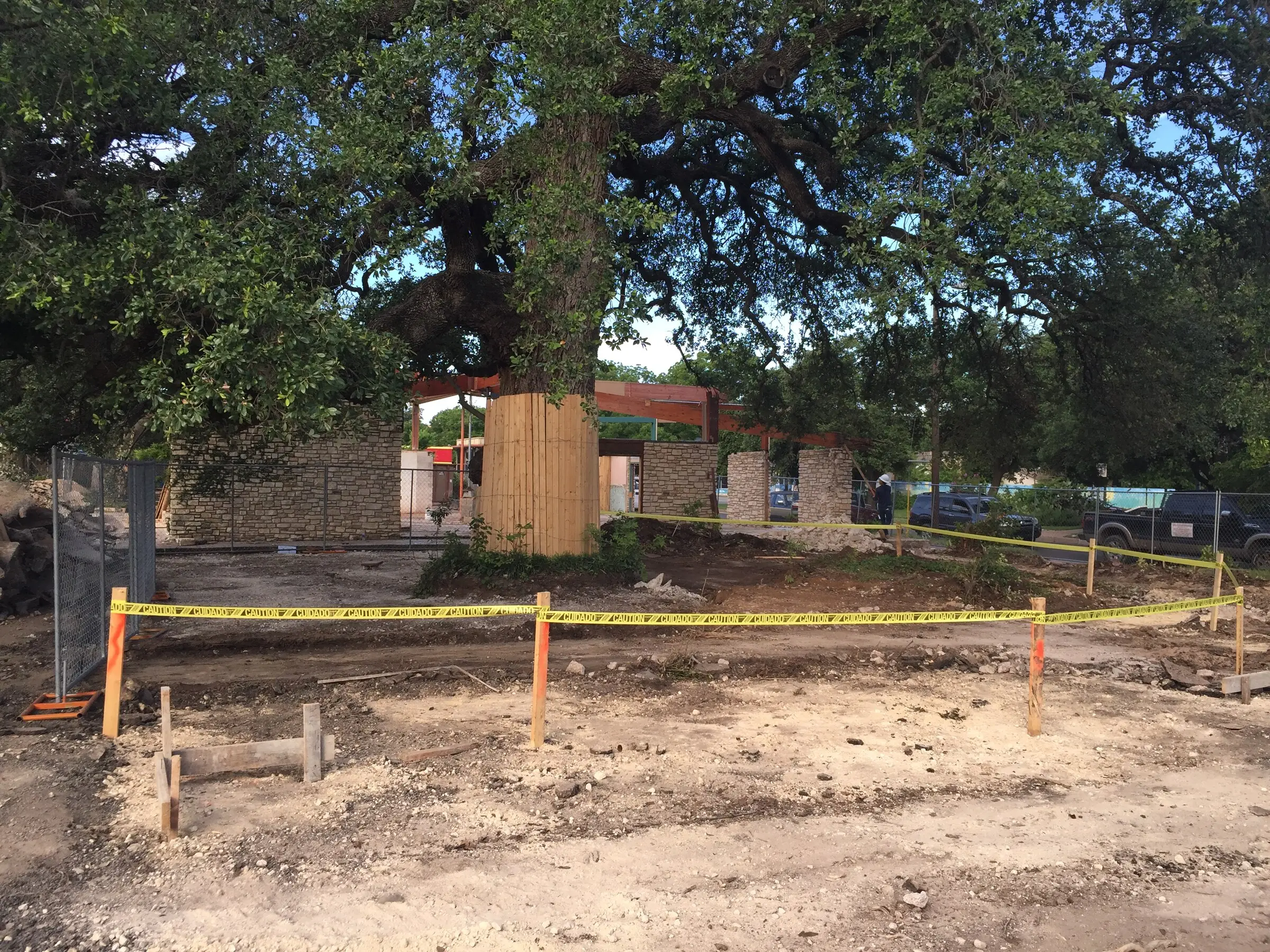
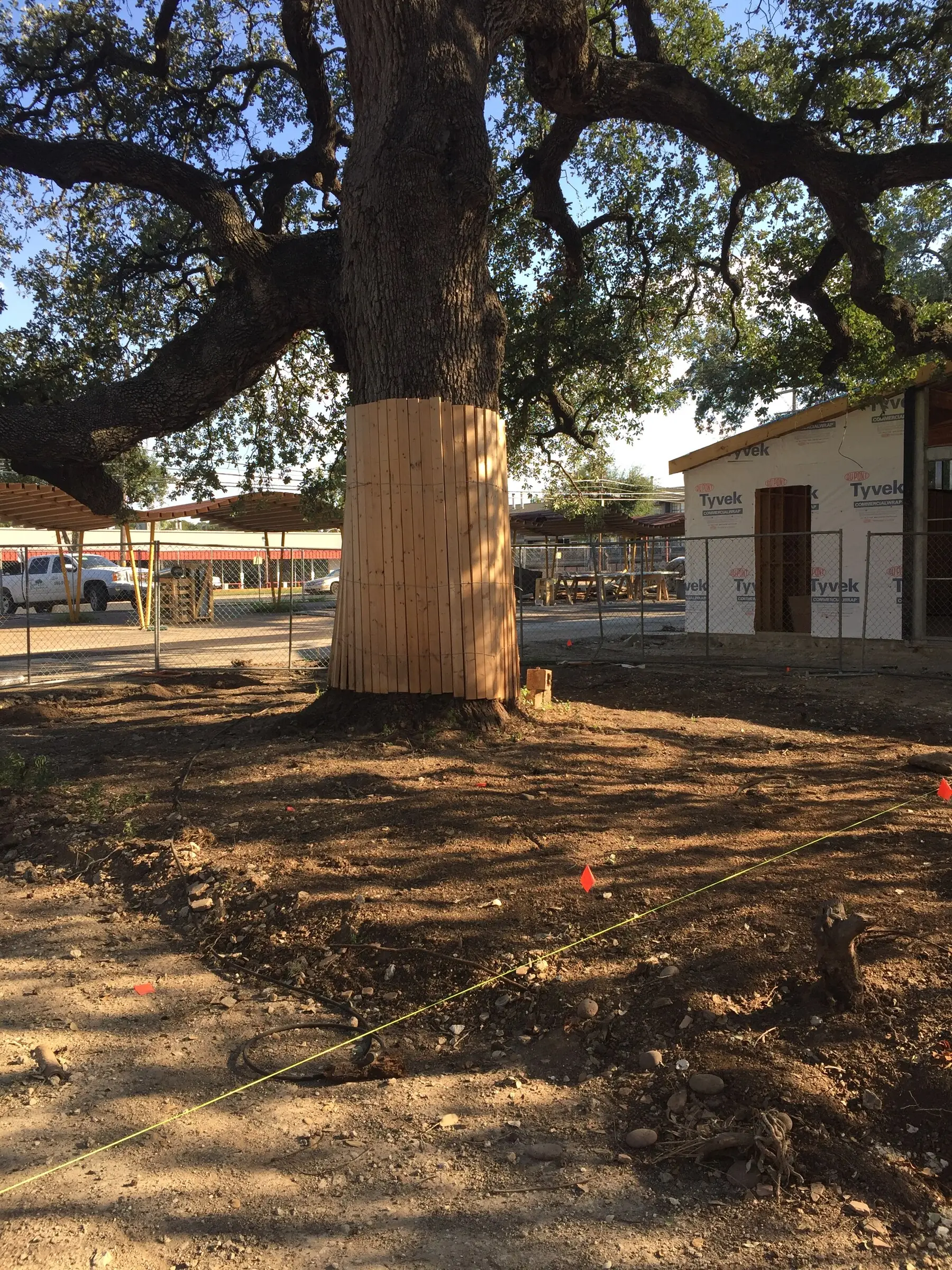
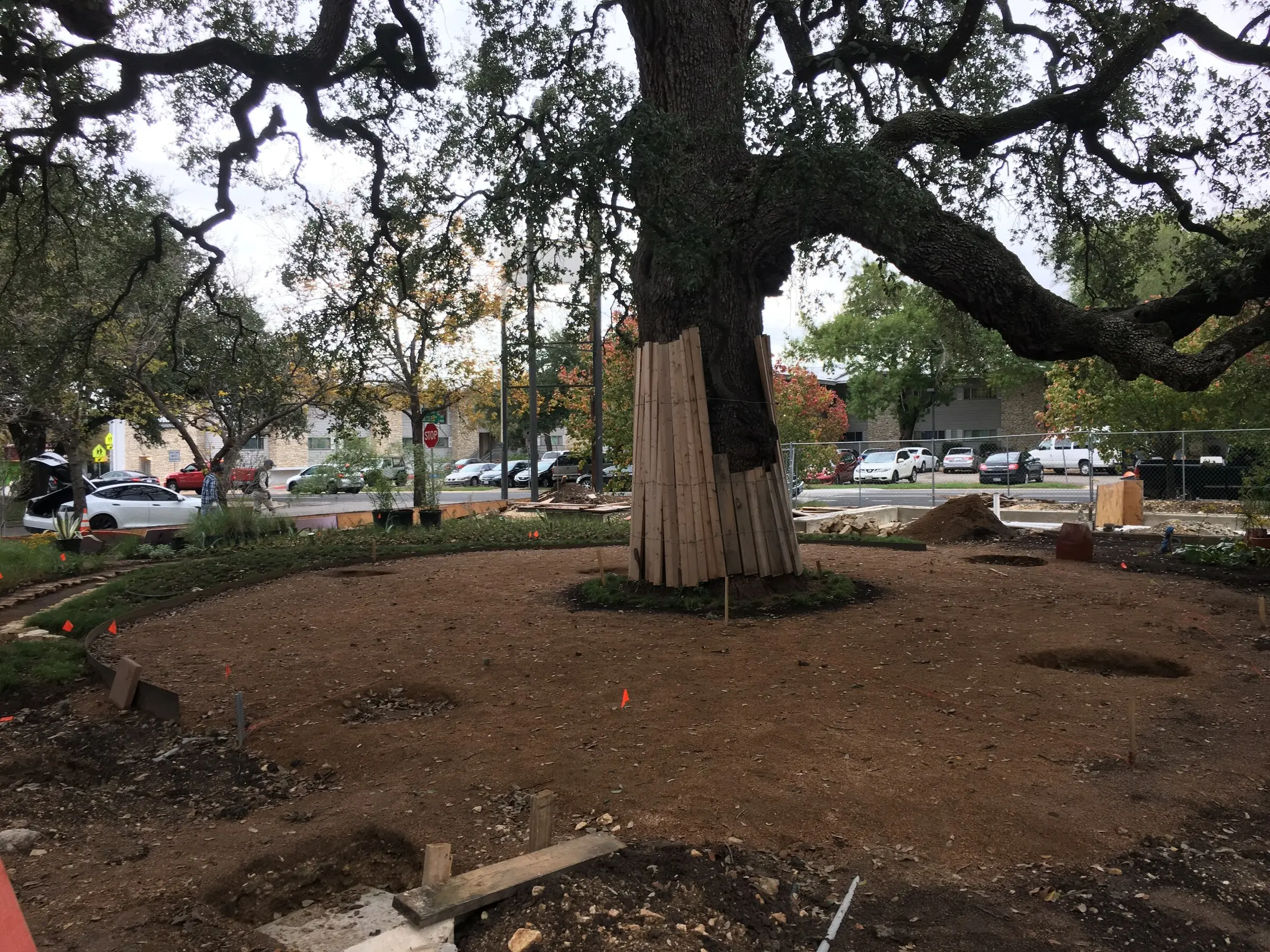
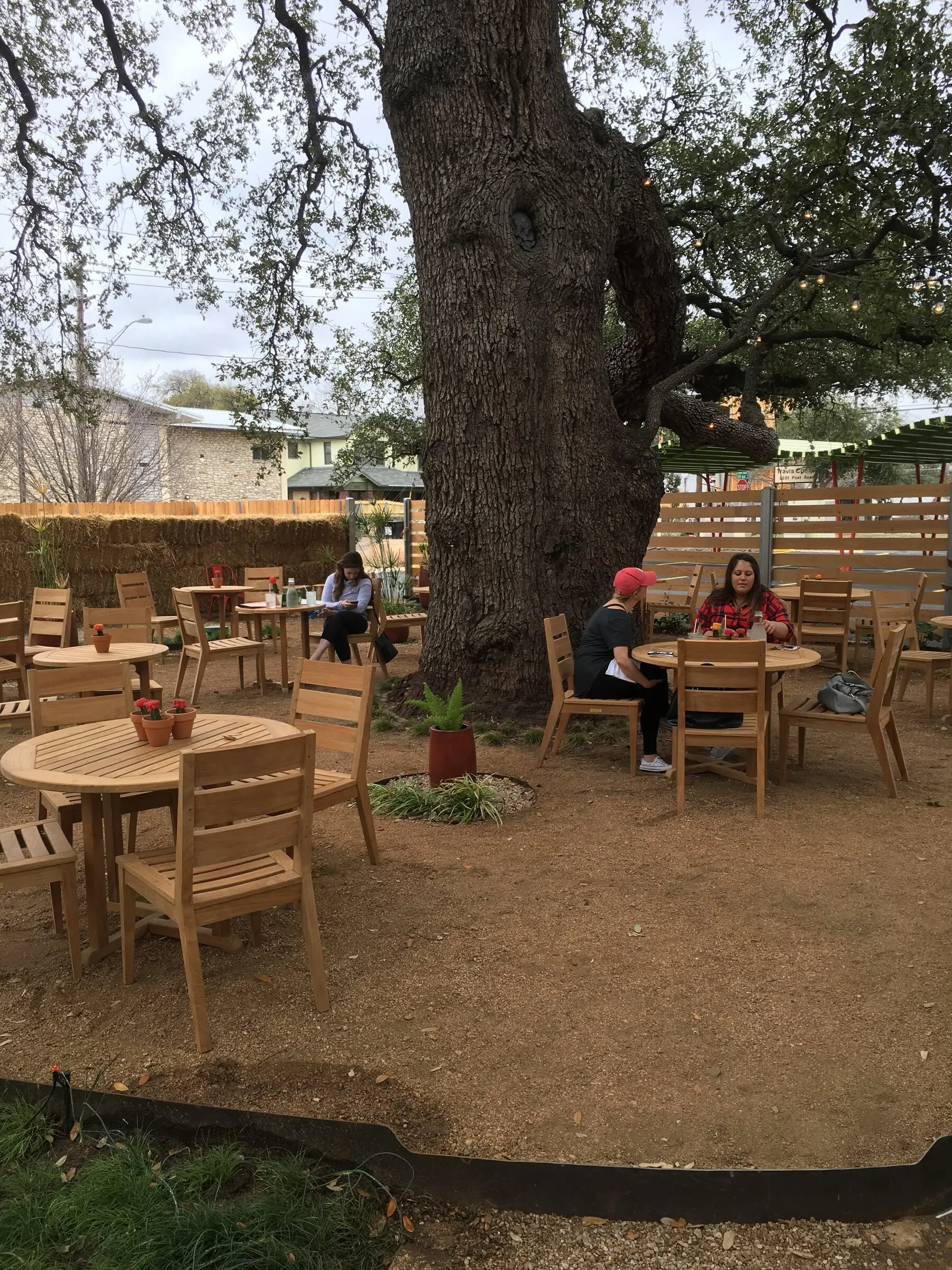
The work started before the design was fixed, with a trench cut through the limestone to find out what the roots actually had to work with. Through the build the trunk was boarded, the root zone stayed under mulch, and the new surfacing was stopped short of the tree instead of run up to it. The patio opened underneath it in February 2016.

What makes this one worth showing is not the protection. It is that we kept photographing it. The last two frames are from July 2026.

Keith on this one: “It was the rare occasion where a customer put their money where there mouth is. We did real tree protection, real soil restoration and maintained aftercare.” They are still a client. The full sequence is on construction tree protection.

A narrow exploratory trench cut down through limestone beside a chain-link protection fence, the bare rock face exposed along its wall
March 2015The trench through the limestone, before anything was designed around it.
A mature trunk wrapped in vertical timber boards and ringed by barrier tape while building work goes on behind it
June 2015Trunk boarded, working area held off it.
The boarded trunk of a large tree standing in a wide mulched root zone, a building wrapped in housewrap under construction behind
September 2015Mulch across the root zone for the length of the build.
A boarded trunk standing in a wide circle of mulch, the surrounding ground graded and the surfacing stopping short of it
November 2015The surfacing stops short of the tree.
Tables and chairs set out on a gravel patio directly beneath a spreading canopy, diners at the nearest table
February 2016Open, with the tree over it.
A wide low canopy spreading over a car park and street under a clear summer sky
August 2020
The full crown of a large tree seen from the street, its lower limbs sweeping almost to the ground
July 2026Eleven years after the first photograph.

Arborist Credentials and Service Standards

Austin Tree Experts was founded in 2003 by Keith Brown, who has been in the trade since 1993, an ISA Certified Arborist since 1997, and an ISA Board Certified Master Arborist, license TX-0985B, since 2005. Board Certified Master Arborist is the top tier of the International Society of Arboriculture’s credential ladder, and the license number is there so you can verify it. ISA Certified Arborists scope the work, tree risk assessments follow ISA’s Tree Risk Assessment Qualification method, and treatments are applied under a Texas Department of Agriculture licensed applicator.

More

Two industry standards sit behind the work, and they are worth naming because they are what make a tree service description checkable rather than a matter of taste. ANSI A300 is the performance standard for tree care. It supplies the vocabulary a work plan is written in, so a written scope means the same thing to our arborist, to the crew executing it, to you, and to a plan reviewer reading it two years later. ANSI Z133 is the safety standard for arboricultural operations and governs how the crew works: work and drop zones, aerial rescue capability, and traffic control on a roadside job.

We carry general liability insurance and workers’ compensation. Ask us for the ACORD certificate, then call the carrier listed on it and confirm the policy is current and covers tree work specifically. That is the standard we tell people to apply to everyone bidding on their trees, and it applies to us.

Service Area

We serve Austin and the surrounding Central Texas communities. What changes most from one address to the next is not the drive, it is the rules: Central Texas has more than thirty municipal jurisdictions and they do not agree with each other about which trees are protected, what needs a permit, or when an oak may be pruned. Our Jurisdiction Finder will tell you which one governs your property, and the Austin tree ordinance page covers the City of Austin in detail.

If you are near the edge of that area, ask. We regularly take on work beyond where we normally run, and the answer depends on the job rather than on a line on a map.

Austin Tree Experts service areaA simplified map of Central Texas showing 10 county outlines with Interstate 35 running north to south through them. Grey shapes are incorporated cities and towns, most of them clustered around Austin. Five places are labelled for reference: Austin at the centre, Georgetown to the north, Bastrop to the east, San Marcos to the south and Fredericksburg to the west. Two green zones sit over the map: a core service area around Austin and a wider surrounding area we also cover. All boundaries are approximate.
Roughly where we work. The edge is approximate — if you are near it, just ask.

Feedback on Our Service

Danny
July 2026
5.0of 5

This is the 2nd or 3rd time I’ve used Austin Tree Experts. I continue to use them based on the reasonable pricing and respect of your property. They came out and talked with me about the best strategy to deal with my situation each time I’ve used them. They have no other agenda other than making sure you are satisfied with their work. Every time I’ve used them they leave my property completely clean with no trace of branches, etc.

Sue
June 2026
5.0of 5

I appreciate that the arborists at Austin Tree Experts are extremely cautious, and not constantly pressuring me to trim our trees. They are extremely careful not to cut too much, which might endanger the health of the trees. This care speaks very highly of their knowledge and professionalism.

Cheryl
June 2026
5.0of 5

Everyone was so nice and the job was well done. I had 2 very large oak to cut down. They were professional and helpful during the entire job.

Read more customer reviews

See all reviews on Google

4.3 of 5 from 29 Google reviews

Arborist & Tree Service FAQs

Show 6 questionsHide questions
Do I need an arborist, or just a tree service?

For most jobs it is the same call. The question is whether whoever bids the work can read the tree and write the right scope, not what the company calls itself. Where it genuinely matters is the ambiguous tree: one that is declining, damaged, or standing near something expensive, where somebody has to decide whether it has a future before anyone decides what to cut. We are both. An ISA Certified Arborist scopes the job and our own crews perform it.

What does ISA Board Certified Master Arborist mean?

It is the top tier of the International Society of Arboriculture’s credential ladder, above a standard ISA Certified Arborist, and it has to be earned by examination and kept current. Keith Brown, who owns Austin Tree Experts, has held it since 2005 under license TX-0985B and has been an ISA Certified Arborist since 1997. You can verify any ISA credential yourself through the ISA’s public certificate directory.

Which parts of the Austin area do you serve?

Austin and the surrounding Central Texas communities. What changes from one address to the next here is usually not the drive time, it is the tree ordinance: Central Texas has more than thirty municipal jurisdictions and they do not agree with each other on what is protected or what needs a permit. Look your address up in the Jurisdiction Finder to see which one governs your property, and ask us if you are near a boundary.

Are you insured?

We carry general liability insurance and workers’ compensation. We would rather you checked than took our word for it. Ask any company bidding on your trees for the ACORD certificate of insurance, then call the carrier listed on it and confirm the policy is current and covers tree work specifically. That is the standard we tell homeowners to apply to everyone, and it applies to us.

Do you work for commercial properties, HOAs and municipalities?

Yes, and it is a large part of the business. Property managers, apartment and multifamily communities, HOAs, retail centers, schools, municipalities, developers, engineers, architects and general contractors. On a commercial site we write one work plan across the whole property and schedule around your operating hours, your parking and your tenants. See facility maintenance pruning and construction site services.

Can you handle the tree permit?

Yes, for the arborist side of it. What a permit needs, and whether you need one at all, is set jurisdiction by jurisdiction, and Central Texas has more than thirty of them. Look your address up in the Jurisdiction Finder to see which one governs your property, and the Austin tree ordinance page covers the City of Austin in detail. What the documentation involves, and where the limits of it are, is on the arborist consulting page.