
Oak Wilt Treatment in Austin

Oak wilt treatment in Austin starts with ruling it out. Where the disease takes hold in a stand of root-grafted live oaks it can be catastrophic — and it is also the diagnosis this market reaches for first. Keith’s read, after working Central Texas since 1993:

Nine out of ten times that I get called to an oak wilt site, there’s some other problem going on and it’s just been misdiagnosed.

So the job does not start with a treatment. It starts with a visit to work out whether the diagnosis could even possibly be correct — and if it is, which trees get injections now, which ones wait, and which ones we would leave alone.

Nine out of ten oak wilt calls are not oak wilt

The internet has done real damage here.

The internet will make you think oak wilt is ultimately what all oak trees die from. The reality is it isn’t nearly as prevalent as the internet makes you think — and diagnosing it is very difficult.

When a live oak is declining and it turns out not to be oak wilt, it is usually one of four things, and all of them are site-and-care problems rather than diseases:

  • Weed-and-feed damage — herbicide applied over the root zone, year after year.
  • Buried root flares, from fill soil or erosion piled against the base of the trunk.
  • Abrupt changes in irrigation — a system turned off when a house changes hands, or turned way up in a panic.
  • Compounding spring stress. Caterpillars strip a tree one spring, a foliar disease hits the next, and the third year the tree looks like something is killing it. Something is. It is just not oak wilt.

That list matters commercially as well as diagnostically, because every one of those is fixable and oak wilt is not curable. Getting the answer wrong in that direction costs you a tree you could have kept.

How we diagnose it: pattern of spread, watched over time

There is no shortcut here and we are not going to pretend there is one.

Working live oaks here since 1993, Keith has never seen one produce a fungal mat, so on a live oak the fungus rarely shows its face directly. Red oaks are the only species that makes a mat — the one above-ground spread route — and mats are rare in this part of Texas. Since 1993, Keith can think of a couple of times he has actually seen one. White oaks are tolerant: “I have not seen them die from oak wilt.”

We also do not send samples to a lab any more, and that is a deliberate departure from the standard toolkit: too many false positives and too many false negatives, and Keith found the tests mostly unreliable. What he uses instead:

The best diagnostic tool we have for oak wilt is pattern of spread. That’s literally the only mechanism I’m personally willing to use.

Pattern of spread means watching a group of trees change relative to each other, across seasons. Keith wrote this down in 2009 and it has not moved since:

A good arborist, who is capable of diagnosing all tree disorders not just oak wilt, needs to visit the site about 4 times over the course of a year. I can’t tell you how many times I show up to meet with a potential client and they have already been told they have oak wilt by 3 different people who have just seen the site for the first time.

What you can do yourself, and it is genuinely useful: photograph your oaks. Whole canopy, same spot, a few times a year. Memory is a bad instrument for this — “it’s easy to get into a conundrum over what the tree really looked like a year ago when you are trying to go by memory” — and a homeowner with two years of photographs has given an arborist something no single site visit can produce.

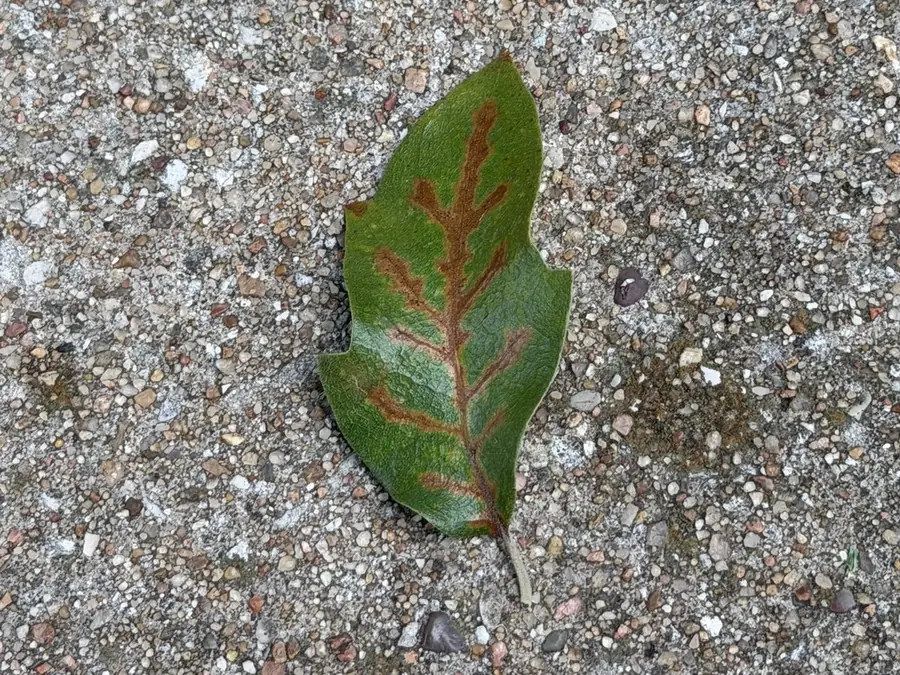
Where it stops being a homeowner job is the reading. Symptoms are not diagnoses. Vein banding is a listed symptom of oak wilt, and it is also produced by chlorosis, herbicide damage, root damage and transplant shock. Sorting that out takes somebody who can diagnose every oak disorder, not just this one, and who knows what the disease has already done in this area. Oak wilt risk is local and site-specific rather than species-wide, and that local knowledge comes from working the ground here — from years of watching how the disease behaves on the sites we work.

What you actually get, start to finish

1. A consultation, which carries a fee. An arborist comes out and works the diagnosis question first.

2. A treatment plan — which trees get injections now, which need to wait, and which we would not treat at all. That plan is a geometry, and it is explained below.

3. Follow-up tree care. Not an oak wilt product — a tree care program, for reasons set out below. A treated tree is a struggling tree, and it needs looking after either way.

Every bid we write ships with two documents rather than a number on a card. The first is a site inspection and work plan from the arborist who walked your property: photos of the trees we plan to treat, usually a marked-up map showing which parts of the property we are working, which need future work and which trees we are not treating. The second is the priced proposal. Both come to you.

The injection, and where it goes

Here is the method in full, because it is the part of the job worth checking us against.

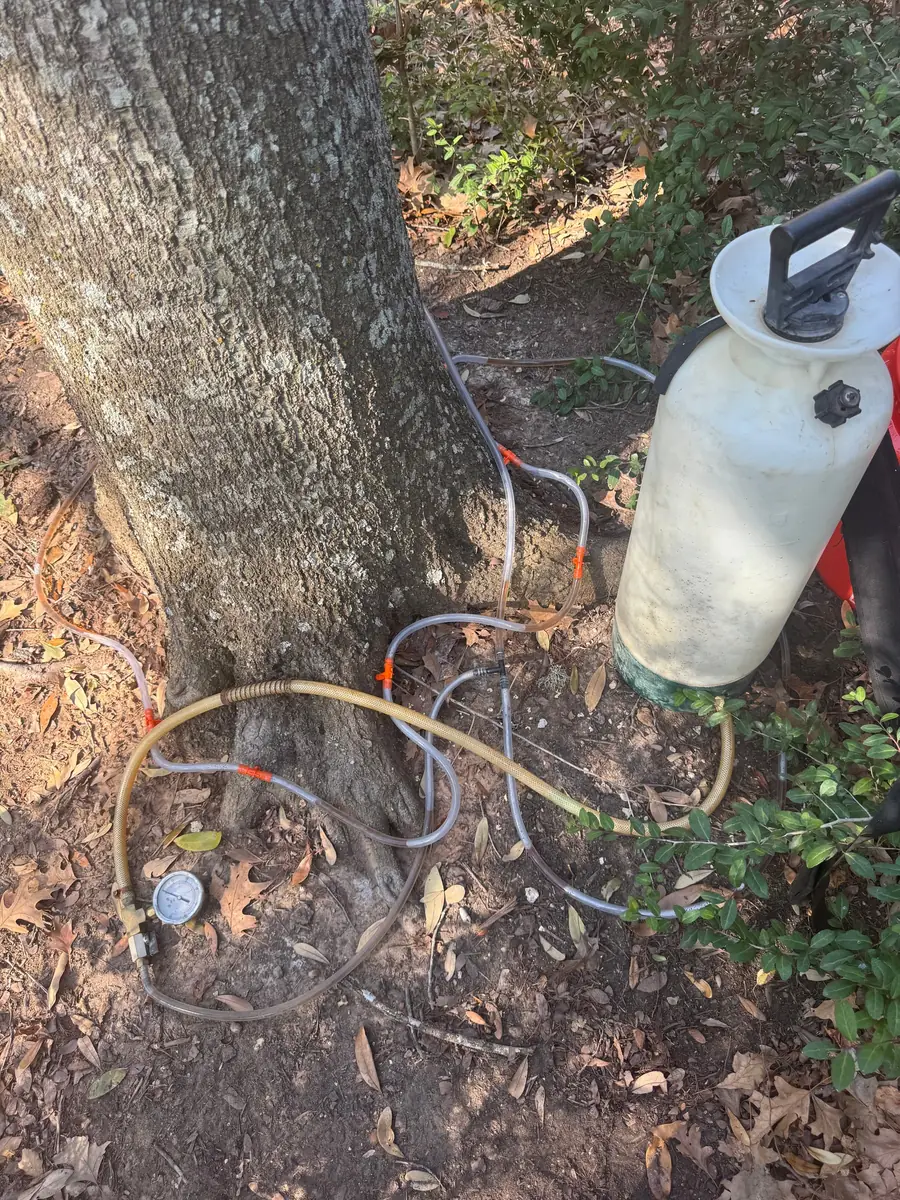
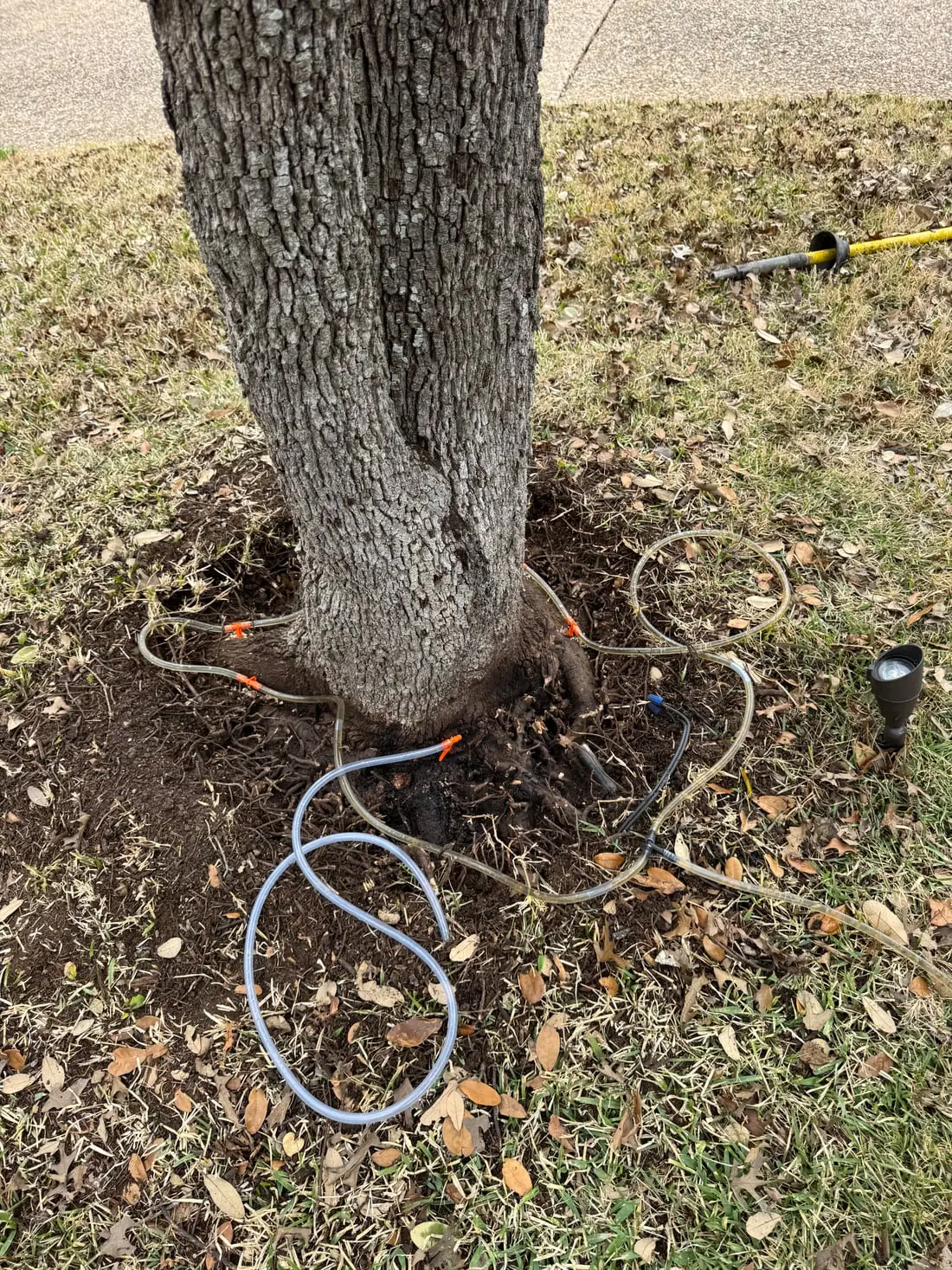
We use macro infusion, the technique embraced by the Texas A&M Forest Service system. The injection has to go into the flare roots at the base of the tree.

The placement is not “treat the oaks near the sick one.” It is a geometry, and Keith’s own description of it is the clearest statement of method on this page:

The disease travels at fifty to seventy five feet per year between trees through interconnected root systems, and treatments need to be reapplied every twelve to eighteen months according to the product label. That means we need to avoid getting out in front of the disease front with treatments. Otherwise the treatment is a waste. Only trees within about a hundred and fifty feet of the last symptomatic tree get injections. We also leave about a seventy five foot buffer between the last symptomatic tree and where treatments may begin, because the disease is moving underground through the connective root systems.

And the reason the buffer exists, which is the honest half:

It’s hard to know exactly where the disease starts and ends, period. Also, some trees that are beginning to become diseased may not be showing symptoms yet, which adds to the confusion on knowing exactly where the disease front is located.

Inside the buffer, it is your call — and not every tree in there is worth treating.

If they are not showing any symptoms of oak wilt, we will give the client the option to treat them. A lot of times, it depends on how valuable the tree is. If it’s a small spindly thing or not significant to the property, we’ll sacrifice it. If it is a large and special tree, it usually gets treated. But it’s a judgment call in large part up to the client.

What injection can and cannot do

We sell this service and we grade it honestly, because a customer who expects salvation from it has been set up to be disappointed.

  • Timing beats everything. Once a tree is showing symptoms there is almost no opportunity for the fungicide to work — you have to be ahead of the game. That is why the plan sorts trees into now, later, and not at all.
  • It is not one-and-done. Every 12 to 18 months, per the product label, for as long as you want to keep protecting the tree.
  • The treatment itself is a wound. Each cycle means drilling into the buttress roots, and Keith is blunt about where that goes: “even if oak wilt doesn’t kill the tree, the constant hole-drilling after ten years is going to kill it by itself.”

Keith’s summary is the one we would rather you heard from us than found out later: “I’ve had some success with them. I’ve had more failures than success.” We will do them, they can be a good short-term play, and sometimes the tree persists. That is the truthful version of the offer.

The side benefit that comes with it

Because the injection has to reach the flare roots, and because in most urban and suburban landscapes those flares are at least partly covered, the job starts by opening them back up — a root flare excavation, done with an air spade so soil moves without cutting roots.

That is not a padding item. Buried root flares are on the short list of things a declining live oak turns out to have when it does not have oak wilt. In Keith’s words, the root flare excavation “is legitimately a secondary benefit to the trees” — the treatment incidentally fixes a different problem on the same tree. It gets its own line item on the proposal, because the amount of work is completely different on a marginally buried flare than on one under years of fill.

Trenching: our honest read, and we will still do it

The Texas A&M Forest Service publishes trenching as the primary tool for stopping underground spread, at a minimum depth of four feet and deeper in deeper soils. That is the standard, and we work in a market where a lot of trenches get cut.

Keith’s read from the field is that in this geology it is unreliable. Tree roots, he says, grow where the cracks in the rocks are, and those cracks run deep:

I’ve personally witnessed eight-inch-diameter tree roots twelve feet below the surface.

On the industry’s term for a trench that did not hold:

There’s a concept of “jumping the trench.” The reality is these trees don’t jump — neither does oak wilt. A two-or-three-foot-deep trench is just not sufficient to reliably break root connections.

There is a second problem, and Keith wrote it down years ago: because symptoms lag infection, the trench has to be cut 100 to 150 feet past the last tree showing symptoms — “unfortunately, doing this means some healthy looking trees will be inside the trench and destined to become infected.”

And here is where we land, because criticizing a service and refusing to sell it are different things:

Yes, we’ll do it. Like any service, I’ll talk through the pros and cons with the client. But if trenching is on their agenda of things that they are going to do, we will absolutely provide them a quote and provide the service.

Neighbors, and the fence line

A hundred-and-fifty-foot radius does not stop at a fence line, so the question comes up. The honest answer is a limit, not a promise:

That depends on the neighbors. It’s ideal to coordinate neighbors, but that’s outside of my control as a service provider. Those situations are discussed as we cross those bridges.

We are not going to tell you we can organize your street. We will tell you what we would do if it were our trees.

Aftercare is a tree care program, not an oak wilt program

Asked what a customer actually gets, Keith went past the injection without being prompted — the follow-up care is, in his words, one of the most important parts of oak wilt work beyond the diagnosis:

Applying the treatment is giving something to a tree that we know is struggling and having a difficult time. The idea that we gave it an injection and all of a sudden it’s gonna go back to being perfectly happy with no problems is a farce. That tree is going to need looking after.

There is no oak-wilt-specific aftercare product here, and we are not going to invent one — “oak wilt aftercare is not special or different.” What a treated tree needs, in his order:

  1. Get the irrigation right, and stop swinging it. Abrupt change is worse than either extreme.
  2. No herbicide applications around the tree. None. It is the same weed-and-feed problem that opens the misdiagnosis list above.
  3. Start a fertilization and composting regimen — a tree care program, with the compost going where the roots are.

If you have oak wilt, this needs to be more than an oak wilt program. It needs to be a tree care program.

Notice that the aftercare list and the misdiagnosis list are the same list. That is not a coincidence — it is the argument of this page, run twice.

When a tree does not make it, removal and replanting are the next conversation. Inside a neighborhood with active oak wilt concerns, Keith will steer a replanting toward a Monterrey oak or a chinquapin oak, which fill that gap and still read as oaks. Outside one, he does not let oak wilt drive species selection at all — “it’s one I believe is overblown.”

The pruning window, and the paint

The Texas A&M Forest Service asks that oaks not be pruned or wounded from February through June, when the beetles that move the fungus are most active. We honor that window by default, and in neighborhoods with a history of oak wilt we hold the line firmly — largely so that nobody drives down the street pointing fingers at our client. Those customers get asked to wait until July.

Pruning inside the window is still legitimate when there is a real reason: a genuine safety hazard, limbs rubbing the roof, limbs hanging so low the garbage truck smacks them and opens a fresh wound every week it comes by. If the tree is being wounded weekly anyway, a single careful February cut is not the unique risk the internet makes of it. That is a judgment call, and it is one to make with an arborist rather than from a blog post. More on how we approach it: tree pruning.

On wound paint, we will give you both halves, because the honest version is more useful than the tidy one. We paint wounds on oak-wilt-susceptible trees. We also think the practice is wrong:

Alex Shigo — the godfather of tree research — had tremendous long-term studies showing wound dressings are bad. Not sometimes: every time. I don’t like painting wounds, but we do it because there’s currently a public rule that says we should. And maybe I’m wrong.

Cleaning tools between trees, by contrast, is not theater. That one is real hygiene and we do it because it works.

How we bid oak wilt work

Worth knowing before you compare quotes, because we are the odd one out here:

Industry standard for oak wilt treatments is to provide a flat rate on a per diameter inch of tree size cost. We don’t do that. I reject it. Every job is different, and my labor associated with those jobs varies. I’m going to figure out materials cost, figure out labor cost, and bid it like I would any other project.

So the proposal is itemized. Root flare excavations get their own line, because the work is small on a marginally buried flare and large where there is a lot of fill or erosion. Tree care plans get their own line too. You can see what each piece is.

Get an oak wilt assessment

The oak wilt assessment carries a fee, and it goes toward the work if you hire us for anything.

An arborist walks the site, looks at the group of trees rather than the one you called about, and tells you what he thinks is actually happening — including when the honest answer is “watch it, and let’s look again in a few months.” Where the answer genuinely is not readable from the ground yet, an arborist consultation is the right next step. Measure twice, cut once.

Call (512) 996-9100 or request an estimate online — an estimate for tree work is free; it is the diagnostic visit, the one that works out whether you have oak wilt at all, that carries a fee. If you have photographs of the trees from previous years, have them ready — they are worth more than anything you can tell us from memory.

We treat and care for trees across Austin and the surrounding Central Texas metro — Westlake, Rollingwood, Bee Cave, Lakeway, Round Rock, Cedar Park, Pflugerville, Georgetown, Dripping Springs, Buda and Kyle. See the areas we serve.

Related: Tree Care · Air Spade Services · Tree Pruning · Tree Planting · Arborist Consulting · Tree Removal

Common questions

How do I know if my oak has oak wilt?

Not from a single visit, and not from a single photograph. Keith has never seen a live oak produce a fungal mat, so on a live oak there is nothing to see directly, and the leaf symptoms people go looking for — vein banding, a thinning canopy, out-of-season leaf drop — are also produced by chlorosis, herbicide damage, root damage and transplant shock. What separates oak wilt from all of those is the pattern of spread through a group of trees, watched over a period of time. Not a week, and not a month.

Can oak wilt be cured?

No. It can sometimes be managed, and injection sold as salvation is the thing to be careful of. What an injection can do is suppress the fungus in a tree that is still ahead of the infection, and it has to be redone every 12 to 18 months according to the product label. Keith has had successes with them and more failures than successes, and we say so before we quote one.

How does oak wilt spread?

In Central Texas, mostly underground. Live oaks graft roots with their neighbors and the fungus moves through those connections at 50 to 75 feet a year — an average rather than a schedule, and USDA and Texas A&M Forest Service guidance records centers that spread nowhere in a year alongside centers that run considerably further in one direction. There is a second, above-ground route that the same guidance describes — sap beetles carrying spores from a fungal mat on a red oak to a fresh wound on another oak — but mats are rare here. Since 1993, working this market, Keith can think of a couple of times he has seen one.

When should I avoid pruning my oaks?

The Texas A&M Forest Service asks that oaks not be pruned or wounded from February through June, when the beetles that carry the fungus are most active. We honor that window by default. If there is a genuine reason to prune inside it — a real safety hazard, limbs on the roof, limbs the garbage truck is wounding every week anyway — pruning in February is a legitimate call, and we will make it with you rather than for you.

Does trenching stop oak wilt?

The Texas A&M Forest Service publishes it as the primary suppression tool, at a minimum depth of four feet. Keith's read from the field is that in this geology it is unreliable, because roots follow the cracks in the rocks far deeper than a trench goes — he has seen eight-inch-diameter roots twelve feet down. We will still cut a trench and quote it honestly if trenching is on your plan; we will just tell you what we think first.

What does oak wilt treatment cost?

It depends on how buried the root flares are, because that work is different on every job. The industry standard is a flat rate per diameter inch of tree, and we reject that outright — every job is different and so is the labor in it. We figure materials, figure labor, and bid it like any other project, itemized so you can see what each piece is. The assessment that produces that number carries a fee, and it goes toward the work if you hire us for anything.

4.3of 5 from 29 Google reviews
Aak
April 2026
5.0of 5

Keith and the crew were wonderful - very knowledgeable and efficient. They offered competitive pricing, flexible scheduling, and are genuinely good people. Highly recommend!

Response from the owner: Thank you so much for the business and kind words! I’m planning to stop by in the next couple weeks so I can put an eye on the pecan in the back when the leaves come. Not worried about it, just want yo know. Thanks again.

Kristi
April 2026
5.0of 5

I've been utilizing Austin Tree Experts for 18+ years. I have 20+ oak trees and other misc. trees on my property - they've been trimming and fertilizing them and helping me during storms to clear debris and I would highly recommend them.

Response from the owner: Thank you for the patronage all these years!

Read more customer reviews

Call (512) 996-9100