

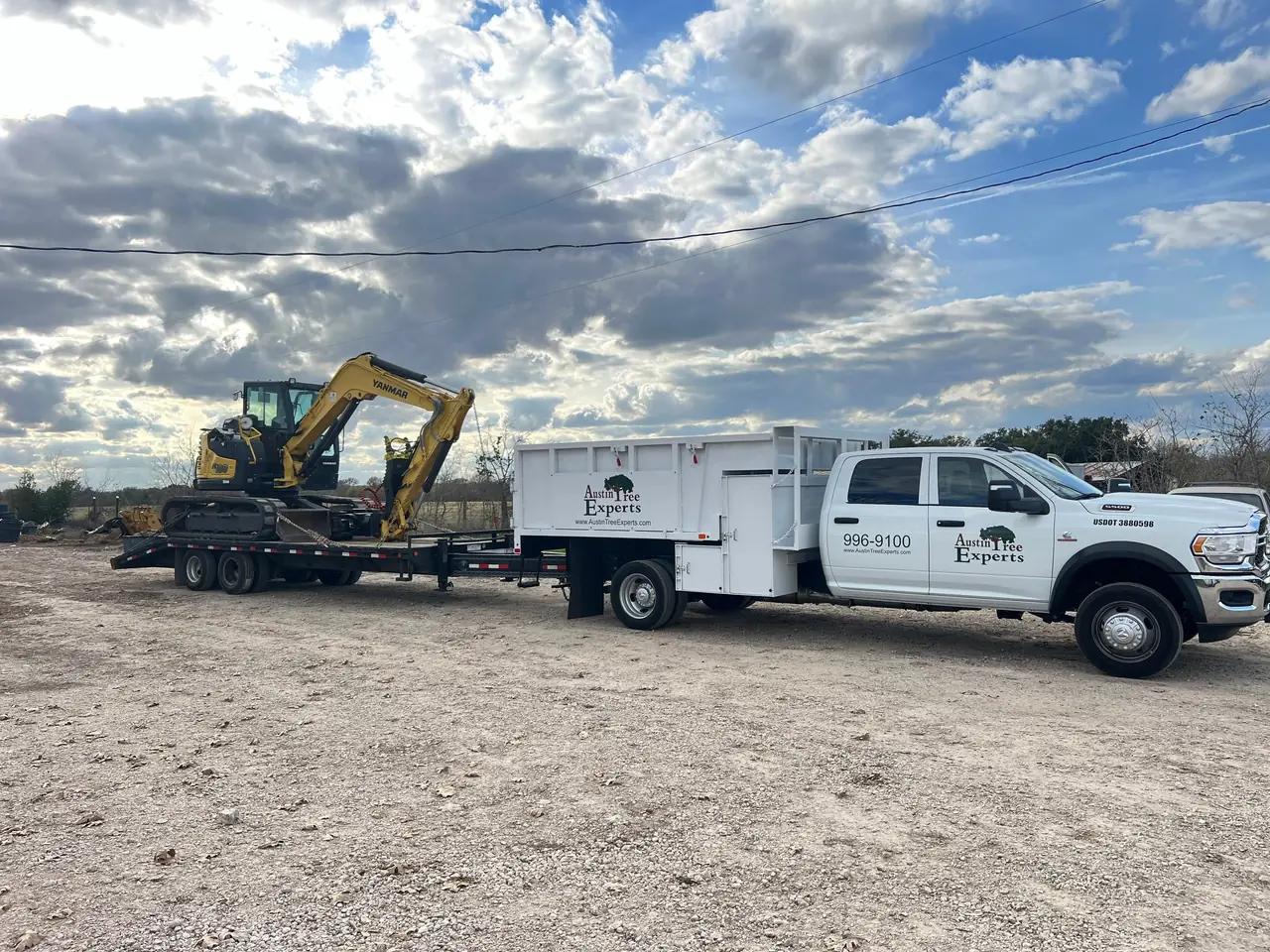
A shaded fuel break is a strip of land where the wildfire fuel is reduced and the shade trees are kept. We build and maintain fuel breaks across Austin and the Central Texas Hill Country for homeowners with acreage, HOAs, municipalities and commercial property managers, and we do the wider land clearing that usually comes with the work. In general it is three jobs: the dead woody material comes out, the standing vegetation is opened up by forest stand thinning, and the ladder fuels are removed.
The difference between a fuel break and a clearing job is the decision about what stays. That decision is made by an arborist, on the property, before a saw runs.
Shaded Fuel Breaks: What One Is
A firebreak takes a strip of ground down to bare dirt. A shaded fuel break does not. The overstory stays, which is where the word shaded comes from, and what comes out is everything under it that connects a ground fire to a canopy: dead limbs and downed wood, the dense understory, and the low branches on the trees that are staying.
The Texas A&M Forest Service publishes fuel break recommendations, and they are what we write a spec against: crowns separated by roughly 25 to 30 feet, low limbs raised about 10 feet off the ground, ladder fuels removed underneath. Those are their published figures for a general case rather than a work plan for your ground. What actually gets marked comes out of walking the property, and it is the part of this job worth paying an arborist for.
The trees that stay are pruned to ANSI A300, the performance standard for pruning, and the whole operation runs to ANSI Z133, the safety standard for tree care work. The spec is written by an ISA Certified Arborist. On a fuel break that matters more than it sounds, because most of the value in the job is in which stems get marked and which get left, and a crew clearing without that judgment will take the oaks you were trying to keep.
The Three Clearing Techniques on a Fuel Break
In general, the work on a fuel break is one of three things.
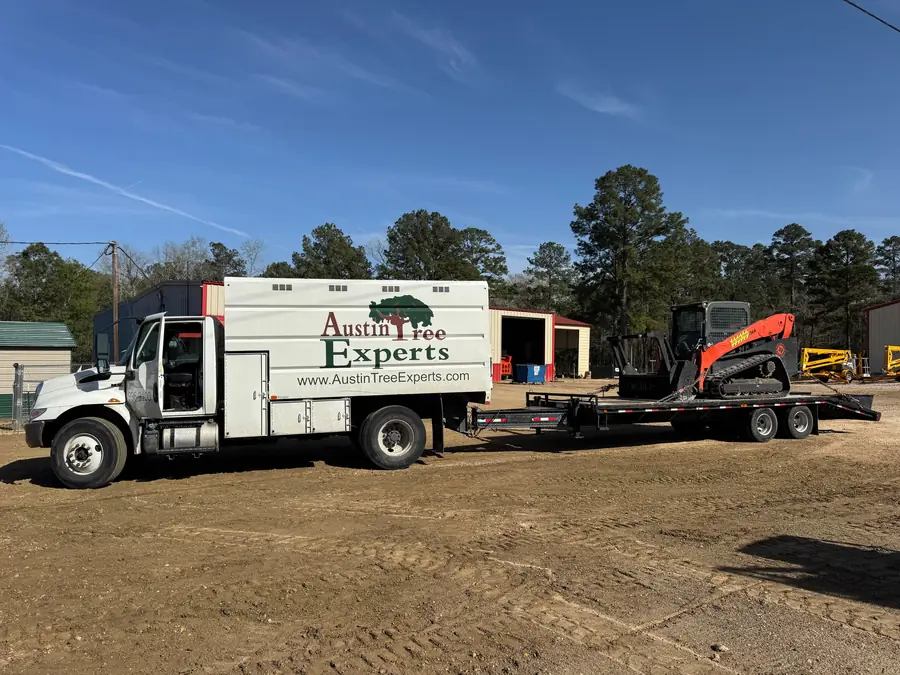
Removing the dead woody material. Standing dead stems, downed limbs, brush piles left by previous work, and the accumulated litter under a dense stand. This is volume work, and volume is an equipment question: chipper trucks with 23-yard bodies, a grapple truck for whole logs, wheel loaders and excavators with log grapples to move material without a crew carrying it.
Forest stand thinning. Reducing how densely the stand is growing so the remaining canopies are separated rather than continuous. Which stems come out is a species and condition call, and on most Hill Country properties it is largely cedar coming out from between the oaks that are staying.
Removing the ladder fuels. Raising the low limbs on the trees that stay and clearing the understory beneath them, so there is a gap between what is on the ground and what is in the canopy.
What decides how much of each, and how each one gets executed, is the property: the slope, what the machines can reach, how close the structures and the drive are, what is actually growing, and what you want left standing when we are done. Steep or soft ground moves work off machines and onto hand crews with saws. A stand too thick to walk moves it the other way, onto a forestry mower. Tight access moves it to the mini skid steers, which fit through a 36-inch gate. Most jobs use more than one of those in different parts of the same property.
Wildfire Risk in Central Texas
Wildfire is not a new subject here. The 2011 Bastrop County Complex fire put it on the agenda for every county in Central Texas, and the Texas A&M Forest Service publishes wildfire risk mapping for the state. Risk on a given property is a matter of that published record and of what is growing on the ground, not of our opinion about it.
What we deal with locally is the wildland-urban interface on the west and southwest sides of Austin: houses and neighborhoods sitting inside country that carries continuous fuel. Cedar (Ashe juniper) grows in dense stands there, holds dead material inside the canopy, and grows low enough to bridge the ground and the trees above it, which is why so much of this work is cedar coming out from under oaks.
We do not sell fuel breaks off a risk score. If a property does not carry the fuel to move a fire into the canopy, the honest answer is that the job is smaller than you expected, and we would rather say that than write a bigger scope.
Residential, Municipal and HOA Applications
Residential acreage. Defensible space around the house, the outbuildings and the drive, and clearance along the access road so a fire engine can get in and turn around. On a large property the break is usually placed rather than applied everywhere, and where it goes is the first thing we work out with you.
HOAs and neighborhoods. Greenbelts, common areas, drainage corridors and the perimeter buffer along the edge of the community. This is repeat scheduled work over a large area with residents living in it, so staging, noise, access and where the material goes are part of the scope from the start rather than problems discovered in week two.
Municipal parks and preserves. Work written to a spec, bid and documented, with habitat and ordinance constraints alongside the fuels objective. We produce tree inventories for this kind of project and can supply the tree data in CAD and GIS formats, which is the same documentation work described on our construction site services page.
Commercial and institutional property. Campuses and structures sitting next to undeveloped land.
Where a permit applies, we prepare and file the application. Inside Austin a tree 19 inches in diameter or larger is protected, and mitigation, when it is required, can be met with replacement planting or with a fee in lieu. Outside city limits much of this work needs no permit at all. Our consulting arborists sort out which set of rules the property is under, and the Jurisdiction Finder will tell you the same thing for your address.
Forestry Mulching and Land Clearing
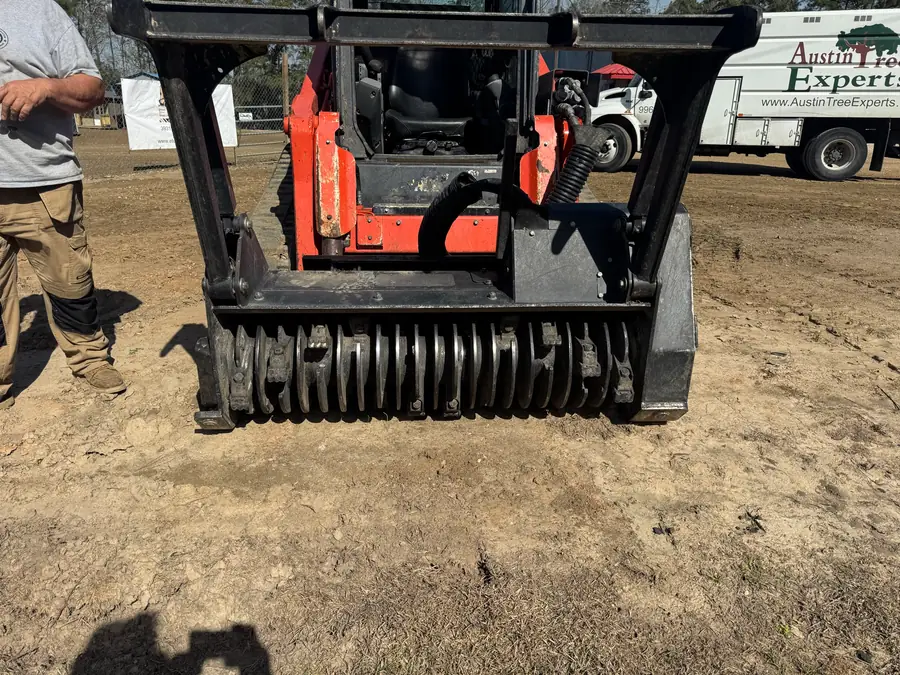
We sell vegetation clearing, and forestry mulching is one of the techniques we use to do it. It varies job to job. We also brush mow, and we hand clear. A forestry mower grinds standing brush and small stems where they stand and leaves the material on the ground as a mulch layer, so nothing gets stacked, hauled or burned. On the right site that is the fastest way through an acre. On the wrong one it leaves more material on the ground than the site can take, and cutting and hauling is the better answer.
Hand clearing is a different operation from forestry mulching, not a slower version of it. The section is cut by hand instead of ground down where it stands, and the brush that comes down is cleaned up and moved out with a grapple. Creek banks and drainage corridors are ordinary ground for it. We hand clear along them as a normal part of fuel break and land clearing work, not as an exception to it.
The other ways through the same acre: cut and chip with the chips blown into a chipper body and hauled off, cut and grapple with whole logs loaded onto the grapple truck, or cut and pile where someone else is handling the material. What decides which technique a site gets is how much disturbance the ground can tolerate, what the access is, and how big the vegetation is.
Material that leaves the property comes back to our yard and gets ground down. That is where our bulk mulch and compost comes from, so on a job that produces a lot of wood the clearing and the mulch are the same operation seen from two ends.
Land clearing and fuel break work overlap and often get bought together, along with tree removal of the hazardous trees found in the process and pruning of the trees that stay. It is normal for one crew and one mobilization to cover all of it.