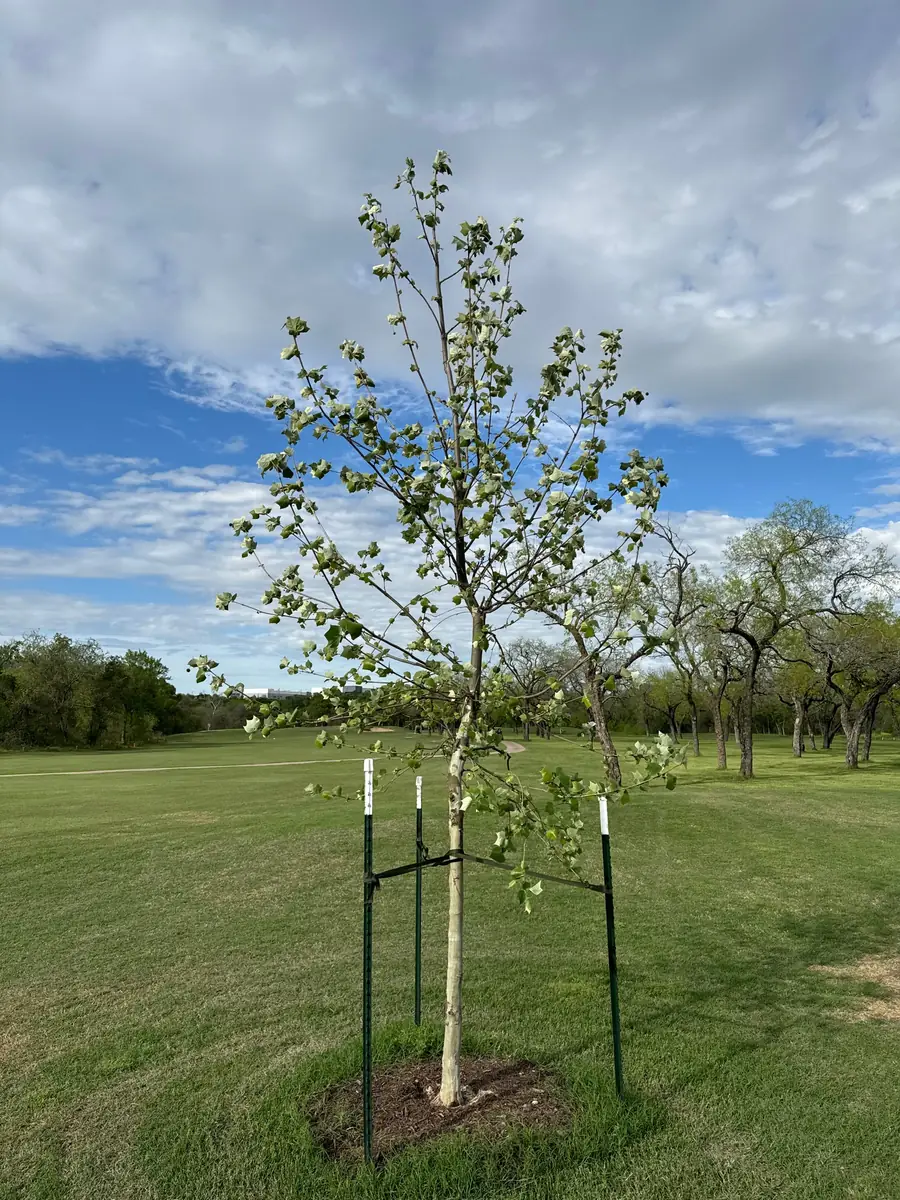

Tree Planting in Austin
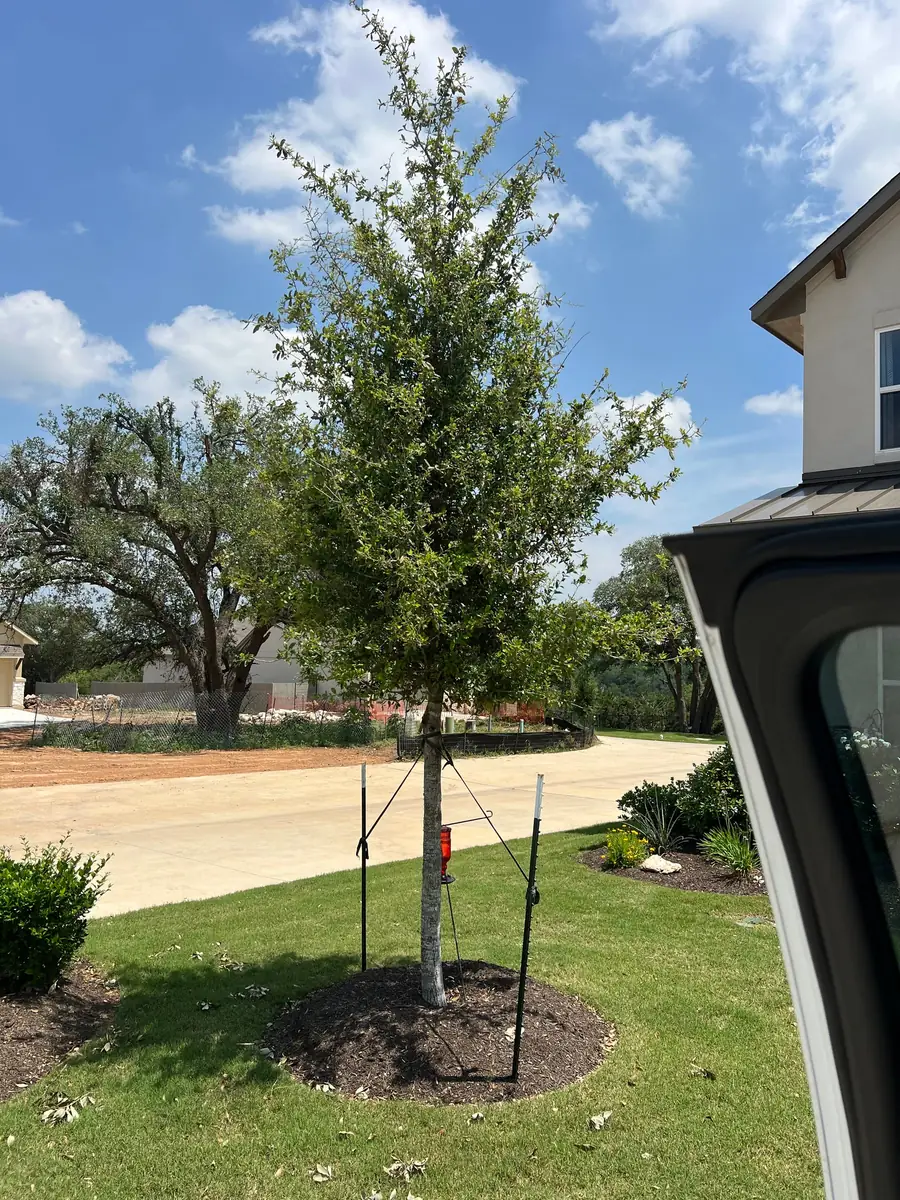
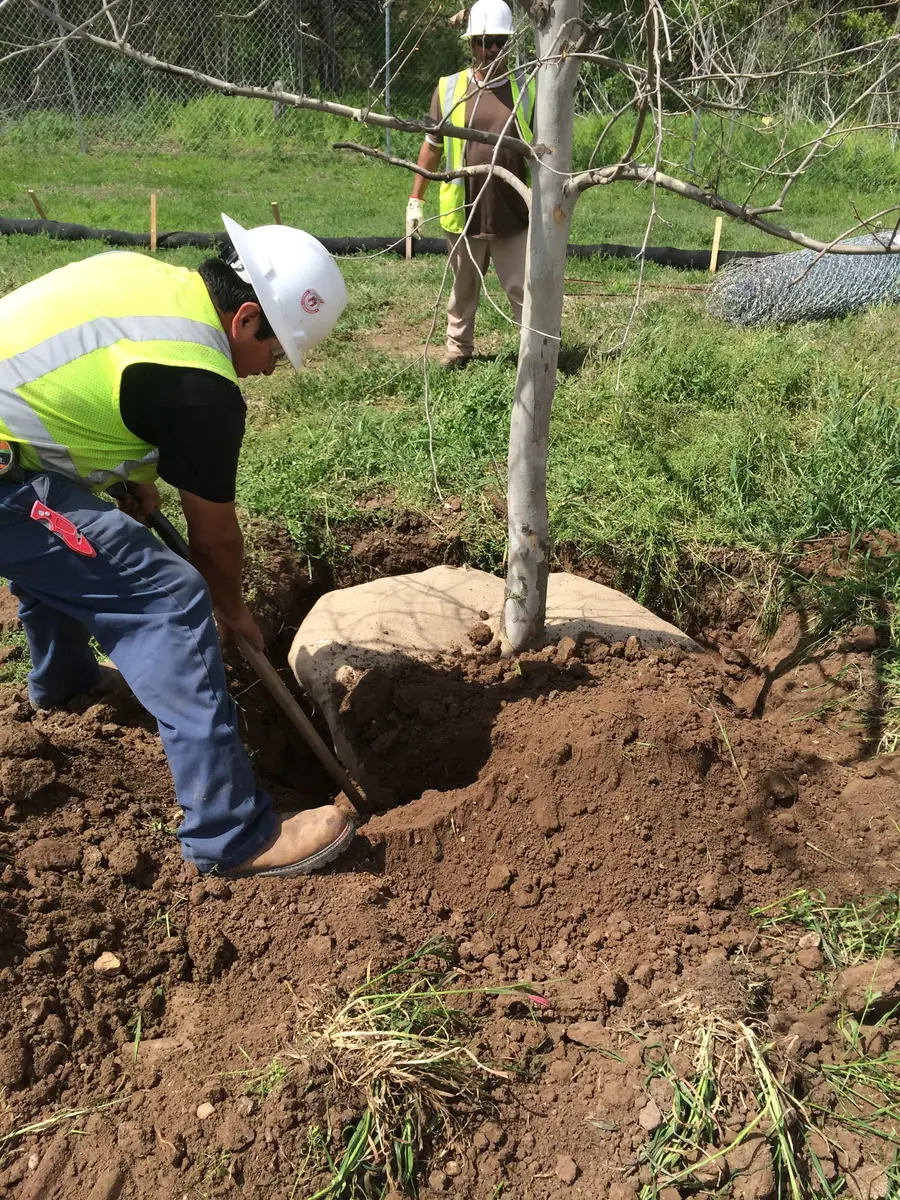
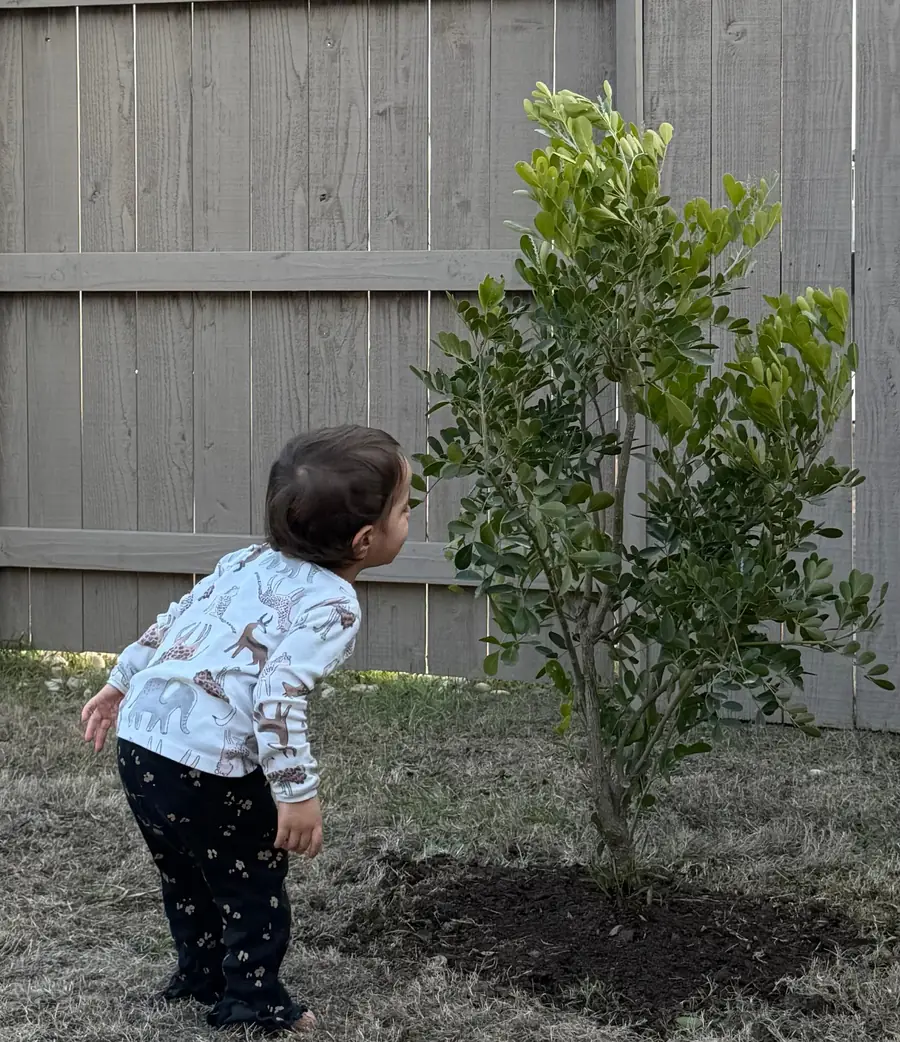
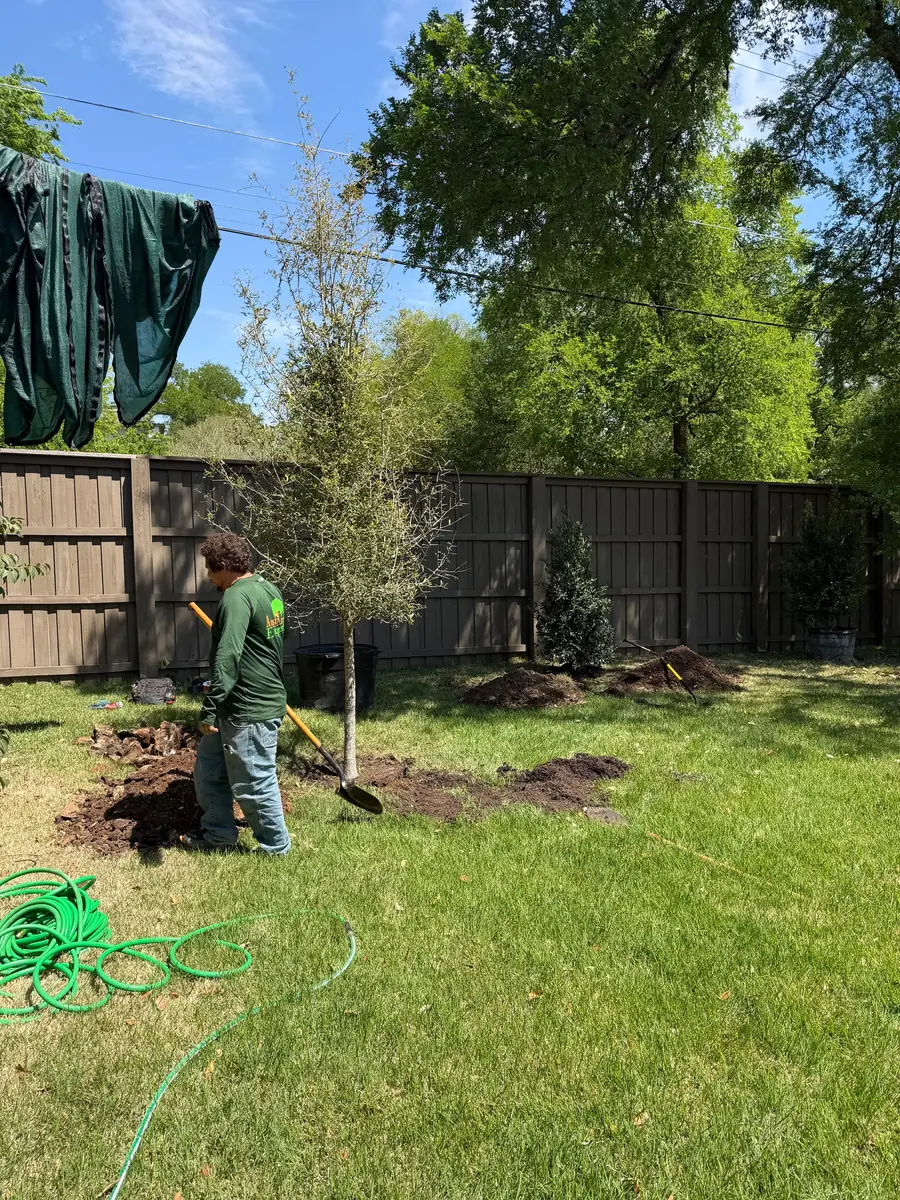
We do tree planting across Austin and Central Texas — one shade tree in a front yard, a screen along a back fence, an orchard, or the mitigation planting a construction permit requires. A certified arborist picks the species and the individual tree, our crews install it, and it’s warranted for a year — three if you stay on the tree care program. There’s no minimum; we’re happy to plant a single tree.
One clarification on scope, because the phrase means two different things to two different readers: we install trees on properties in and around Austin. We don’t run corporate reforestation or carbon-offset planting programs, and we don’t do sponsored “we’ll plant a tree for every customer” partnerships.
What you’re buying is the sourcing decision, not the tree
Two trees can sit on the same truck — same species, same container size, same tag — and be worth completely different things. One was grown from regional stock adapted to alkaline soil, hard summers and the way it rains here. The other was grown out of region and shipped in. On delivery day they look identical; most people would never know. The difference shows up two or three years later, when the second one goes chlorotic and just never takes.
That difference between regional and out-of-region stock is a firsthand observation from a long time buying trees in this market, not a rule you’ll find published anywhere. It shows up most on red oak, which is grown out of region on a large scale.
So there are two questions worth asking anyone selling you a tree, and almost nobody asks them: what’s the seed source? and where was this tree grown? You have to know who and what to ask for, and trust that the person can give you a real answer. We don’t run a nursery you can walk through. Our planting specialist, a certified arborist, meets you on site, settles the size and species, then hand-selects the individual trees for that site. You can refuse any tree we bring, though it rarely comes up.
The same logic covers the defects that arrive with the tree. Repotting at the farm often buries the root flare a few inches, so part of the job at planting is correcting something the nursery already did. On a young red oak a buried flare is an open invitation to boring insects. And some species simply don’t container-grow well — bur oak is a taproot tree, and that, not the species, is our reservation about it.

Choosing a species for Central Texas
We sort the conversation into three jobs a tree can do: shade, screening, or ornamental. Pick the job first and the species list follows from it, along with your soil, your sun, the slope, and whether there’s irrigation to work with.
Shade trees
Most shade conversations start in one of two places. Mexican sycamore is the only genuinely fast-growing tree here that’s also a good tree — fast trees usually buy you speed with surface roots, weak structure and a short life. This one gets sixty to eighty years and needs little pruning. Its one catch is siting: it runs ten to twenty percent past the size you’d expect, so keep it further off the house. Cedar elm is the other opener, and its case is about owning it rather than biology — a small trunk for the canopy it carries, less pollen, papery seed wings instead of acorns staining a sidewalk, and leaves that break down in a single mow. It handles drought and flooding both. Wet feet, dry feet.
Live oak needs its own paragraph, because there are two of them. The escarpment live oak (Quercus fusiformis) is the Hill Country native and the real jewel — three hundred years — but it’s rare in the nursery trade, which is exactly why seed source matters. The coastal live oak (Q. virginiana) is what almost everybody actually plants: eighty-plus years, grown faster on the farm, notorious for surface roots, and it needs real structural pruning while it’s young or it develops included bark and starts shedding limbs decades later.
Whether to plant another live oak is mostly a growth-rate question. A forty-five gallon Mexican sycamore gives you the beginnings of a shade tree in about five years; a live oak has barely moved by then, and you’re really looking at ten to fifteen. So a bare lot usually gets steered elsewhere, and a yard that already has canopy can plant one happily. Growth rate here is simpler than people think: live oak is slow, Mexican sycamore is fast, and just about anything else out of a nursery sits in the middle.
Where oak wilt is a live concern in a neighborhood we steer toward Monterrey oak or chinquapin oak. They fill the gap for someone who wants an oak that still looks like an oak, and knowing whether that applies to your street is a judgment your arborist makes from working the area. Monterrey oak is also our rescue species — on a site where nothing seems to take, we can generally flip to one and it will. There’s more in planting new trees in oak wilt sensitive areas. Red oak is a good tree too, with one honest caveat: the fall color people buy it for is decided by the weather months earlier, and a hot dry summer scorches the leaves brown instead.
Screening and privacy
Hollies — Nellie Stevens, Eagleston, Burford, Sky Pencil — are the reliability pick, hardy just about anywhere here. Worth knowing that “bush form” and “tree form” are the same plant pruned differently at the farm, so you can ask for the other one. Eastern red cedar (Juniperus virginiana, not the ash juniper behind cedar fever, which is a different tree at a very different density) is a good conifer that wants decent drainage and appreciates some protection from late afternoon sun; Arizona cypress wants more sun and heat with the same drainage sensitivity. Cherry laurel makes a good hedge if you have creek frontage or real irrigation — and if you have neither, don’t. Where a hillside already supplies the elevation and you don’t need height, Texas mountain laurel is excellent for long-term durability.
A screen is a portfolio, not a purchase. Thinking you’ll make a few plantings today and have it be perfect for thirty straight years is farce. Plant twenty plants and you should expect one or more of them to be gone. The durable strategy is a variety of species, so the wrong pest or the wrong winter can’t take out everything at once. That said, plenty of people want the clean, modern look of a uniform hedge, and that’s a legitimate thing to want — if that’s what you’re after, we’ll help you get the best version of it.
Ornamental and flowering trees
We sort ornamentals by mature height rather than by flower. The twelve-to-twenty-foot band is redbud — Mexican redbud is the one most native to Central Texas, eastern redbud suits central and east Austin with irrigation — plus Texas mountain laurel, which is slower, heat-hardy and easy to kill by overwatering. The twenty-five-to-thirty-foot band is Mexican plum, which wants a creek unless you’re irrigating, plus chitalpa and althea. Availability is a real constraint up here: bigtooth maple is expensive because it’s scarce, not because it’s premium.
Crepe myrtle sits in all three categories, and the whole decision is size. Most people understand that there are hundreds of varieties of roses and every grower has their own; crepe myrtles are the same thing — some max out at two feet, some reach forty. Pick one that grows to the height you want and stays there and you never need to top it. They also buy shade rather than grow it: a ten-to-twelve-foot crepe myrtle five feet off a patio gives immediate protection from the southwest sun, which often beats a big fast tree in the middle of the yard.
The honest frame for the whole category: an ornamental is a twenty-year asset with a planned ending. It isn’t a three-hundred-year live oak, it’s a twenty-year redbud. It’s going to look great for a while, you’re going to cut it down, it isn’t going to be dangerous when it goes, and you can regrow one quickly. All three of those are what make it a good buy — not permanence.
How long trees actually live here
Worth knowing before you spend money, because it decides what “long-term” means on your property. Sixty to eighty years is the normal expectation for a good Central Texas tree. The three-hundred-year live oak is the outlier, not the standard.
| Tree | Realistic lifespan here |
|---|---|
| Cherry laurel | 20–30 years |
| Ornamentals — redbud and similar | ~20 years |
| Hackberry | ~50 years |
| Hollies | 50+ years |
| Cedar elm, Mexican sycamore, eastern red cedar, red oak | 60–80 years, ~100 if lucky |
| Coastal live oak (Q. virginiana) | 80+ years |
| Escarpment live oak (Q. fusiformis) | 300 years |
How big a tree should you buy?
Trees are sold by container size. Five sizes get planted regularly, and container size decides both the height that shows up in your yard on planting day and — less obviously — what the planting job itself looks like.
| Container | Typical height planted | What it takes to put it in |
|---|---|---|
| 15 gallon | 3–4 ft | One person. Only worth doing in multiples |
| 30 gallon | 6–7 ft | One person can dig the hole and set the tree |
| 45 gallon | ~8 ft | Two people, preferably three |
| 65 gallon | 10–12 ft | Crew job |
| 100 gallon | 13–14 ft, ~5” caliper | Crew plus a machine, and a real access conversation |
For a shade tree, forty-five gallon is the size we recommend by default. It’s the first one that stands taller than a person, so it reads as a tree the day it goes in rather than a little twig you worry about the yard guy mowing over. Thirty gallon is the smallest shade tree we’d normally plant. We can get shade species in fifteen gallon, but for a single tree it isn’t worth the trip — sourcing, delivery and digging cost about the same whether the tree is small or large, which is why fifteens make sense in multiples and rarely on their own.
Screening and ornamental trees go the other way. We’ll drop to thirty gallon almost every time, and to fifteen for ornamentals — partly because you often can’t find ornamentals any bigger, and partly for a reason worth thinking about before you pay for size: an ornamental that lives twenty years and tops out at fifteen feet has already spent fifty to seventy-five percent of its life by the time it fills a thirty or forty-five gallon container. You’d be buying the back half of a tree. Screening species also run shorter than shade trees at the same container size — an Eagleston holly or a cherry laurel is around eight feet out of either a forty-five or a sixty-five.
Sixty-five gallon is a niche size. Put a forty-five and a sixty-five in two different yards and you probably wouldn’t notice the difference; side by side you would. Where it earns its keep is when you’re aiming at a specific height — an evergreen hedge that has to finish taller than a six-foot privacy fence is the real case, and a live oak in that class clears the fence too. If you have the budget and the motivation to go past forty-five, our advice is to skip sixty-five and go to a hundred.
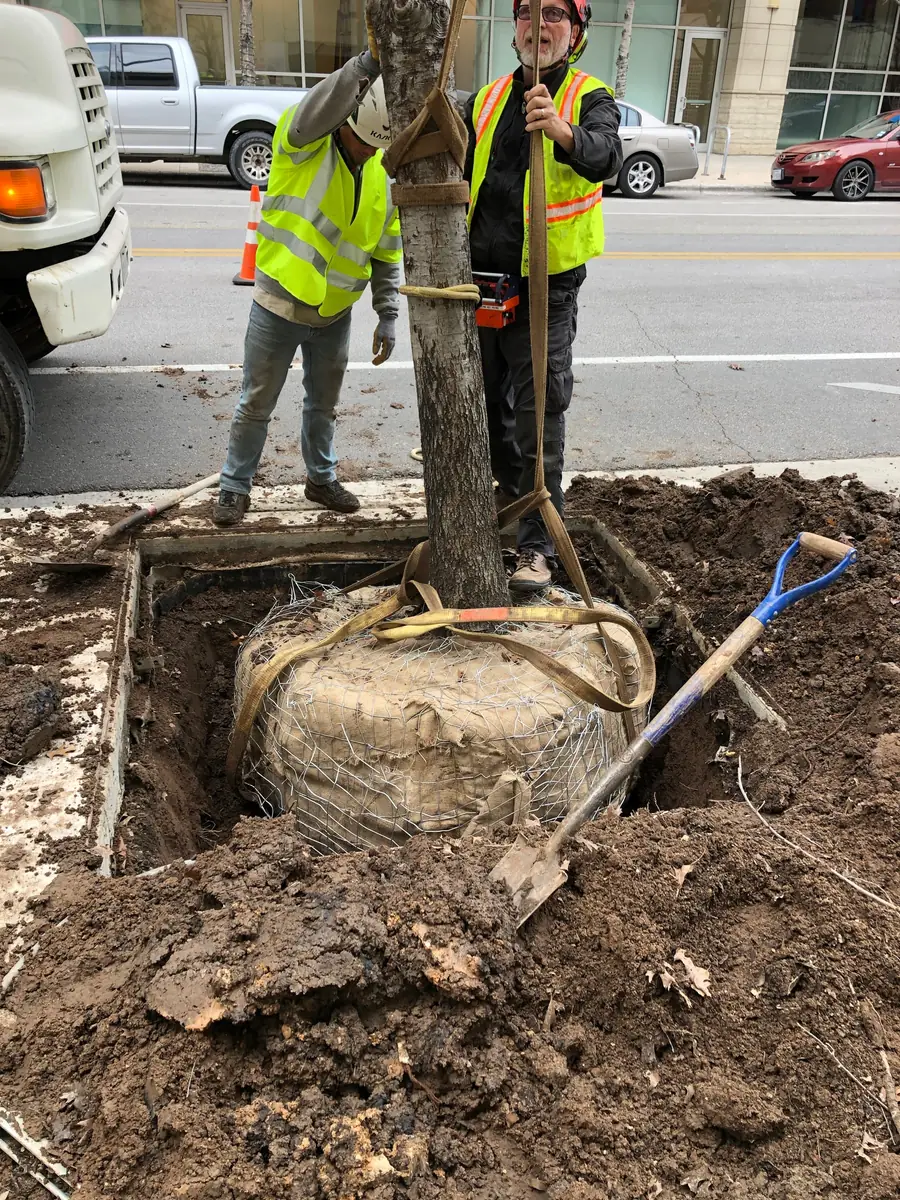
A hundred gallon tree is legitimately big — thirteen or fourteen feet, wide, around five inches of caliper, and it looks like something the day it lands. It’s also a different job: a machine to move it, a real excavation for the hole, and on a sloped yard with very rocky soil the downhill side may have to be retained before the tree can go in. We look hard at back yard access, and sometimes a fence panel comes down.
And here’s the part nobody selling you a tree tends to mention: the smaller tree catches up in about five years. You keep a little of the head start permanently, but at five years out you won’t really notice the difference in what you bought. That’s the honest frame for the whole ladder — you’re buying the first five years, not the tree’s final size.
What the bigger tree genuinely costs you on the back end is water. A larger root ball means a longer, heavier establishment period. The failure risk people warn about is more conditional than it sounds: when we’re picking the tree and planting it, we buffer that out. Hand the same hundred gallon tree to a builder or a landscape contractor who isn’t qualified to pick a good one and yes, the big tree is the bigger gamble. The size isn’t the risk. Who chose it is.
One last thing on size: we favor quality over size when we select, and heights vary between individual specimens, between species, and from year to year. If an exact height matters to you, tell us before we go shopping.
We don’t publish a price list. What moves the number is straightforward enough to plan around: species and container size, access to the planting spot, site conditions, whether an old stump has to be dealt with, and how many trees are going in. Every planting includes the tree, the installation labor, mulching and the one-year warranty, and usually the first year of the tree care program as well. Ask us for a proposal and we’ll come look.
Where it goes — siting, separation, and what’s under the soil
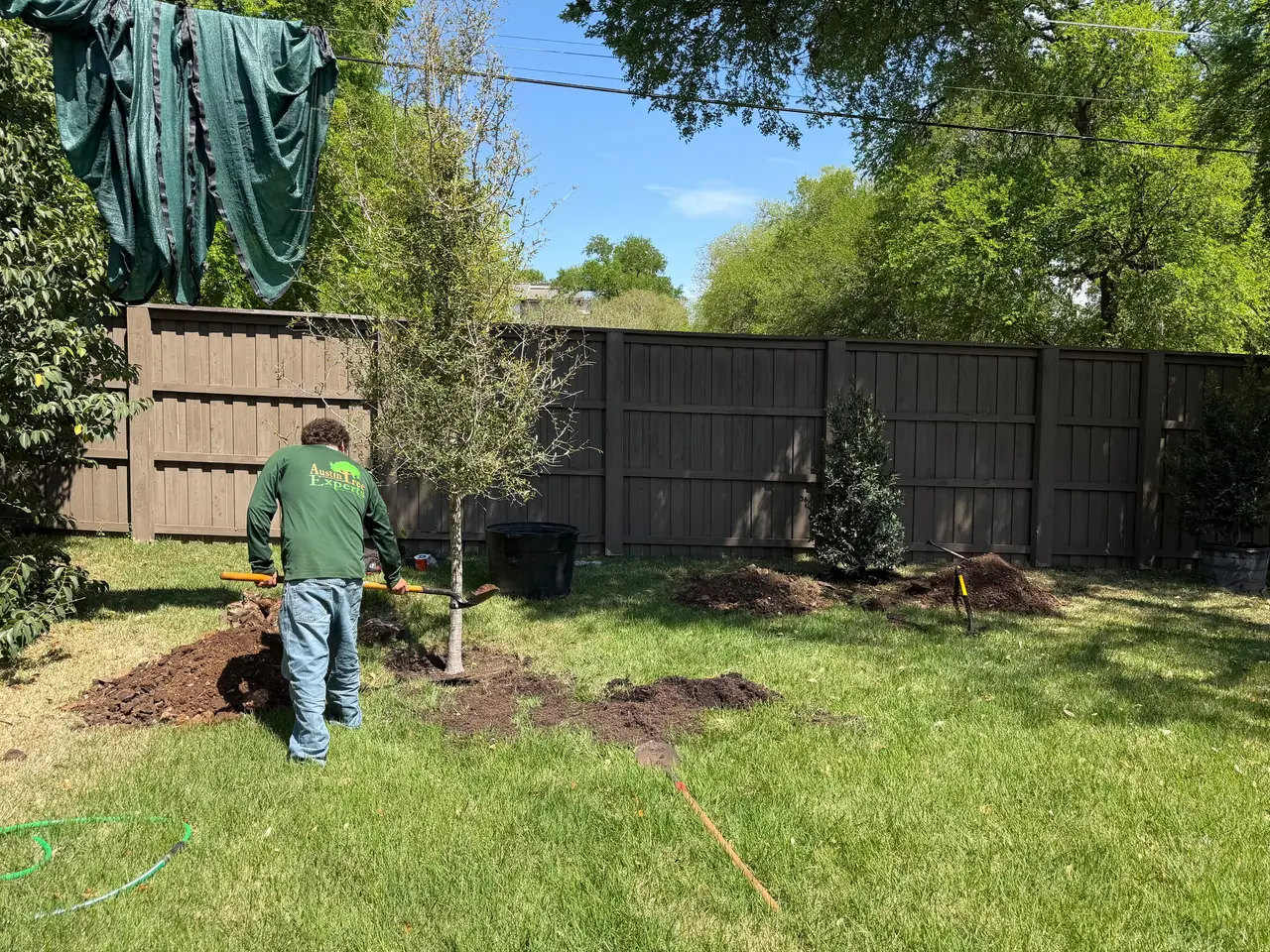
We’re happy to help you settle on the ideal spot, and in a suburban landscape some of the limits are unpredictable. Underground sprinkler pipe is the classic one. On an ordinary residential planting we hand-dig the holes, and if we hit a pipe or another obstruction we move over a bit rather than force it — so if the exact location matters to you, say so up front.
Shallow soil and bedrock
Around here we frequently hit rock a few inches down, and that limits the size of tree a site can carry. What happens next depends on what kind of rock it is. If the bedrock is naturally fractured, it’s safe to chisel a bigger hole into it — the cracks still drain. If it’s a solid boulder or a ledge, that’s the wrong move, because what you’ve built is a bowl that holds water with nowhere for it to go.
The reassuring part is that solid limestone shelves are less common than people expect. Most of what sits at the surface is fractured limestone, which we can work with; the true solid shelves tend to be deeper and isolated to particular areas, and we’re talking about the Hill Country when we’re talking about them at all.
We usually know what we’re dealing with before anyone starts digging, because the site tells you. Slope and visible surface rock say a lot on their own, and in a neighborhood carved out of a hillside, the extent of the leveling is the tell: if they cut a flat pad into the hill to set the house on, there probably isn’t much soil left to work with. If the lot is still steeply sloped and they built the foundation up to accommodate it, you’re more likely still in fractured rock. That’s a visual read done during the estimate, and where it seems warranted we’ll dig test holes.
That leaves a handful of options. Fractured limestone we open up with a jackhammer and a rock bar. It’s fine to set the tree slightly above grade and build soil up around the root ball. On a sloped yard with very rocky soil, retaining walls and backfilled soil are worth serious consideration — an expensive treatment and a very effective one, because you’re manufacturing a growing environment the site doesn’t have.
How much soil sits over the rock is often what decides the size of tree a site can carry. A forty-five gallon tree wants something like twenty-four inches of depth. That figure is a starting point for a conversation, not a chart — the sizing decision gets made on the site, looking at the site.
How far from the house, driveway and street
These are the distances for planting something new near a house, a driveway or a street.
| Tree | Separation from house, driveway or street |
|---|---|
| Screening holly — Eagleston, Nellie Stevens, Burford | As close as 3 ft, which is why a holly works against a boundary |
| Crepe myrtle | As close as 5 ft — roots aren’t aggressive and it tolerates the ongoing pruning tight siting brings |
| Eastern red cedar | 10 ft |
| The average tree | ~15 ft |
| Chinquapin oak | 15 ft — a shade oak that doesn’t want large-canopy clearance |
| Cedar elm | Closer than 15 ft is fine |
| Escarpment live oak (Q. fusiformis) | 20 ft |
| Mexican sycamore, red oak, large canopy trees | 20–25 ft |
| Coastal live oak (Q. virginiana) | 20–25 ft — notorious surface roots |
Building near a live oak that’s already there is a different question with a different answer — as close as ten feet can be okay, because surface roots on an established tree can be pruned if it’s done in a mindful way. That’s a consideration, not a free pass, and it isn’t the number to use when you’re siting something new.
Distance from a fixed object is engineering. Distance from another tree isn’t, and we won’t hand you a spacing chart: the closer you plant them together, the more instant gratification you get and the more long-term problems you get, and budget is part of that decision too. There’s no silver-bullet answer, which is why we’d rather stand in the yard with you.
Replacing a tree that was removed
An old stump changes the plan. Replacing a small tree that died is easy — the old root ball comes out for little or nothing. If the tree that came out was large, the stump and root ball decide where the new tree can go, and there are three ways to handle it.
- Grind it below ground level. This is the right answer in the vast majority of cases. It needs access for a large stump grinder — front yards are easy, and a back yard needs a wide service gate, or a fence panel that can come down.
- Leave it and move over. A stump left in the ground isn’t a problem for the new tree; it just occupies the spot. Two to three feet over is normally enough clearance. If you want to sit closer than that, we can read the flare roots at the base of the old stump and tell you what’s actually down there — sometimes that buys you room, and sometimes it says move further out.
- Excavate the root ball with a small machine. This physically removes the stump and root ball and is the only option that puts a new tree back in exactly the same spot. It’s genuinely necessary only in special circumstances — when the location is the whole point.
A word about the grindings, because this usually gets described backwards. Ground-up wood mixed through the native soil is exceptional planting material, and we reuse it where it’s genuinely usable rather than trucking it off. What gets hauled away is the solid chip material.
You may have read that wood chips in a planting hole tie up nitrogen, and the word doing the work there is mixed. We’re not planting a tree into a bed of mulch — this is a small proportion of wood shavings distributed through the soil. Does that technically consume a little nitrogen as it breaks down? Probably. It is not the same thing as laying four inches of uncomposted mulch across the ground, which genuinely does. Small amounts of wood mixed into the soil are not a problem, and the instinct that a site has to be scraped clean before anything can be planted is wrong.
If the tree you lost came out because of oak wilt, species selection for the replacement is its own conversation, and we’ll have it before anything goes in the ground.

When we plant in Central Texas
The planting season here runs in two windows:
- Deciduous trees — October 1 through March 1.
- Evergreen trees — October 1 through May 30.
Those two windows are also what the one-year warranty is written around, and planting outside them is one of its exclusions.
The warranty — one year, or three with the care program
Every tree we plant is warranted for one year from the planting date. It covers removing the tree, buying the replacement and the labor to install it. It does not cover consulting fees to evaluate planting site conditions, and it does not cover pruning.
The planting price usually includes the first year of our tree care program, which is what puts us back on the property to monitor the tree and give it timely treatments. Keep the program going after that first year and we’ll extend the warranty two more years — three total. We won’t extend it past three, and the reason is worth saying plainly rather than dressing up: if a tree has come through its first year vigorous and healthy, there was nothing wrong with the tree we supplied or the way we installed it. By year three, with the program running and the tree doing well, there’s no plausible way an installation defect kills it. Selling you coverage past that point would be selling you nothing.
The four exclusions
Stated plainly so there are no surprises:
- Death from a lack of water. Supplemental watering is the single largest factor in whether a new tree lives.
- Herbicide applied near the tree — and that includes weed-and-feed and other weed-control lawn treatments. A tree is, biologically, a very large weed, and broadleaf herbicide doesn’t know the difference between a dandelion and your new redbud.
- Payment not received within 30 days of the invoice date.
- Planting outside the optimal season above.
How a warranty call actually goes
Warranties are complicated in practice, and we’d rather describe how one gets handled than let you discover it.
Looking at a tree that died, the first thing to check is soil moisture — squat down, pull the mulch aside, put your hands in the ground. Whether a root ball is dry isn’t a difficult call. Then we ask about watering, and people are generally honest. The common case isn’t somebody covering for themselves; it’s somebody who thought they were doing plenty and simply wasn’t.
The other thing to look for is herbicide, because that one catches people who are trying. The assumption is that keeping weed-and-feed out in the lawn, just past the edge of the root ball, is safe. It isn’t. Small amounts move into the root ball, and the tree’s roots are growing out into that adjacent soil anyway — that’s what roots do. The tell is a lawn that looks a little too perfect: no broadleaf weeds anywhere, only grassy ones left standing.
So it’s an investigation, and context counts. No automatic irrigation and two hot weeks nobody noticed in time is a very reasonable way to lose a tree, and it isn’t the same as neglect. Keith has replaced trees he didn’t think we were on the hook for, for long-standing customers. Evaluating a claim isn’t a formula and we’re not going to pretend it is — which is exactly why the goal is to head all of it off at planting, by being clear about what the tree is going to need from you.
The replacement tree carries its own warranty; a second tree isn’t planted uncovered. Before a third tree goes in we ask for something in return: documentation of a more capable irrigation plan, and a commitment to no chemical weed control in the yard at all — not near the tree, not anywhere. Past a second failure, we generally conclude it’s the site rather than the trees, and at that point the useful conversation is about the planting site.
Aftercare: the watering is yours
On a site with no irrigation, it does not have to be. We can run establishment watering off a truck-mounted 600-gallon sprayer body, so the trees get a real soak while they are getting established.
Otherwise the watering is yours, and it matters more than anything else on this page. Supplemental watering is the single most important factor in a new tree’s survival, and there’s no one schedule that fits every site and every tree. Soil moisture has to be monitored, not assumed. It’s no small task, and it’s worth being honest with yourself about it before the tree goes in — because it’s also the first exclusion on the warranty.
Watch the thermometer, not the calendar. A tree planted in winter and watered in well at planting may need almost nothing until late winter, especially if it rains. As temperatures warm and the tree breaks bud it moves to once or twice a week. When temperatures reach the eighties, three times a week. When they’re consistently in the nineties, every other day, and it stays there through the first year. Taper back as fall arrives.
Your site moves those numbers. On a rocky slope it’s essentially every day through the first year, even into spring, because the ground simply doesn’t hold water. A flat site with deeper soil gets away with a little less.
How much water: start from about a gallon and a half per diameter inch of trunk, per day. That’s what the tree needs to accumulate, so what it comes to per watering depends on how often you’re out there. Worked through for a four-inch trunk: six gallons a day, which at three waterings a week is fourteen gallons each time. Double that through the tree’s first summer, then taper by how the tree is doing. That’s the number most people are missing — they get the frequency approximately right and deliver a fraction of the water. There’s more detail in how to water a newly planted tree.
Automatic irrigation is the ideal. On a dedicated tree or shrub zone the answer is a bubbler or a drip ring, chosen to match whatever else shares that zone, or something gets shorted. You don’t always need a new zone — a drip ring can be peeled off an existing lawn zone, so if that zone runs forty-five minutes, the tree gets forty-five minutes of drip. With no automatic system the whole thing lands on you. Gator bags and slow-drip bags are great as long as you remember to fill them, and you have much less control over volume; hand watering gives you the most control and depends entirely on your memory. Go on vacation, get sick, have a week go sideways, and in July that can cost you the tree. An above-ground temporary rig is a perfectly good answer — a hose-bib timer and a quick-attach running drip out to the new trees, so the timer handles the part humans are worst at.
To be clear about the division of labor: where we are not running establishment watering, the watering is yours, and the chemistry isn’t. We supply the fertilizer. There are no pesticides to approve, because a new tree shouldn’t be getting any.
The rest of the first few years:
- Mulch — we mulch at planting; it’s part of what the planting includes. Keep it off the trunk.
- Pruning — none in the first two years, and rarely in the third. Shaping usually starts somewhere in year three or four, and when it starts it’s structural work: building the tree a single dominant leader. Lifting the low limbs is the thing people reach for first and it’s the wrong move this early, because canopy comes off a tree that has barely established and the structural work never gets done. Pruning isn’t covered by the warranty, and it isn’t something a new tree needs early.
- Air-spade root work — once the tree is established and growing vigorously, we recommend excavating the root flare and pruning off any girdling or deflected roots. They’re a consequence of a tree spending its first years in a container, and dealing with them while the tree is strong prevents a larger problem later.
- Fertilization and monitoring — the care program’s visits are also what put us on the property to read the tree’s watering demand and tell you what we see. Check your contract for what’s included; it doesn’t replace your own monitoring.
Mitigation plantings and construction permits
We prepare and execute mitigation plantings for construction permit requirements across the Austin metro. If a project is in planning or underway, start at construction site services, and use our jurisdiction finder to see which tree ordinance actually governs the address.
Worth being precise about what comes with what. A free bid for tree work ships two documents — a site inspection and work plan with photos of the trees, and a proposal. That is a scoping document we share with you; it is not an arborist report and it is not a permit filing. The recommendation of what species to plant and where, written to satisfy a removal-mitigation requirement, is an advanced consulting deliverable — scoped and quoted per engagement. On a construction project, the initial on-site consultation varies with the design phase, and typically covers the challenges we foresee and the tree protection status on the ground, plus quotes for any advanced reports the permit will need. If you’re not sure which of those you need, that’s the right thing to ask about first — measure twice, cut once.
Orchards and large installs
One shade tree needs a crew and a shovel. An orchard is a different problem, because every hole has to come out the same. The hydraulic auger on our Yanmar Vio55 excavator drills clean, consistent planting holes, which is what makes that repeatability possible. Our Giant G1200 tele-loader shuttles the trees around the site. It’s the same arborist judgment picking the trees either way.

Related tree services
- Tree Pruning — the structural work a young tree needs, once it’s old enough
- Tree Care & Fertilization — the program that extends the planting warranty
- Mulching & Composting — root-zone material, buyable on its own
- Air-Spade Services — root flare excavation and girdling root pruning
- Stump Grinding — clearing the way for a replacement tree
- Construction Site Services — mitigation plantings for permit compliance
Talk to an arborist before you buy the tree
The species, the spot and the stock get decided standing in your yard, and they’re what the next sixty years run on. Every free estimate comes with a written site inspection and photos of the trees — what we saw, what we’d do, and what’s in the way — alongside the proposal. Austin Tree Experts is owned and run by an ISA Board Certified Master Arborist (TX-0985B), in the trade since 1993. One tree or a whole orchard, we’ll come look.
Call us today: (512) 996-9100