

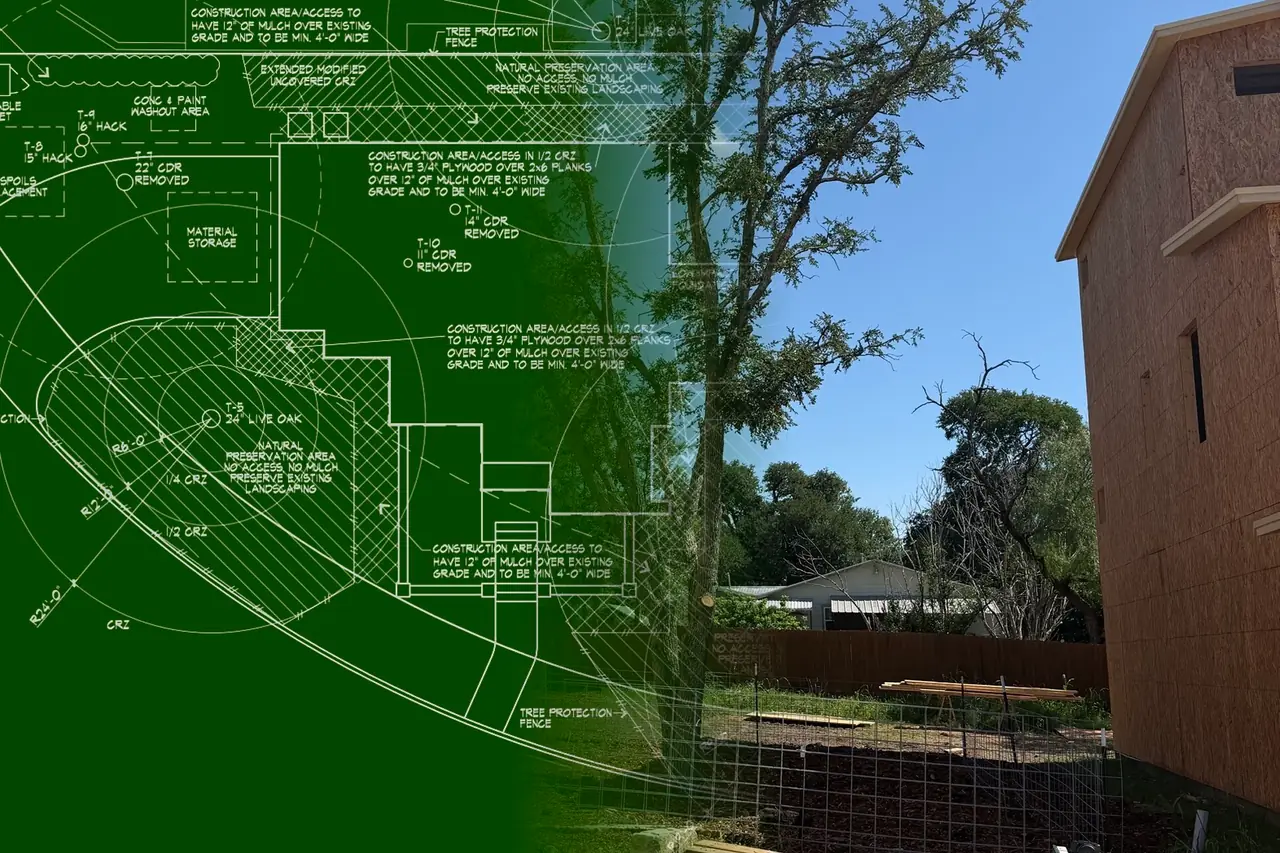
Construction tree protection in Austin covers the tree side of a build, from the drawings through the work that follows the last inspection: tree ordinance compliance and permit filing, tree protection installation, pruning and removals, airspading inside root zones, monitoring visits while work is underway, and mitigation and tree care once the site is quiet.
On a build, the tree contractor sits on the schedule. Our fence trailer stays loaded with panels and posts, and our roll-off trucks change bodies in minutes, so one crew can arrive with fencing, an airspade rig and a chipper on the same trip instead of coming back three times. A complicated list of tree work can often be finished in one visit. Crews work to ANSI A300 for how the work is performed and ANSI Z133 for how it is done safely, which on an active site matters to more people than the trees.
Tree Ordinance Compliance & Planning
The first question on a site with trees on it is which rules govern the parcel, and the answer changes at the city line. Inside Austin, a tree measuring 19 inches or more in diameter at four and a half feet above grade is protected and a removal permit is required. At 24 inches, a tree belonging to one of ten listed species is a heritage tree and is handled under its own part of the code. Thresholds, species lists and mitigation rules are different in every other jurisdiction we work in. Start with our Jurisdiction Finder, and see the Austin tree ordinance for the City’s rules in full.
Most jurisdictions want arborist documentation before they will issue a tree permit. We prepare tree condition assessments, documentation of canopy and root zone impacts, mitigation plans where mitigation applies, and the arborist portion of the application package. Reports are written by an ISA Board Certified Master Arborist, license TX-0985B, and by ISA Certified Arborists, and the work they call for is written against ANSI A300, so a recommendation names a practice rather than leaving it to interpretation.
We file the application on your behalf. We do not represent you at the City: no variances and no appeals. How long a review runs is the City’s to answer, but what makes one run long is usually visible before submittal. An incomplete package, a survey that does not match what is standing on the ground, species or diameters recorded wrong, mitigation left unsettled. Those are the parts we can do something about.
The tree protection plan itself is not ours to author. What a jurisdiction accepts as a tree protection plan is the protection measures drawn onto the building plans, and those belong to the design team’s plan set. Ours is the audit of that plan set against the trees actually standing on the ground, returned to the design team to incorporate, and then the implementation in the field. Plan audits and the reports behind them are arborist consulting work.
A tree inventory is ours outright: every tree in scope gets species, trunk diameter, condition and location, recorded consistently enough that the same site can be compared to itself later. A tree survey is a different document and requires a state registered surveyor, so what we provide there is the audit. Trees on the drawing that are not there, trees on the ground that are not on the drawing, species identified wrong, sizes measured wrong. Every downstream number runs off that base layer, which is why it is worth reconciling early.
We provide tree data in formats compatible with CAD and GIS software, so location, species, trunk diameter and condition go back to the design team as data they can bring into the plan set rather than as a document a drafter has to retype. We also attend design meetings when needed. When a tree and a footprint are in conflict, the fastest way through it is a conversation with the people who can move the footprint.
Tree Protection Installation
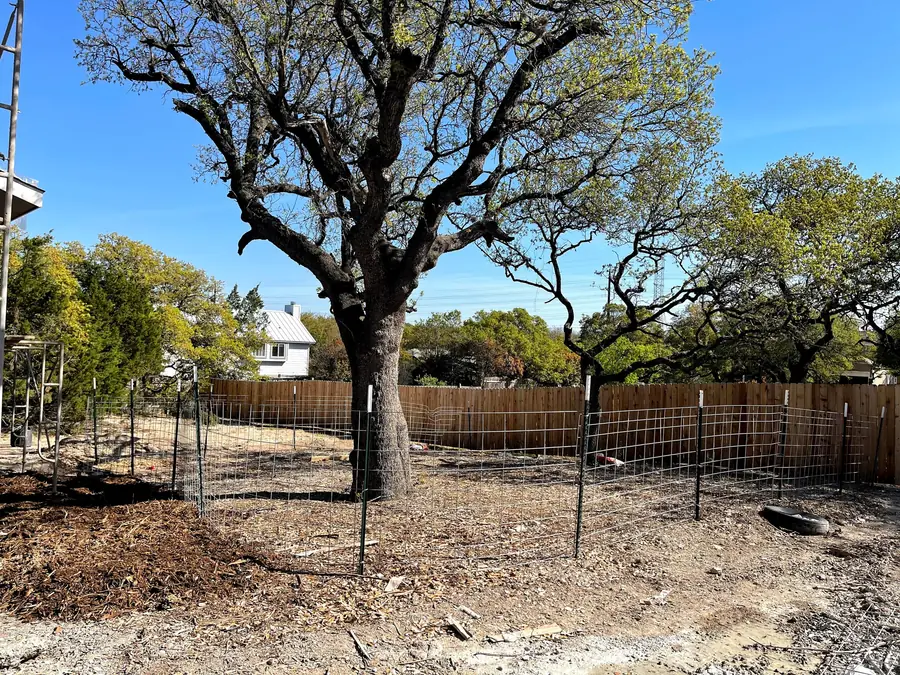
We install tree protection fencing around the root zones of the trees a project is keeping: 16-foot handy panels on T-posts, set to the line the approved plan calls for, with signage where the plan requires it.
The fence trailer stays loaded. It carries a custom-built mount that holds the panels and the posts, so hooking a truck to it is the whole mobilisation and the crew installs on arrival. There is no load-out and no staging trip. When fencing is the item standing between a builder and a demolition date, that is worth more than anything we could say about the fence itself.
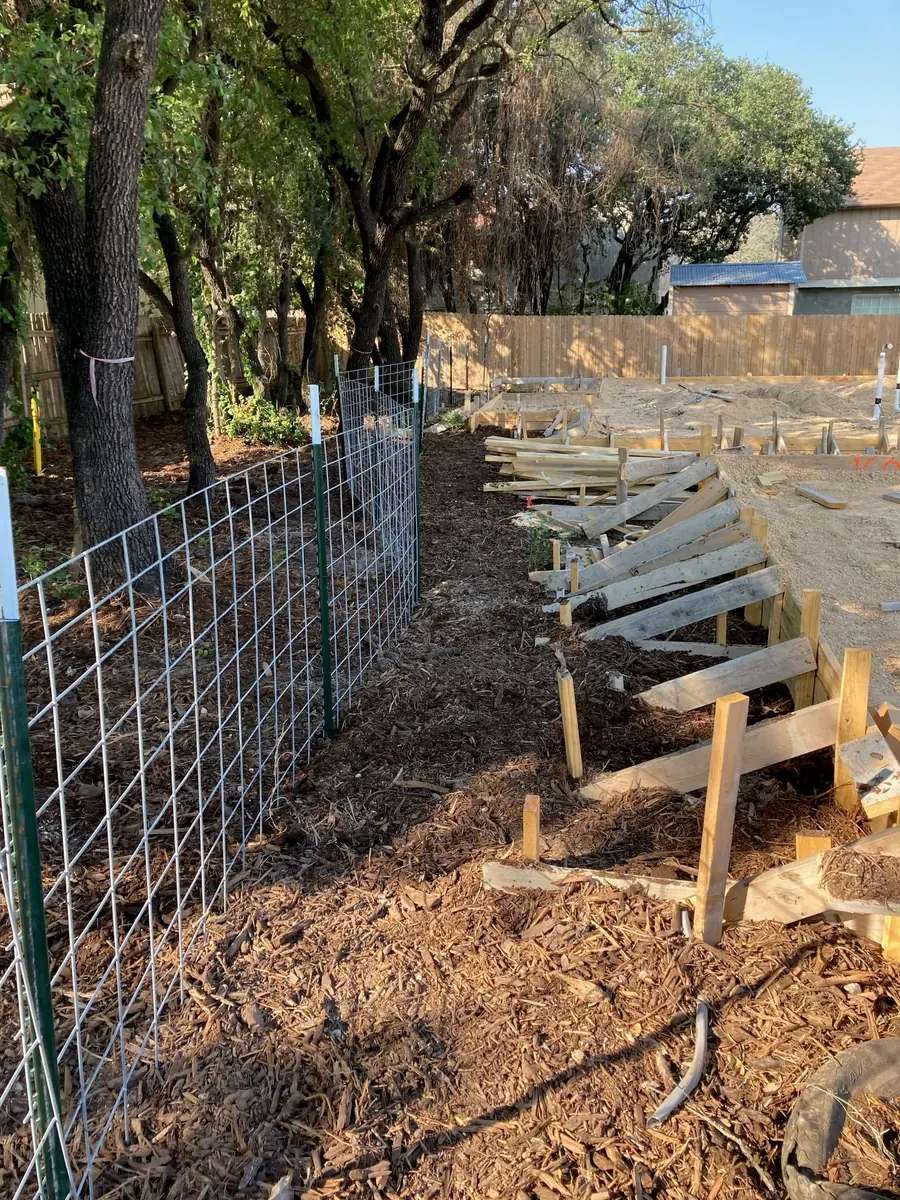
Inside the fence, bare ground gets mulched. Where traffic genuinely has to cross a root zone, ground protection goes down over a mulch layer so the load spreads across the surface instead of being driven into the soil. Sometimes we install it. On plenty of sites the builder’s other subs do, and what we supply then is the work plan they build to.
How much root zone gets held inside the fence is the judgment in this. The zone is sized from the tree’s trunk diameter, and the rule that turns a diameter into a distance is written by the jurisdiction, so the same tree draws a different circle on two sides of a city limit. Check the parcel with the Jurisdiction Finder. Where the fence cannot go where the plan wants it, we would rather say what that costs the tree than move the line quietly.
Tree Pruning and Removals
Clearance pruning for equipment access, crane and boom paths, scaffold lines and the finished building itself, cut to ANSI A300. On an active site the constraint is usually not what is best for the tree in the abstract but what the build physically requires, and we would rather make those cuts deliberately, in the right places, than watch a boom take the same limbs off by accident.
Permitted removals come with the documentation the permit requires, and that includes trees inside a footprint and trees a design decided were not worth keeping. Where a stump sits in the way of the work, stump grinding is part of the same job rather than a second contractor to schedule.
Access is usually what decides how this work gets done. Our mini skid steers fit through a 36-inch gate and will work between a fence line and a foundation, the tracked lift reaches trees a bucket truck cannot park under, and the roll-off bodies mean the chipper and the airspade rig arrive behind the same truck. On a tight site that is the difference between the tree work happening on the day it was scheduled and the trade behind us waiting.
Airspading
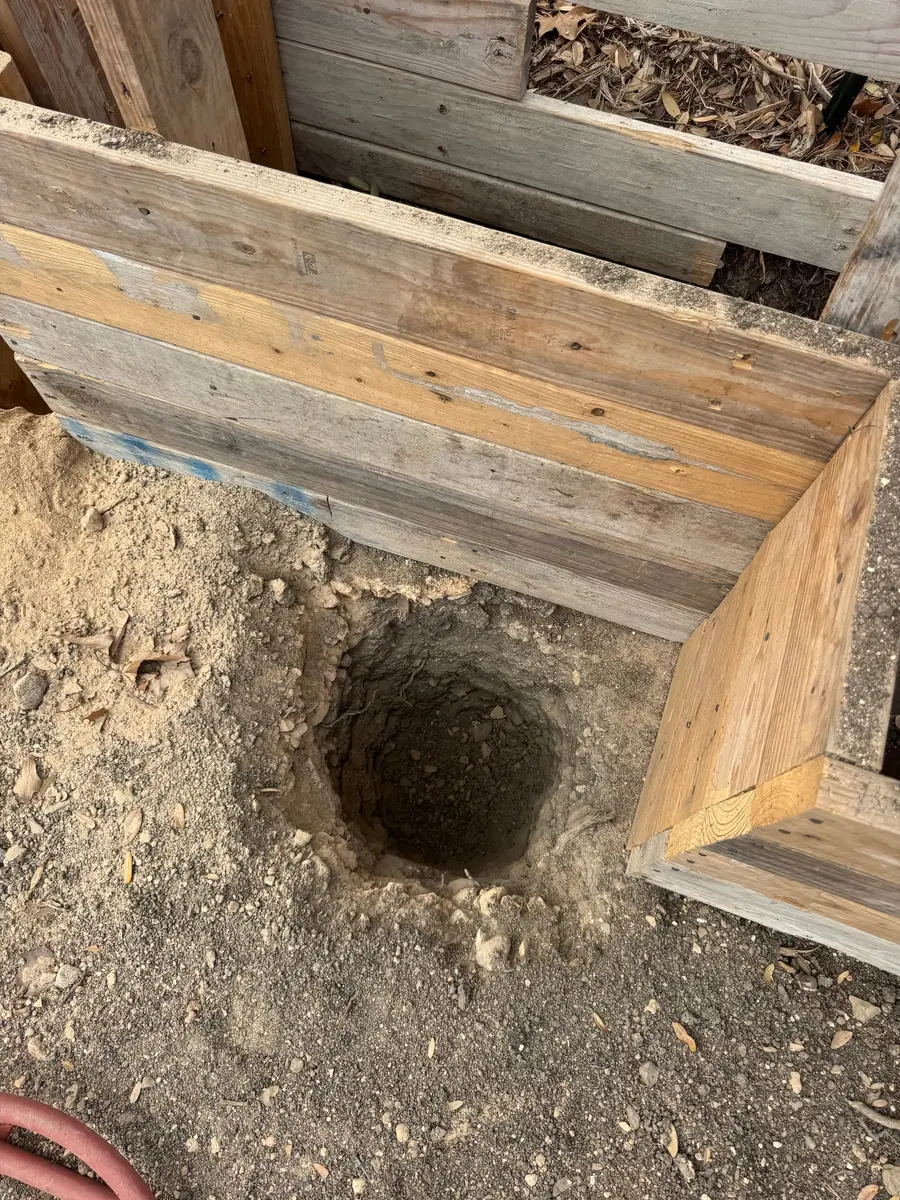
Roots in the path of a trench, a pier hole or a footing get severed one way or another. The question is whether they are cut cleanly at a point somebody chose or torn out by a bucket. We excavate with airspades, which move soil with compressed air and leave roots standing, so the roots that have to go can be identified and pruned properly and the rest stay where they are.
That is also how we dig inside a protected root zone at all: utility and irrigation trenches, pier holes, deck footings and fence posts. On pier holes, if we run into a root we can often relocate the pier a small amount, which is typically not a problem for the engineers drawing the plans.
After the build the same tool does decompaction, loosening soil that took the traffic without cutting the roots running through it. Our compressors run off the same roll-off bodies as the rest of the equipment, and one body carries a spray rig and a compressor together, so airspading and root zone treatment can happen on one trip. The full scope is on our airspade services page.
Site Monitoring
We sell periodic visits through a build to check that the protection measures are still there and still doing their job. Fences get taken down. Mulch gets removed from a protected root zone. Almost nobody on site set out to do either one, which is exactly why somebody has to go and look.
How often we come back is a question for the job rather than a fixed interval: the length of the build, how much of the work happens near the trees, and what the plan set commits to. We scope it with you before it starts. When we find something out of place we tell you what we found and what needs putting back.
Mitigation & Post Construction Tree Care
Where a removal triggers mitigation, what is owed is set by the jurisdiction, and it can take the form of replacement planting, a fee paid in lieu of planting, or a combination of the two. The choice between them is a real decision worth making deliberately rather than defaulting to whichever one the form mentions first. Where planting is the answer, it is tree planting work and we do it ourselves, sited so the replacements have somewhere to grow.
Construction damage does not present the day the fence comes down. A tree finishes a build with less root and less canopy than it started with, in soil that has been worked over, and it has to close wounds and hold off decay from a weaker position than it had before. What shows up later started then.
So recovery is worth scoping as its own piece of work rather than assuming the tree will sort itself out. That means airspade decompaction of the root zone, mulch over bare soil, deep root fertilization where the tree’s condition calls for it, attention to how the finished site waters, and a follow-up assessment to see which way the tree is actually heading. Programs are on tree care. It is a long game, and hedging the odds on a tree that has already taken the hit, not something solved on the last day of the build.
What Protection Looks Like Eleven Years On
Tree protection is easy to promise and hard to check. A job that went well produces a tree that is still standing, which looks exactly like a tree nobody ever threatened. The only way to show the difference is to photograph the same tree for long enough that the build becomes history.
We have one Travis Heights job on that record. It runs from March 2015, before anything was built, to July 2026.
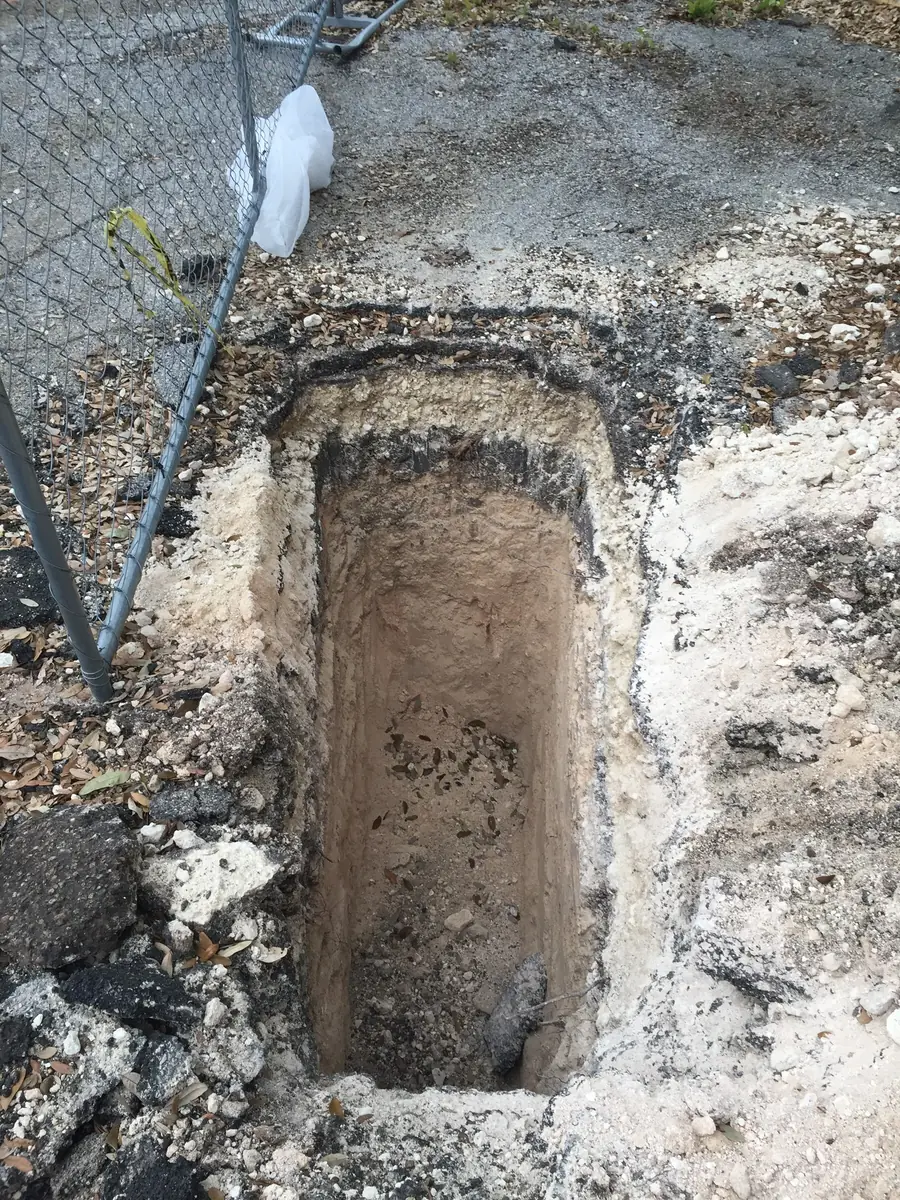
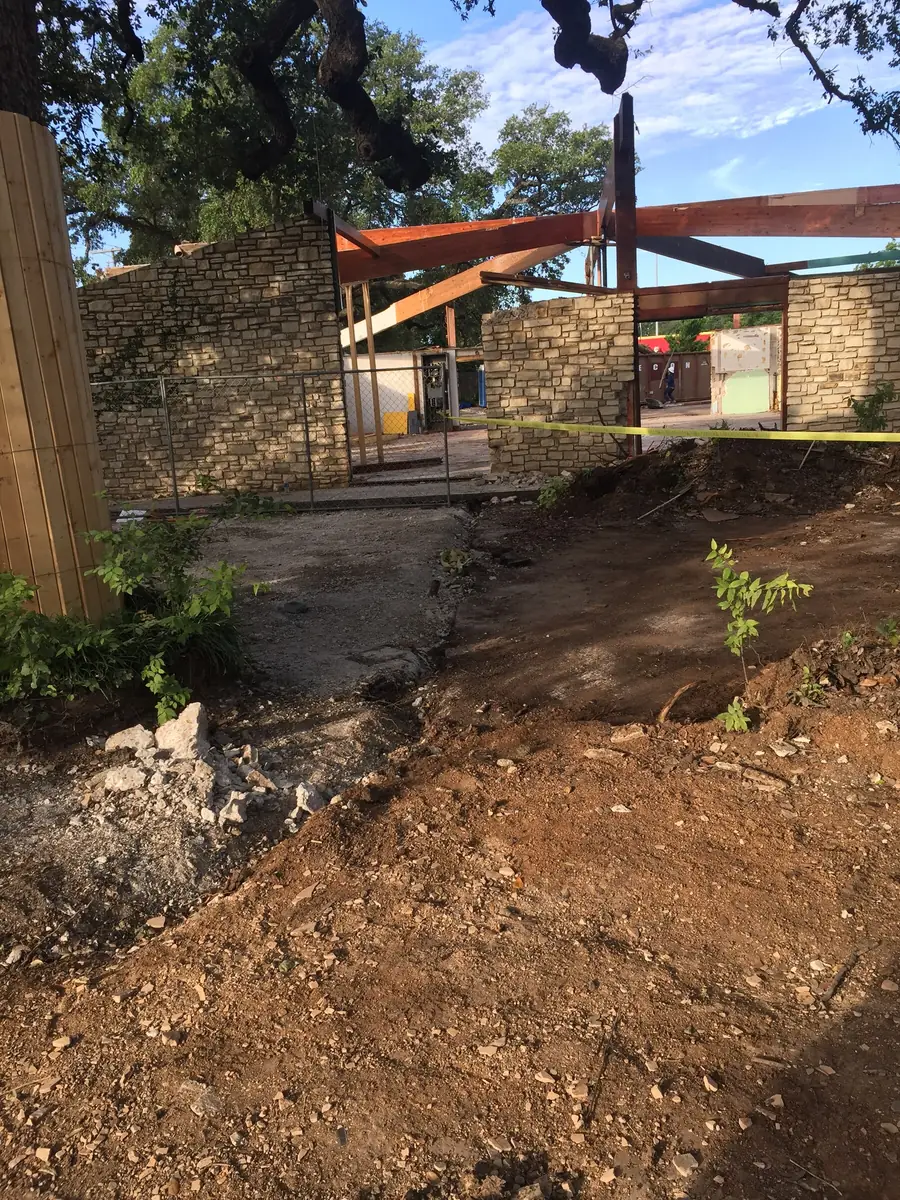
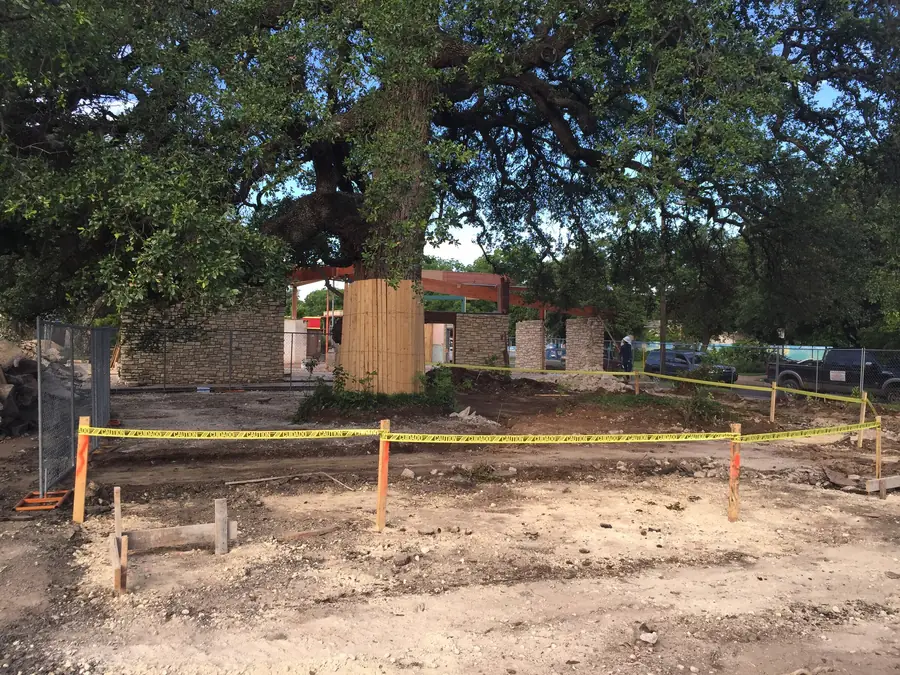
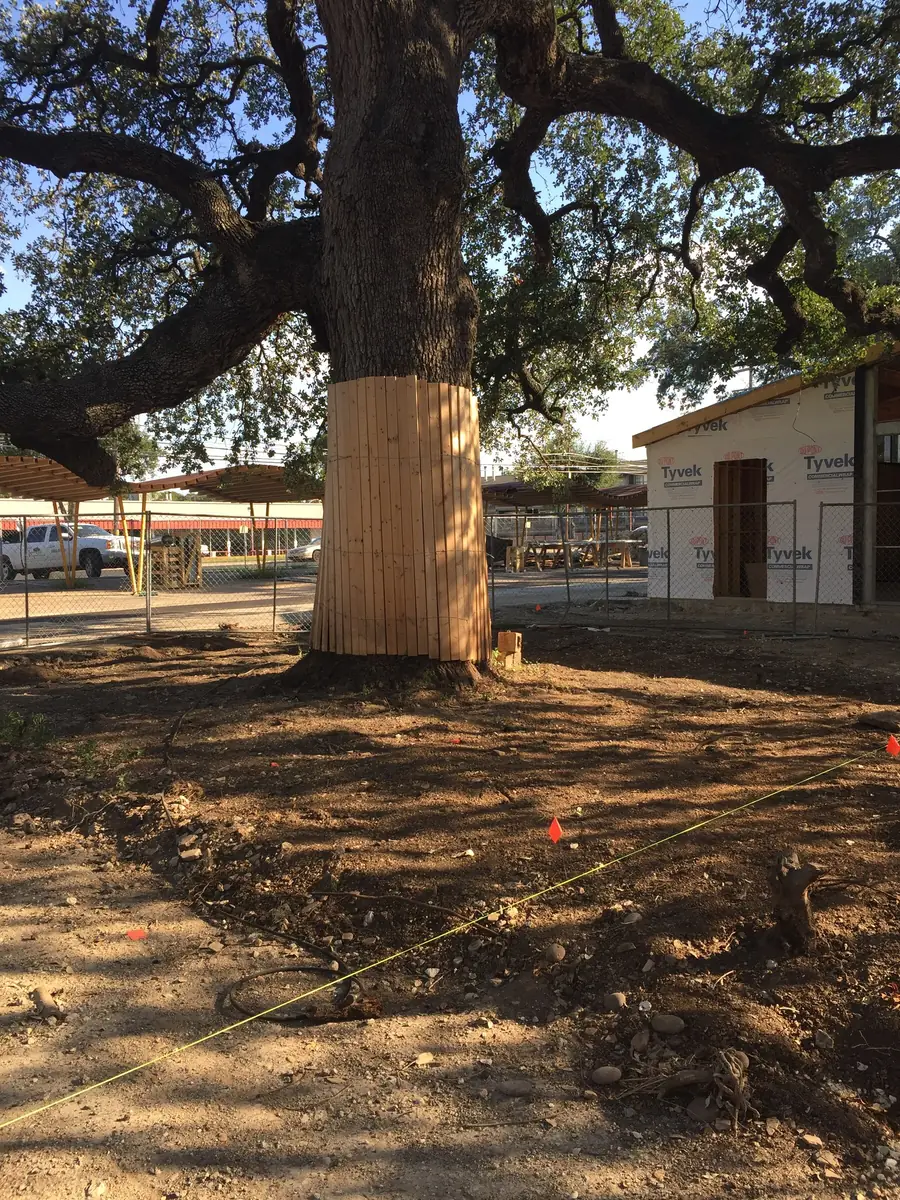
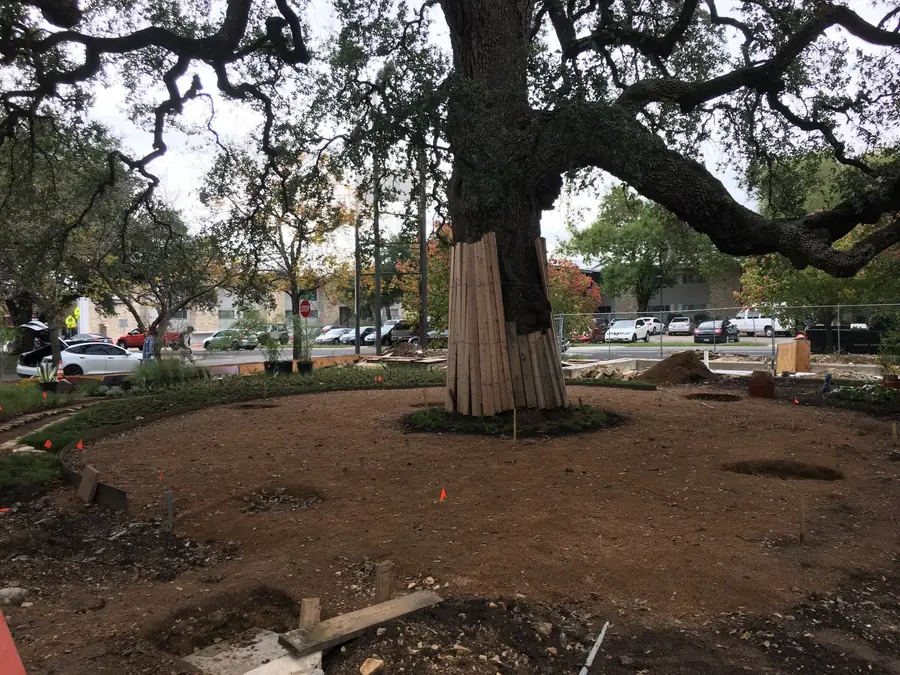
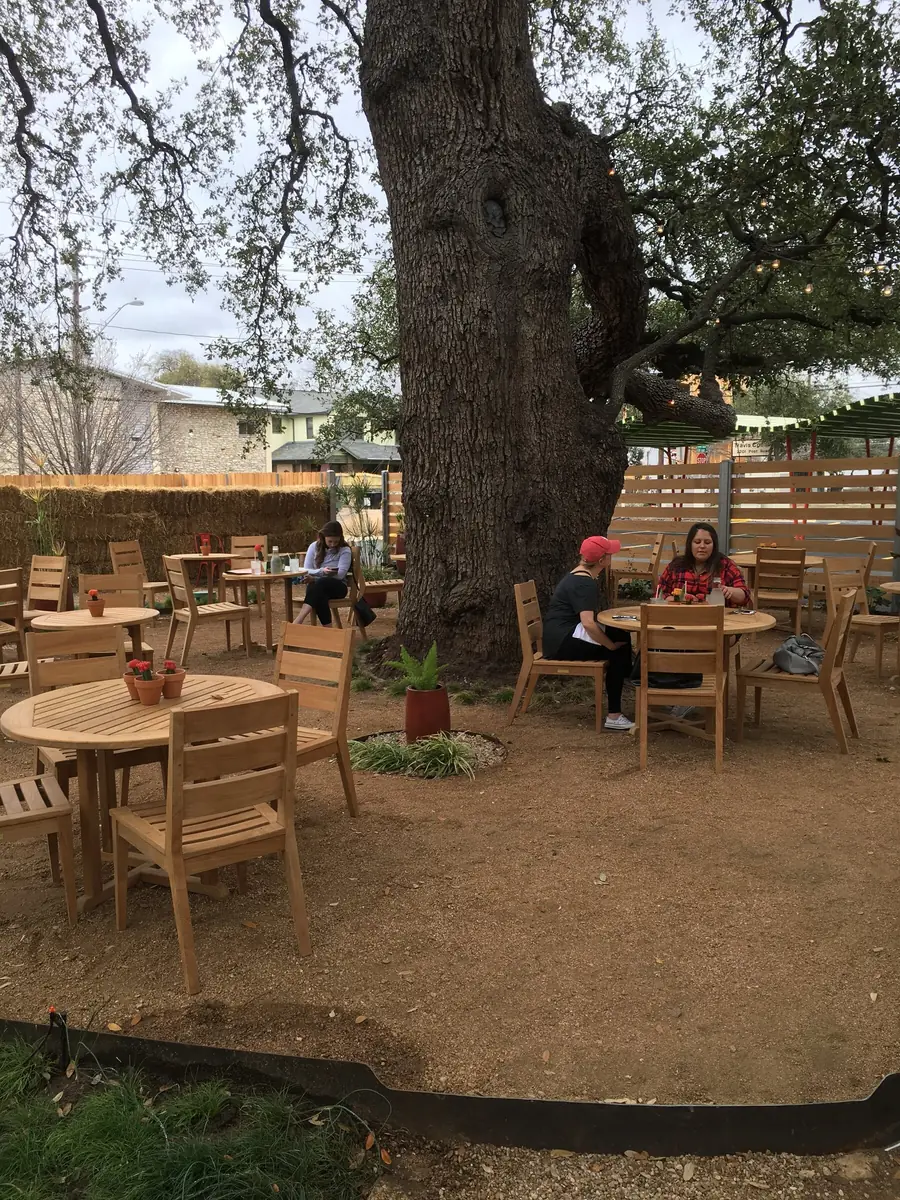
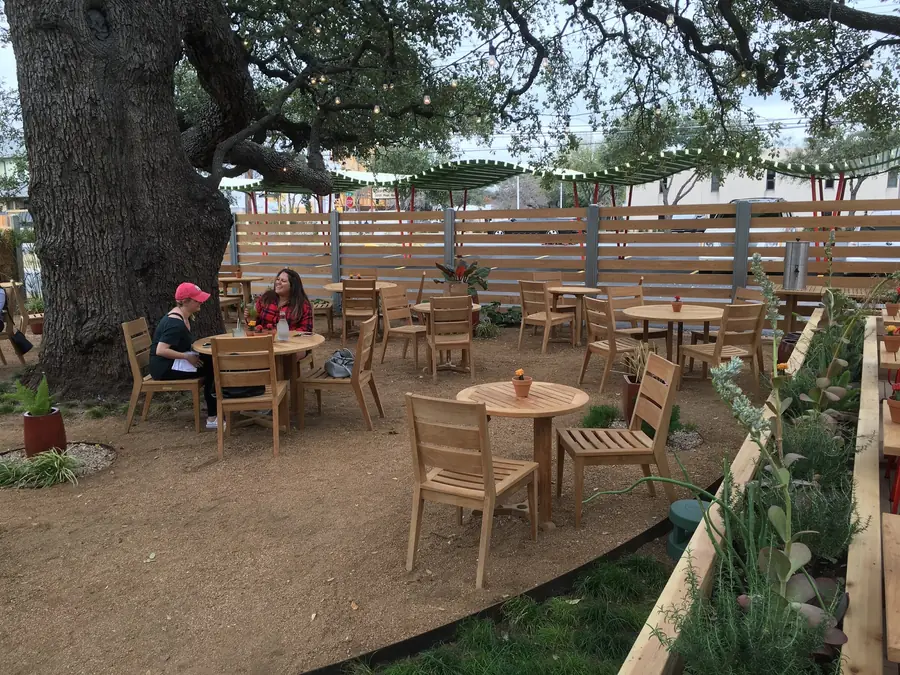
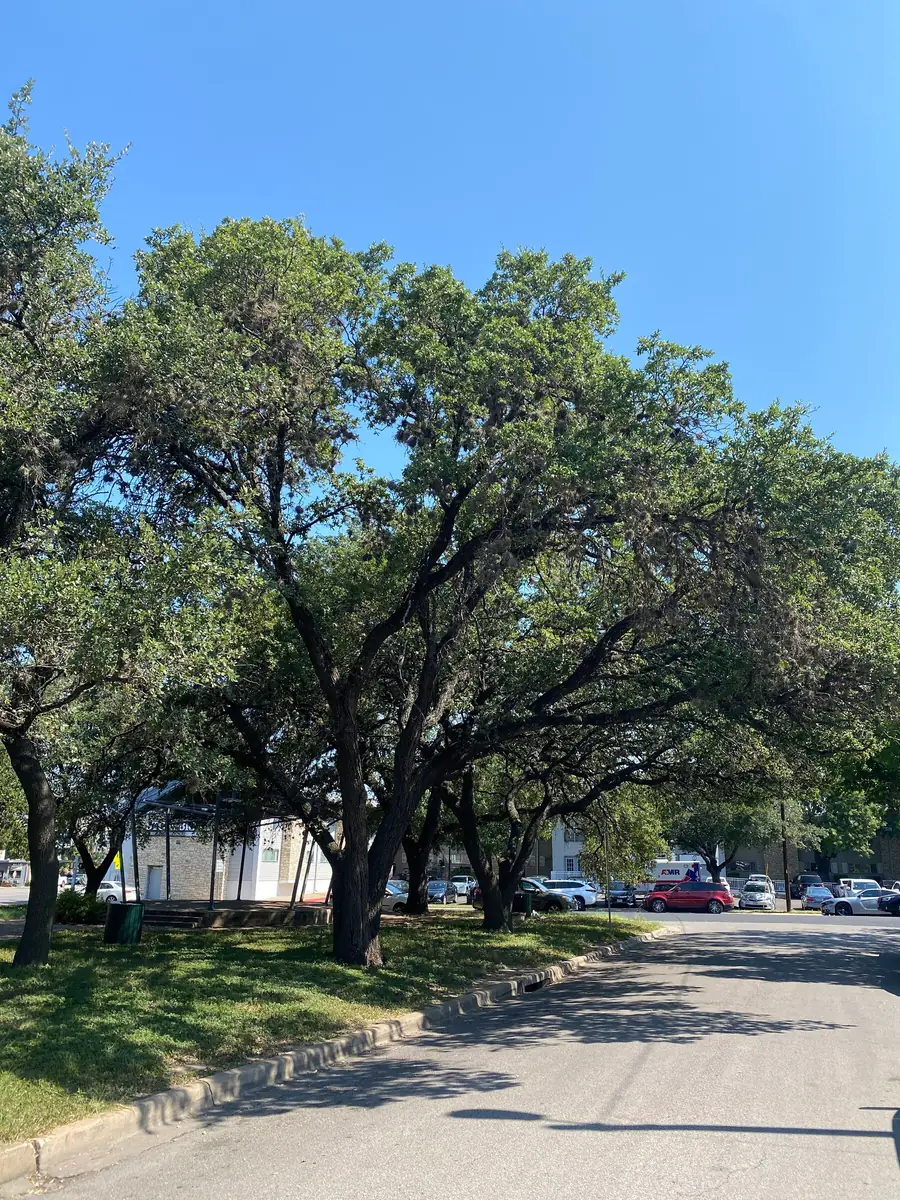
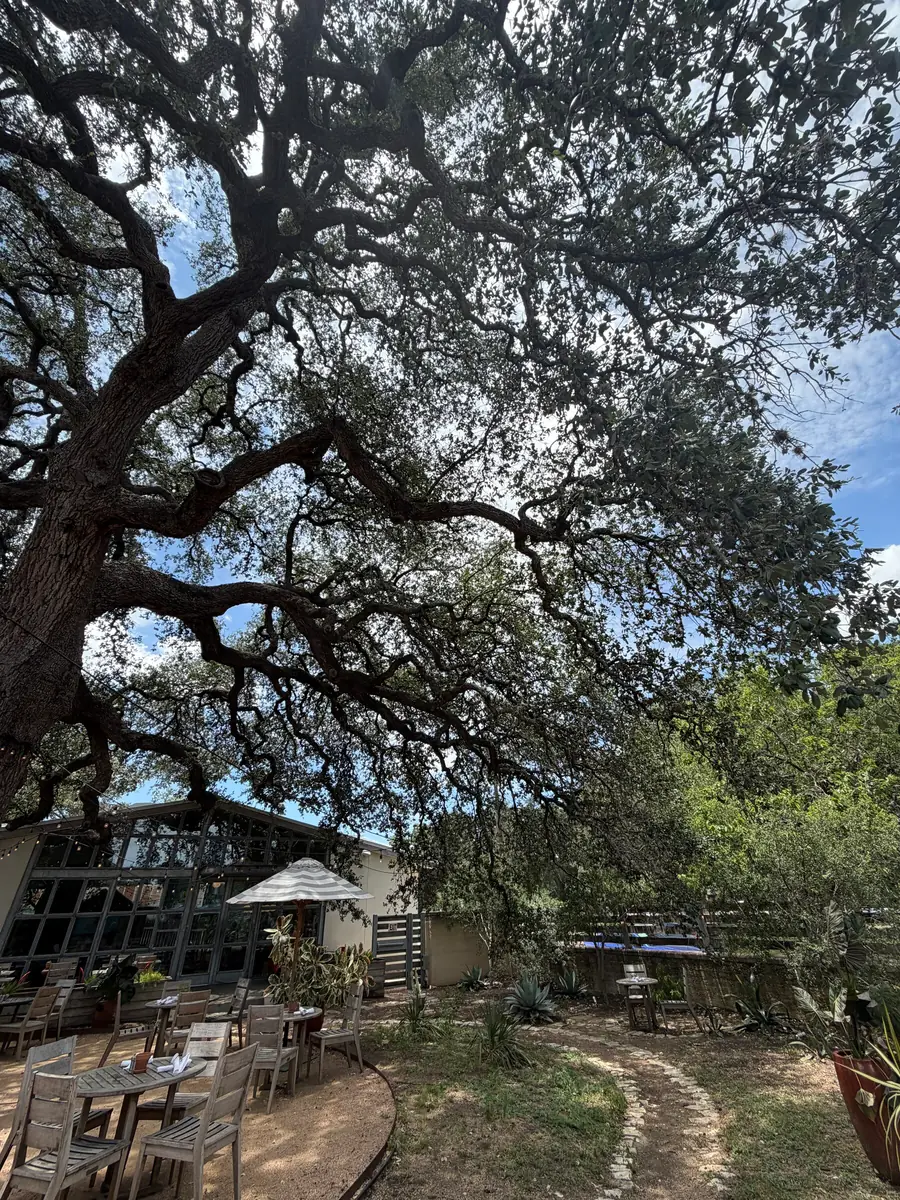
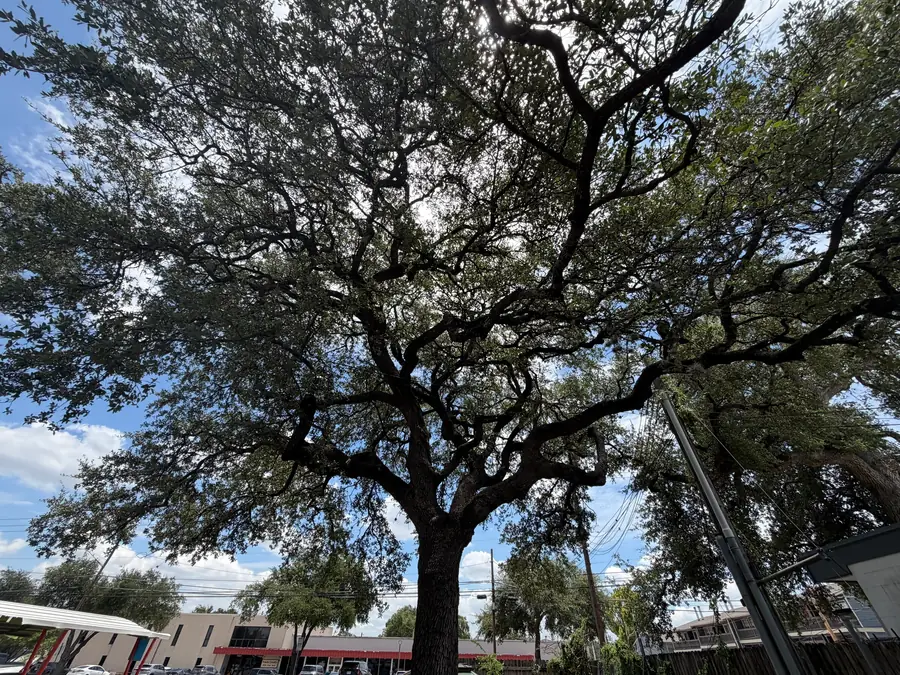
The photographs show the protection. They cannot show the rest of it, and the rest is Keith’s account rather than something a picture proves. In his words: “It was the rare occasion where a customer put their money where there mouth is. We did real tree protection, real soil restoration and maintained aftercare.” They are still a client.
The order is the part worth copying. The investigation came before the design was fixed, the protection held for the whole build instead of the first fortnight, and somebody kept looking at the tree after the fence came down. Any one of those on its own buys a tree that survives the job and then declines quietly over the following decade.