

Hiring and Costs
Tree Appraisal Outlook
How much is a tree worth? In dollars, I’m not talking about the sentimental value (that’s impossible to calculate). Performing a tree appraisal to assign a dollar value to trees in some ways is straight forward; in other ways, it is very complex. I’ve been involved in a number of projects where I’m appraising the value of trees. Almost every time, somebody is trying to tell me how I should be valuing the tree.
[pe2-image src=“http://lh5.ggpht.com/-Hps9-0ykAAE/U-zFmPYQg9I/AAAAAAAADrY/IxLeiGqSFzM/s144-c-o/Screen%252520Shot%2525202014-08-14%252520at%2525209.19.53%252520AM.png” href=“https://picasaweb.google.com/113640949372639323790/SiteIndex#6047425660405711826” caption=“Screen Shot 2014-08-14 at 9.19.53 AM.png” type=“image” alt=“Screen Shot 2014-08-14 at 9.19.53 AM.png” ]
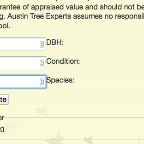
However, it turns out that there are some industry standard protocols for appraising the value of trees. “I played under this tree when I used to visit my grandma as a kid,” isn’t one of the factors we use to determine value. The book to turn to is called the “Guide for Plant Appraisal, 9th edition, written by the Council of Tree and Landscape Appraisers. This council is a collection of some of the most experienced professionals from across several industry organizations. Supposedly the 10th edition was going to be coming out about 5 years ago; we’ll see if it ever gets done. This guide outlines the different techniques that are considered standards of practice. Every case is different so its up to the arborist to determine what the most reasonable approach is. In the urban setting that I primarily work in, the approach most commonly used is called a “cost” approach, and I’ll frequently use a “trunk formula method” for calculating much of the cost. I made this nifty appraisal calculator that I use to help crunch the numbers. There is a lot of behind the scenes technique in that formula. Be warned that you shouldn’t be trying to appraise your own trees for any official or legal matters with my calculator without proper training and understanding of the formula behind the calculations. However, it can be fun to play with.
There are a couple other tree value scenarios to think about outside of this industry standard approach. One angle that is under heavy research is an ecological benefits value. Trees help dissipate storm water, clean the air, provide shade (reduced cooling needs) and beauty to the environment around us. These types of benefits are complex to quantify. Some of the advanced minds from Casey Trees in Washington DC and the Davey Tree Expert company have developed the Tree Benefits Calculator that utilizes much of the pier reviewed research for calculating these benefits.
Another consideration is that the City of Austin uses $200 per diameter inch to value protected trees. If you are engaged in development or construction within the city’s full purpose jurisdiction, this would be the primary tree appraisal method you’d use to determine how to best plan your tree protection activities around the city’s tree protection ordinance.
Over the years, I’ve seen a lot of people get really bent out of shape over this topic. I get it. I would be very upset if some drunk idiot plowed over one of my trees or if my neighbor accidentally poisoned my trees while treating his lawn for weeds. Sifting through the emotion and arriving at a legitimate appraised value can be difficult if you are the one with the damaged tree. But remember, most trees are a renewable resource, they don’t last forever. My unofficial opinion is that trees are really worth tears and joy, not money. But that doesn’t really work in our society.